
Most people think weight loss happens at the gym. Or at the dinner table. Or somewhere in the brutal space between willpower and exhaustion.
But Jon Gabriel’s most powerful metabolic shift didn’t happen during a workout. It didn’t happen over a meal plan. It happened while he was lying completely still, eyes closed, in the dark.
Sound impossible? Keep reading.
You’ve probably already tried the hard things. The 5am alarms. The calorie counting. The white-knuckling through cravings. And if you’re honest, you’re exhausted, not just physically, but in that deep, demoralizing way that comes from trying everything and still not seeing the results your effort deserves.
Here’s what most people don’t know: your body doesn’t release fat when it’s fighting. It releases fat when it feels safe.
That changes everything. Because it means the most important metabolic work you can do isn’t at the gym. It’s in the 60 minutes before you fall asleep.
What follows isn’t a vague “wind-down routine” or generic self-care advice. It’s the exact biological sequence Jon developed over years of research and personal practice, the same protocol he still uses today, 220 pounds lighter.
The Core Principle Behind This Protocol
The body has one overriding priority: survival. When it perceives threat, physical, emotional, or psychological, it locks down fat stores and floods your system with cortisol. The evening practice in this article is designed to do one thing: send your body a clear, repeated signal that the threat is over, and it’s safe to let go.
Why Your Body Is Still “On” When You’re Trying to Sleep
You close your eyes. The room is dark. The house is quiet. By every external measure, the day is over.
But inside your body? The alarm bells are still ringing.
This is the part nobody talks about. Most people focus on what they eat, how much they move, how many calories they burned. But the conversation that’s happening inside your nervous system at 10pm, that conversation is quietly running the whole show.
Your body has a threat-detection system. It lives deep in the brain, in a small almond-shaped structure called the amygdala. And here’s the thing about the amygdala: it doesn’t care what time it is. It doesn’t wind down because your phone says bedtime. It doesn’t switch off because you changed into pajamas.
If it received threat signals during the day, and in modern life, it receives hundreds of them, it stays activated. It keeps scanning. It keeps waiting for the next problem.
And while it’s doing that, it keeps your cortisol elevated.
Cortisol is supposed to follow a natural curve. High in the morning to get you moving. Gradually dropping throughout the day. At its lowest point at night, so your body can shift into repair mode. That’s the design. That’s what optimal looks like.
But for most people, especially people who’ve been struggling with their weight for years, that curve is completely flattened. Cortisol stays high. The body stays on guard. And the metabolic damage that causes is enormous.
The Science: Elevated nighttime cortisol suppresses growth hormone secretion, your body’s primary fat-burning and cellular repair signal, which is supposed to surge during deep sleep. No cortisol drop, no growth hormone surge. No growth hormone surge, no overnight fat burning. It’s that direct.
That’s not all. High nighttime cortisol keeps your blood sugar artificially elevated, which blocks fat oxidation completely. And it sends a signal straight to your FAT Programs, the deeply wired survival mechanisms that control whether your body holds weight or releases it, telling them that the threat is still real. That famine is still possible. That now is not the time to let go.
Jon knows this pattern from the inside. At 400 pounds, his nights weren’t rest. They were an extension of his days. Racing thoughts. Food anxiety. Mentally rehearsing tomorrow’s diet while lying in a body that felt completely out of his control. He wasn’t lazy. He wasn’t weak. His nervous system was simply stuck in a loop it didn’t know how to exit.
Sound familiar?
Here’s the metaphor that makes this click. Imagine a deer standing in a field. The moment it senses a predator, every single system in its body reorganizes around one priority: survival. Digestion stops. Fat burning stops. Every available calorie gets locked down and hoarded. The body becomes a fortress.
Now imagine that deer never gets to leave the field. The predator never fully disappears. So the deer stays locked in that survival state, 24 hours a day, 7 days a week.
That’s what chronic stress does to your metabolism. That’s what most modern humans are living inside of without even realizing it.
This isn’t a sleep hygiene problem. It isn’t solved by a better mattress or blackout curtains. It’s a safety problem. Your body, at a cellular level, believes it is still under threat. And no amount of willpower overrides that belief.
The evening practice Jon developed isn’t about winding down in a vague, feel-good sense. It’s about sending a very specific biological signal, in a language your nervous system actually understands, that says: the field is safe. You can rest now.
Everything that follows is built around delivering that message.
What Elevated Nighttime Cortisol Actually Does to Your Body
When your stress hormone stays high after dark, three things happen that directly block fat loss. First, it signals your FAT Programs to stay active, your body interprets ongoing stress as evidence that resources are scarce, so it holds on to every calorie it can. Second, it suppresses growth hormone, which is the primary signal your body uses to burn fat and repair tissue overnight, this surge is supposed to happen during deep sleep, but cortisol blocks it. Third, it keeps blood sugar elevated through the night, making fat oxidation biologically impossible. Your body cannot burn fat and defend against a perceived threat at the same time. It has to choose. And under stress, survival always wins.
The Window You’re Missing and Why Nighttime Is Metabolically Sacred
Here’s what most people don’t know: the 60 to 90 minutes before you fall asleep is the most neurologically powerful window of your entire day.
Not the morning. Not your workout. The quiet stretch before sleep.
And almost everyone wastes it.
Think about two versions of the same night. Same person. Same body. Same day behind them.
Version A: They scroll through their phone in bed. Half-watch something stressful on TV. Mentally replay an argument from work. Eat a bowl of cereal because the anxiety needed somewhere to go. Finally close their eyes at midnight, still wired, still worried, cortisol quietly humming and drift into a shallow, restless sleep.
Version B: The same person puts the phone down at 8:30. Does something gentle and intentional for the next hour. Sends a very specific signal to their nervous system before their head hits the pillow. Falls asleep feeling genuinely calm and their body spends the next eight hours doing exactly what it was designed to do.
Same person. Completely different hormonal outcome by morning.
The difference isn’t discipline. It’s understanding what’s actually happening in that window — and choosing to use it.
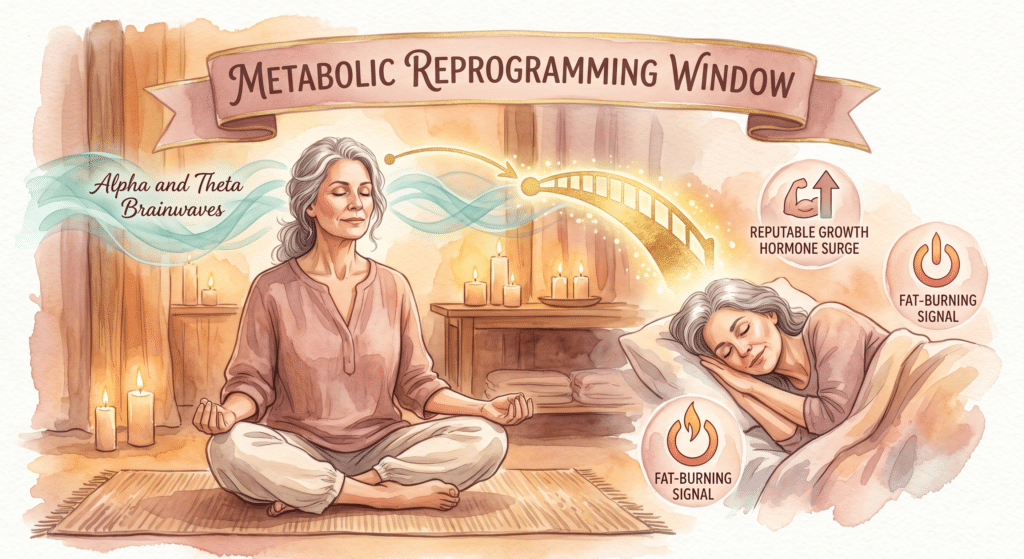
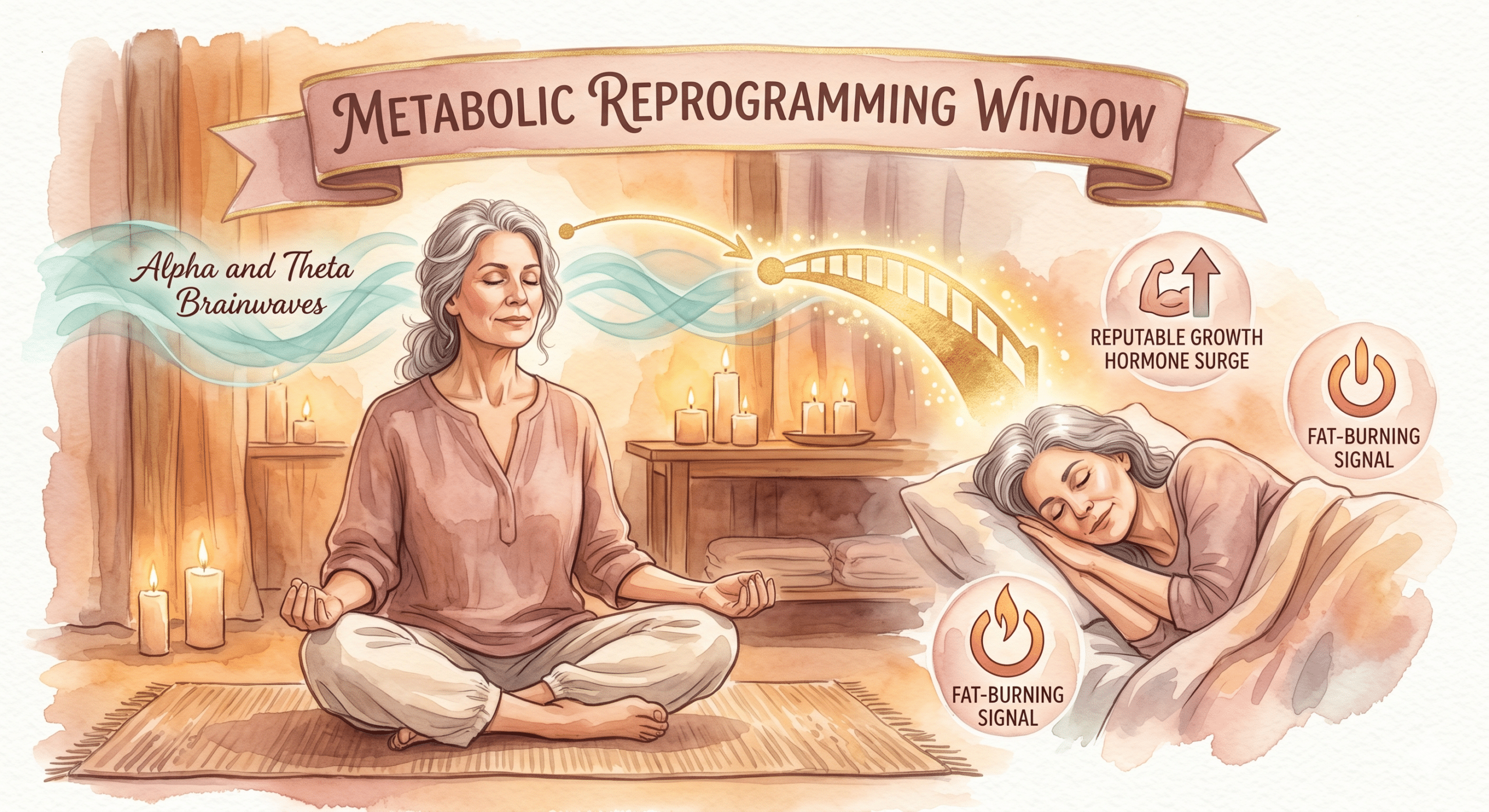
Here’s the biology. As the day winds down, your brain naturally begins shifting from Beta brainwaves, the fast, alert, analytical state you live in all day, toward Alpha and Theta states. These are the same brainwave frequencies accessed during deep meditation. During hypnosis. During the visualization practice Jon calls SMART Mode.
In this transitional state, your subconscious mind becomes extraordinarily receptive. The filters come down. The analytical guard relaxes. And whatever you feed your mind in this window gets absorbed at a much deeper level than anything you’d encounter at 2pm on a Tuesday.
This is where SMART Mode comes in. It stands for Super Mental Alert Reeducation Training. Think of it as a state of relaxed, open awareness, not sleep, not full wakefulness, where the mind can receive new instructions like a sponge absorbing water. Jon developed this practice specifically to use this window on purpose, delivering a clear and repeated message to the body: you are safe. You can let go. You can burn fat tonight.
The Science: Neuroplasticity research confirms that repeated signals sent during Alpha and Theta brainwave states accelerate the rewiring of neural pathways, meaning the pre-sleep window is when new metabolic “programming” takes hold fastest, quite literally reshaping the brain’s default response to stress, hunger, and fat storage over time.
And this connects directly to the core of what Jon discovered: the body only releases stored fat when it feels safe.
Sleep is the deepest repair window your body has. Growth hormone surges. Cortisol bottoms out. Every system gets a chance to reset. But your body will only enter that deep repair mode if it goes to sleep believing the threat has passed.
The pre-sleep window is the bridge. The transition between the stress of the day and the restoration of the night. What you do in that window, or don’t do, determines which side of that bridge your body wakes up on.
What Happens Metabolically During Genuine Restorative Sleep
When your body feels safe enough to enter deep sleep, here’s what it actually does overnight:
- Growth hormone surges: your body’s primary fat-burning and repair signal
- Cortisol drops to its lowest point of the entire day
- Leptin, the “I’m satisfied” hormone, resets and recalibrates
- Cellular repair and detoxification accelerate throughout the body
- FAT Programs receive a “standby” signal, allowing fat release to begin
None of this happens fully when your nervous system goes to bed still believing it’s under threat. The pre-sleep window is how you unlock it.
Most people think sleep is something that happens to them. Jon learned it’s something you can actively prepare your body for, starting 90 minutes before your eyes close.
That preparation is where everything changes.
Step One: The Digital Sunset (The Cortisol Cutoff)
Here’s what most people don’t know: the first step in Jon’s evening practice has nothing to do with meditation. Nothing to do with visualization. Nothing to do with breathwork.
It’s a hard stop on everything that’s spiking your cortisol.
Most conversations about screens and sleep focus on blue light. Blue light suppresses melatonin. You’ve probably heard it a hundred times. And yes that matters.
But it’s actually the smaller problem.
The bigger problem is the content. The news. The social media scroll. The work email you’re “just quickly checking.” Even the gripping drama series you’re watching to “unwind.” All of it is activating your amygdala, the brain’s threat-detection center and flooding your system with cortisol.
Think about what you’re actually feeding your nervous system in those final hours before bed. A highlight reel of everything alarming in the world. Notifications designed by engineers to create urgency and anxiety. Unresolved problems that your brain now feels compelled to solve at 10pm.
Every single one of those is a micro-threat signal.
And here’s the part that should stop you cold: your amygdala cannot tell the difference between a stressful text message and a predator in the field. The biological response is the same. Cortisol goes up. FAT Programs stay active. Fat burning stops.
The Science: Cortisol has a natural daily rhythm, it’s supposed to drop to its lowest point overnight so growth hormone can surge and your body can shift into genuine fat-burning and repair mode. Every cortisol-spiking input you consume in the evening delays and blunts that drop, compressing the window where metabolic restoration actually happens.
Jon’s rule is simple: no screens, no news, no email after 8 or 9pm. Adjust the time to your schedule, but hold the line.
This isn’t about becoming a monk. It’s pure biology. You’re not restricting yourself. You’re simply cutting off the cortisol supply early enough that your body has time to come down before you need to sleep.
Replace that window with something that doesn’t demand anything from your nervous system. A physical book. A quiet conversation. Gentle music. Light stretching. Or honestly just sitting in silence for a few minutes. Nothing needs to be complicated here.
Sound familiar, the idea of watching TV to “decompress”? Here’s the truth about that: passive screen consumption is still an input. Your brain is still processing, reacting, generating stress hormones. You’re not decompressing. You’re swapping one stimulant for another and wondering why you feel wired when the lights go out.
True decompression means reducing stimulation, not rerouting it.
I know this sounds simple. Maybe too simple. But I promise you, this single change, consistently applied, will shift your cortisol curve within two weeks. I’ve seen it happen in my own body. And we have seen it happen in thousands of people who’ve done this work. The body responds fast when you finally stop telling it the world is on fire.
Why the Digital Sunset Works: The Cortisol Curve
Cortisol follows a natural 24-hour rhythm. It peaks in the morning to wake you up and is meant to taper steadily toward its lowest point overnight. Every alarming headline, stressful notification, or anxiety-provoking piece of content you consume in the evening injects a fresh cortisol spike into that curve, flattening the drop your body desperately needs. A consistent digital cutoff time allows the curve to fall naturally, signaling to your FAT Programs that the threat has passed and it’s safe to begin overnight repair and fat release.
If you’re ready to stop fighting your body and actually start working with it, Jon Gabriel would like to invite you to experience the complete step-by-step system inside the 12-Week Total Transformation Program.