
You went to bed at a decent hour. You tried to eat well yesterday. You even made it to the gym earlier this week.
And yet here you are. It’s not even 9am and you’re already exhausted, already ravenous, already wondering why the scale crept up again despite everything you’re doing right.
Sound familiar?
Here’s what most people don’t know: the problem isn’t your diet. It isn’t your gym routine. It isn’t your discipline or your willpower or some personal failing you haven’t figured out yet.
It’s what’s happening while you sleep.
Or more accurately what’s not happening.
Sleep apnea triggers the exact same hormonal cascade as chronic starvation. Your body can’t tell the difference between slowly suffocating in your sleep and slowly starving in a famine. It responds the same way: store fat, spike hunger, and hold on for dear life.
And here’s the cruel part. The extra weight that sleep apnea helps create also makes sleep apnea worse. It’s a biological trap and it has nothing to do with how hard you’re trying.
Once you understand the mechanism, everything starts to make sense. And that’s exactly where we’re starting.
The Biological Trap in One Sentence
Sleep apnea causes your body to hoard fat like it’s surviving a famine and carrying that extra weight makes your airway collapse more easily at night, deepening the cycle. This isn’t a willpower problem. It’s a biology problem.
You’re Not Lazy. You’re Oxygen-Starved.
You went to bed last night. You did everything right. You were under the covers by 10pm, phone face-down, lights off. Eight hours later, the alarm goes off and you feel like you’ve been hit by a truck.
Your eyes are heavy. Your brain is wrapped in fog. And somehow, somehow, you’re already hungry before your feet hit the floor.
Sound familiar?
Here’s what most people do at this point. They blame themselves. They think they need more discipline. More motivation. A better diet. An earlier bedtime. They try harder, and harder, and harder and nothing changes.
But what if the problem has nothing to do with any of that?
What you’re feeling is not weakness. It is oxygen deprivation.
Here’s what sleep apnea actually is, in plain terms. While you sleep, the soft tissue in your airway relaxes and collapses. Your breathing stops. Sometimes for ten seconds. Sometimes for thirty. Sometimes hundreds of times per night.
Your brain notices. It fires a micro-alarm, a tiny jolt of survival response, that pulls your body just barely awake enough to gasp for air and resume breathing. You never fully wake up. You never remember it. But it happens. Over and over and over again, all night long.
You are not sleeping. You are being repeatedly rescued from suffocation.
Think about what that means. Every time your brain sounds that alarm, it drags you out of deep, restorative sleep. The stages where your body repairs tissue, regulates hormones, and consolidates memory, you never get there. Or if you do, you don’t stay long enough for it to matter.
The result? You spend eight hours in bed and wake up more depleted than when you lay down.
The Science: Deep sleep, specifically slow-wave sleep and REM sleep, is when the body releases growth hormone, resets hunger signals, and performs critical cellular repair. Sleep apnea interrupts these stages so frequently that the body never completes the process, leaving you hormonally depleted every single morning regardless of how many hours you spent in bed.
Jon Gabriel often uses a simple analogy that cuts right through the noise. Imagine you’re sitting in a room, and the oxygen is slowly running out. You’d gasp. You’d panic. You’d fight for air. And nobody, nobody, would call you lazy for it.
Sleep apnea is the same thing. Your body is fighting for survival every single night. Willpower has nothing to do with it.
Here’s the part that makes this even harder. An estimated 80% of people with sleep apnea are undiagnosed. They don’t know they stop breathing at night. They just know they’re exhausted. They just know the weight won’t budge. They just know something feels deeply, persistently off and they can’t explain why.
Take a 45-year-old who’s tried every diet on the market. He exercises when he can drag himself to the gym. He tracks his calories. He does everything the experts tell him to do. The scale hasn’t moved in two years. What nobody checked, until a sleep study revealed he was stopping breathing 40 times per hour, was what was happening in the dark.
Forty times per hour. That’s nearly once every ninety seconds. Every one of those moments, his brain was pulling him out of a burning building. Then sending him back in.
Sleep Apnea Doesn’t Feel Like Not Sleeping
It feels like never being fully awake. The exhaustion is real. The brain fog is real. The relentless hunger is real. And none of it is a character flaw, it’s a biological emergency playing out while you’re unconscious and completely unaware.
Before we can talk about breaking this cycle, we have to understand exactly why it’s so effective at keeping weight on. Because this isn’t just about being tired. What happens inside your body during those stopped-breathing moments triggers a hormonal chain reaction that almost guarantees weight gain, no matter what you eat or how often you exercise.
And that’s where it gets both disturbing and, ultimately, hopeful.
What Happens in Your Body When You Stop Breathing
Every time your airway collapses during sleep, your brain registers one thing: danger.
Not a mild inconvenience. Not a blip. A full-scale, red-alert, survival-level threat. And your body responds accordingly.
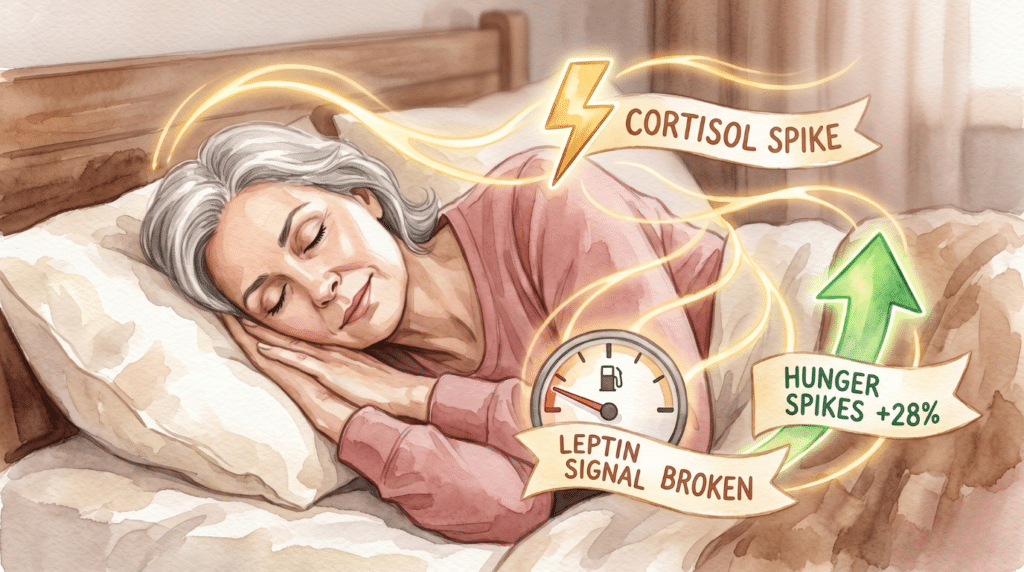
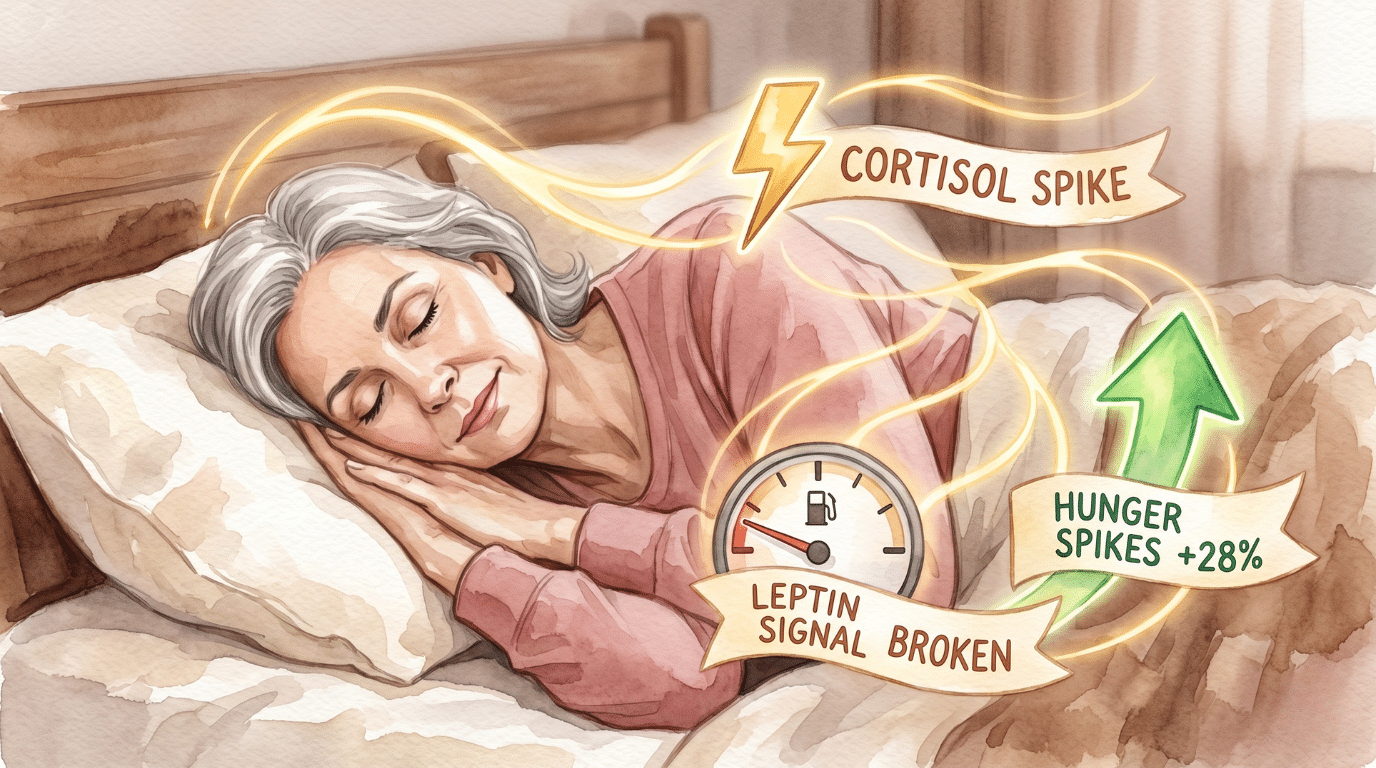
The moment breathing stops, your brain floods your system with cortisol, the same stress hormone that surges through your body during a car accident, a physical attack, or a famine. Your heart rate spikes. Your blood sugar rises. Your entire physiology shifts into emergency mode.
Think of cortisol as your body’s alarm system. When it fires, your brain shuts down everything it considers non-essential, digestion, cellular repair, reproductive function and redirects every available resource toward one goal: keeping you alive right now.
That’s a smart system. In a genuine emergency, it saves your life.
But here’s the problem. When this happens dozens, sometimes hundreds, of times in a single night, your body stops treating it like an emergency. It starts treating it like the new normal.
The Science: Chronic cortisol exposure from repeated sleep apnea events signals the body’s FAT Programs, the ancient biological switches designed to protect you during famine or extreme stress, to stay permanently switched on. A body that believes it is in danger does not release fat. It hoards it. Specifically around the midsection, where energy reserves can be accessed fastest in a crisis.
This is why you can eat less, exercise more, and still watch the scale refuse to move. Your body isn’t being stubborn. It’s being protective. It genuinely believes you are in danger. And it will hold onto every calorie it can until it feels safe again.
But cortisol is only part of the story.
Enter leptin, the hormone responsible for telling your brain “we have enough stored energy, you can stop eating now.” Think of leptin as your internal fuel gauge. When it’s working properly, you feel satisfied after a meal. Cravings quiet down. Your body hums along without constantly screaming for food.
Chronic cortisol exposure cuts the signal wire. Your fat cells are still producing leptin. They’re practically shouting. But your brain has gone deaf to the message. The gauge is broken, stuck on empty, no matter how much fuel is actually in the tank.
So you keep eating. Not because you’re weak. Because your thermostat is broken.
And then there’s ghrelin.
Ghrelin is the hunger hormone, the one that growls “feed me now.” After a poor night of sleep, ghrelin levels spike by up to 28%. Your body isn’t just ignoring the “full” signal. It’s actively amplifying the “hungry” signal at the same time.
It’s the biological equivalent of someone handing you a plate of donuts right after telling you that you almost died in your sleep. Your body experienced a survival crisis all night long. Of course it wants high-calorie, high-carbohydrate food this morning. That’s exactly what it’s designed to crave after a threat.
What One Night of Sleep Apnea Does to Your Hormones
This isn’t about one bad night. This is what’s happening inside your body on a repeating loop, every single night left untreated.
- ↑ Cortisol: stress and fat-storage hormone stays elevated
- ↑ Ghrelin: hunger hormone spikes up to 28%, driving intense cravings
- ↓ Leptin sensitivity: fullness signal breaks down; the brain stops hearing “stop eating”
- ↑ Insulin resistance: cells stop responding efficiently to blood sugar signals
- ↓ Growth hormone: fat-burning and overnight cellular repair are suppressed
So you wake up exhausted, ravenous, and reaching for sugar, not because you have no self-control, but because your hormones have been completely hijacked overnight.
This is not a willpower problem. This is a biology problem. And once you can see it clearly, you can finally start addressing the right thing.
Why Extra Weight Makes Sleep Apnea Worse
Here’s where the trap snaps shut.
Because it’s not just that sleep apnea causes weight gain. It’s that the weight gain turns around and makes your sleep apnea worse. And then the worse sleep apnea makes the weight harder to lose. And then the extra weight tightens the noose a little more.
This is not a coincidence. This is a biological feedback loop. And once you’re inside it, willpower alone cannot get you out.
Here’s the mechanical reality. Fat tissue accumulates around your neck, throat, and airway. As body weight increases, so does the soft tissue surrounding your upper airway. That tissue is heavy. When you lie down at night and your muscles relax, that extra tissue collapses inward, narrowing the airway, restricting airflow, and making it dramatically easier for breathing to stop.
Studies show that even a 10% increase in body weight can make you six times more likely to develop or worsen sleep apnea. Six times. From ten percent.
Think about what that means. The hormonal chaos from your sleep apnea is pushing your weight up. And every pound that goes up is physically squeezing your airway shut a little more each night. You’re not just spinning your wheels. You’re actively digging the hole deeper, through no fault of your own.
The Science: Fat deposits in the tongue and soft palate are particularly significant. As visceral fat increases, it doesn’t just sit under your skin, it infiltrates the muscles and tissues of your upper airway, reducing the diameter of the passage your breath has to travel through. Less space means more resistance. More resistance means more apnea events. More apnea events means more cortisol, more ghrelin, more leptin resistance and more weight gain.
There’s also a second layer to this that most people never hear about. Fat tissue is metabolically active. It produces inflammatory chemicals called cytokines. Those cytokines interfere with the nervous system signals that control your airway muscles during sleep. So it’s not just the physical weight pressing down. The fat itself is chemically disrupting the signals that keep your airway open.
Sound familiar? You go to bed. Your airway collapses. Your body panics. Cortisol floods your system. You wake up exhausted and starving. You reach for something fast and high-calorie because your ghrelin is through the roof. The weight creeps up. Your airway gets a little narrower. Tomorrow night is a little worse than tonight.
Jon Gabriel spent years inside this exact trap, trying harder, eating less, dragging himself through days on empty, not realizing his body had flipped into full-on survival mode. The weight wasn’t a discipline problem. It was a signal that his body felt deeply, biologically unsafe. And a body that doesn’t feel safe will not let go of fat. Not for any diet. Not for any amount of exercise.
The Vicious Cycle at a Glance
Sleep apnea triggers cortisol and hormonal chaos → hormonal chaos drives weight gain → extra weight narrows the airway and worsens apnea → worsened apnea triggers more cortisol and hormonal chaos. The cycle doesn’t break on its own. But understanding it is the first step to stepping outside it entirely.
This is why the answer is never just “eat less and move more.” That advice ignores the loop entirely. You have to address what’s happening at the biological level, the safety signals your body is receiving, or failing to receive, every single night.
The good news? The cycle works in reverse too. And that’s exactly where we’re going next.
Want to dive deeper into this approach? Discover how to turn off your body’s fat-storage programs for good by joining Jon Gabriel inside the 12-Week Total Transformation Program.