
What if the reason you can’t lose weight has nothing to do with food, exercise, or willpower and everything to do with your brain being stuck in the wrong frequency?
Sound harsh? Maybe. But for millions of people, it’s the most liberating thing they’ve ever heard.
Because if you’re reading this, you’ve probably tried. Really tried. You’ve tracked the calories, cut the carbs, white-knuckled your way through restriction. You’ve lost the weight and then watched it creep back, almost like your body had a plan of its own.
It did. And that plan had nothing to do with your discipline.
Here’s what most people don’t know: your conscious mind, the part that sets goals, reads labels, and commits to “eating clean”, controls maybe 5% of your biology. The other 95%? That’s your subconscious. And it’s running the show.
Your subconscious controls your hunger signals, your hormone levels, your fat-storage instructions, and something called your Famine Response, the ancient survival program that fights back every time you try to lose weight.
Willpower can’t reach it. Diets can’t touch it. But there’s one thing that can.
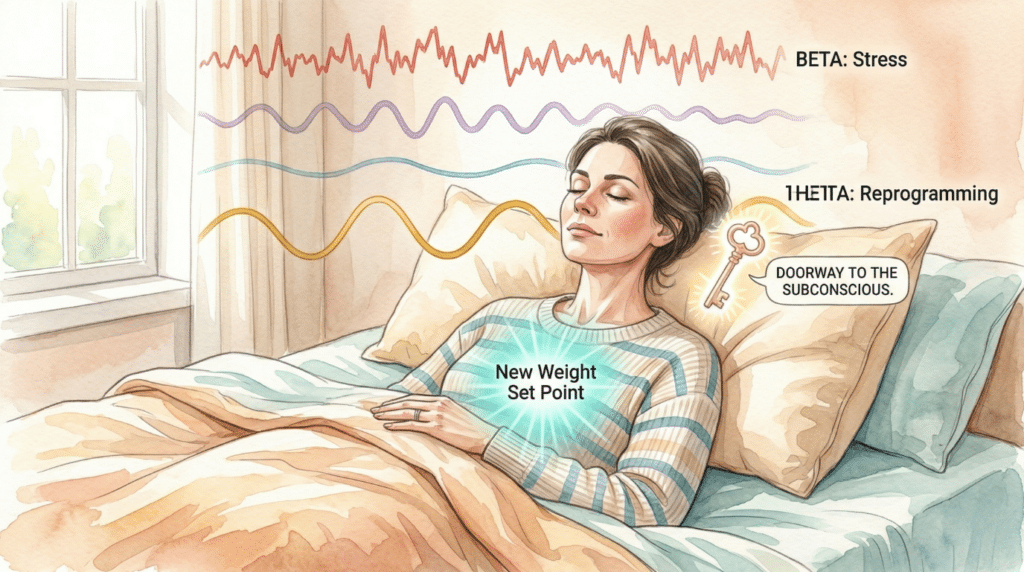
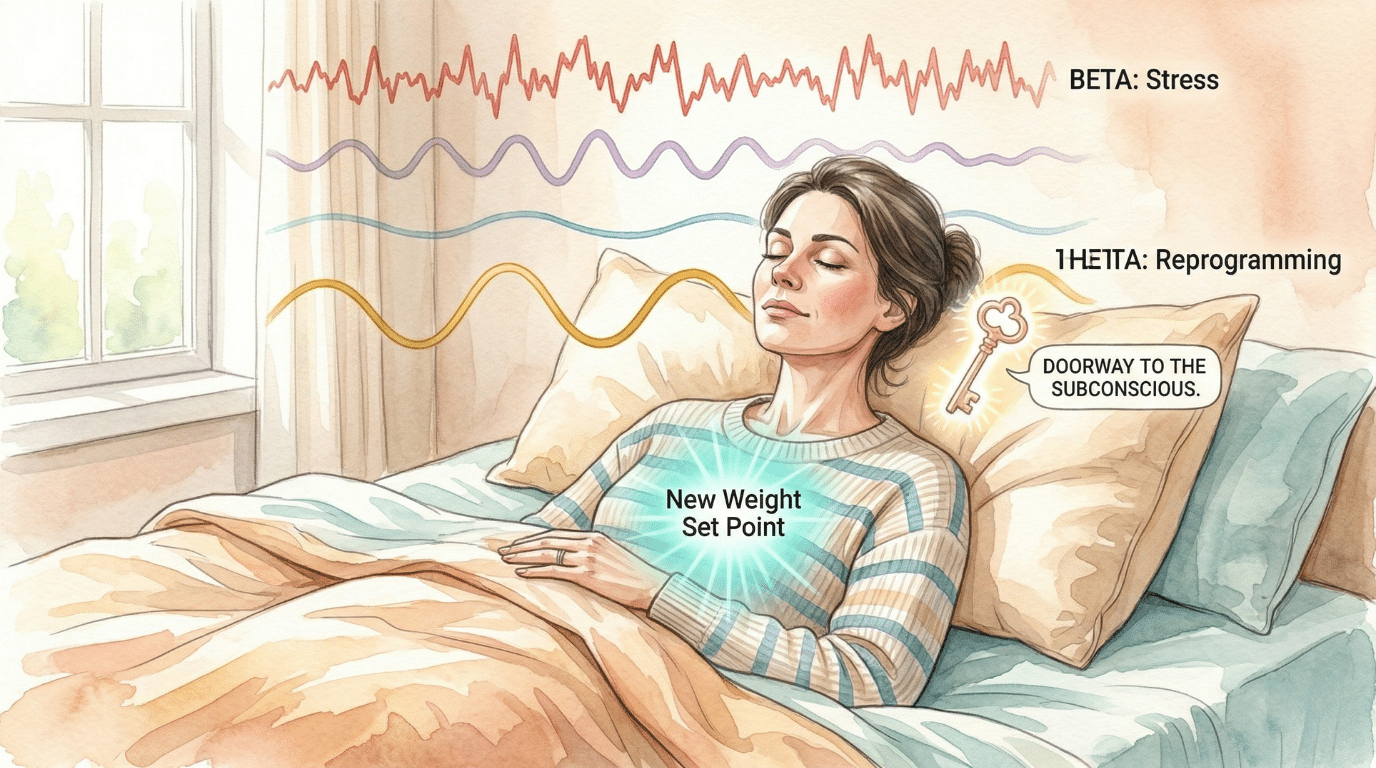
There’s a specific brainwave frequency, called theta, that acts as the biological doorway to your subconscious mind. It’s the only state where that deep programming can actually be changed.
And once you know how to get there, everything changes.
Why This Is Different From Every Weight Loss Approach You’ve Tried
Most diets target your conscious choices, what you eat, when you eat, how much you eat. But the real weight-loss software lives below conscious awareness. Theta brainwave access is the only scientifically-recognized way to directly communicate with that subconscious system and finally update the programs keeping your body stuck.
Why Willpower Has Never Been Your Problem
Let’s start with the most damaging lie the diet industry ever told you.
That you failed because you didn’t try hard enough. That if you just had more discipline, more grit, more self-control, the weight would have stayed off. That every time the scale crept back up, it was your fault.
That lie has cost you years. Maybe decades.
And it’s completely, provably wrong.
Here’s what’s actually happening inside your body. You have two minds running simultaneously. The conscious mind, the part reading these words right now, handles your thinking, planning, decision-making, and reasoning. It’s the part that says “I’ll eat the salad, not the fries.”
Then there’s the subconscious mind. This is the 95% operating beneath the surface. It controls your heartbeat, your hormone levels, your hunger signals, your fat storage instructions. It runs your entire body on autopilot, 24 hours a day, without asking your permission.
Think about it this way. Your conscious mind is the person sitting in the driver’s seat. Your subconscious mind is the engine, the fuel system, and the GPS combined. You can grip that steering wheel as hard as you want. But if the engine is programmed to run in fat-storage mode, you are going nowhere.
This is where Jon Gabriel’s story gets interesting.
Jon spent years at over 400 pounds. He tried every diet. He white-knuckled through restriction after restriction. And the weight always came back, sometimes more than before. Not because he lacked willpower. He had enormous willpower. But he was using a conscious-mind tool to fight a subconscious-mind problem.
That’s like trying to reprogram your car’s GPS by yelling at the windshield.
The Science: Research consistently shows that the subconscious mind processes roughly 11 million bits of information per second, compared to the conscious mind’s 40 to 50 bits. Your body’s fat-storage decisions are being made in the 11-million-bits department. Willpower lives in the 40-bits department. It was never a fair fight.
The Gabriel Method calls these FAT Programs. And here’s the crucial thing to understand: they are not a character flaw. They are ancient survival software. Your body activates fat storage automatically in response to signals of threat, scarcity, and chronic stress because in evolutionary terms, fat equals survival.
Sound familiar? Restriction dieting sends exactly those signals. Every time you cut calories dramatically, your subconscious hears one thing: famine is coming. And it responds accordingly.
You wouldn’t shame someone for gasping in a low-oxygen room. Stop shaming yourself for craving food when your body’s deepest programming is screaming that survival is at risk.
The Two-Brain Problem Nobody Talks About
Diets target the conscious mind, the 5% that plans meals and tracks calories. But FAT Programs live in the subconscious, the 95% controlling hormones, hunger, and fat storage. Until you address the subconscious, you’re solving the wrong problem entirely.
So if FAT Programs live in the subconscious, logic can’t touch them. Meal plans can’t touch them. Motivational pep talks can’t touch them.
The only way to turn them off is to speak the language the subconscious actually understands.
That language isn’t words. It isn’t logic. It isn’t calorie math.
It’s imagery. Emotion. Sensation. Delivered at a very specific brainwave frequency that most people hit only by accident, twice a day.
Once you learn how to get there on purpose? Everything changes.
What Is a Brainwave And Why Does It Matter for Fat Loss?
Your brain is always producing electrical activity. Always. And that activity runs at different speeds depending on what you’re doing, thinking, or feeling.
Those speeds are called brainwave frequencies. And understanding them, even at a basic level, might be the most important thing you ever learn about why your body holds onto weight.
Here’s the simple breakdown.
Beta is your wide-awake, thinking-hard, answering-emails state. It’s where you spend most of your day. It’s also where stress lives. Where cortisol spikes. And where your FAT Programs are constantly being fed by the anxiety, urgency, and overwhelm of modern life.
Alpha is the transition zone. Relaxed focus. That soft, dreamy state when you’re lost in a good book or watching a sunset. You’re still conscious, but the mental chatter is quieting down.
Delta is deep, dreamless sleep. You’re completely unconscious. Fully offline.
And then there’s theta.
Theta sits between 4 and 8 Hz. It’s the state you drift through every single morning just before you fully wake up. That hazy, warm, half-here-half-not place. It’s also where you go during deep meditation, during hypnosis, and in those last few moments before you fall asleep at night.
Most people slip through theta twice a day without even noticing. But here’s what they’re missing.
The Science: Theta is the only brainwave state where the subconscious mind becomes fully accessible. In beta, your conscious mind acts as a gatekeeper, filtering, judging, and rejecting new information before it can take root. In theta, that gatekeeper steps aside completely. New beliefs, new body-image blueprints, and even new hormonal set points can be installed directly into the subconscious.
Think about children for a moment. Kids between the ages of 2 and 7 spend the majority of their time in theta. That’s not a coincidence. That’s why they absorb language so fast. Why they pick up beliefs, fears, and emotional patterns without any effort at all. Their subconscious minds are essentially wide open, constantly receiving, constantly encoding.
Everything you learned about your body as a child, whether food was safe or scarce, whether your body was something to be proud of or ashamed of, was installed during those theta years. It’s running inside you right now. Quietly. Automatically. Shaping every craving, every hormone signal, every moment of inexplicable self-sabotage.
The good news? What was installed in theta can be uninstalled in theta.
This is also why hypnotherapy works for some people. Why deep meditation shifts things that nothing else touches. Why certain forms of prayer feel genuinely transformative. They’re all, whether intentionally or not, accessing this same theta doorway.
Now connect this directly to your weight.
Your body has a weight set point, a number your subconscious has decided is “normal” and safe. It defends that number fiercely, using hormones like leptin and ghrelin to drive hunger, slow metabolism, and override every conscious choice you make. If your set point is programmed at 250 pounds, your subconscious will sabotage every attempt to stay below it. Not because you’re weak. Because it’s doing exactly what it was programmed to do.
Willpower cannot lower your set point. Restriction cannot lower your set point. Only one thing can, reprogramming the subconscious itself.
And the only door into the subconscious is theta.
Your Brain on Theta: The Four States at a Glance
Beta (14–30 Hz): Alert, analytical, stressed. Where cortisol surges and FAT Programs thrive. Most people live here all day.
Alpha (8–14 Hz): Relaxed awareness. The gentle on-ramp to deeper states. Where light meditation begins.
Theta (4–8 Hz): The subconscious gateway. Deep meditation, hypnosis, the edge of sleep. This is where real reprogramming happens.
Delta (0.5–4 Hz): Deep, dreamless sleep. Fully unconscious. Profound physical restoration, but not accessible for intentional change.
Jon Gabriel calls his method of deliberately accessing this state SMART Mode, Super Mental Alert Reeducation Training. It’s not a vague concept. It’s a specific, repeatable, neurological process for opening that subconscious door on purpose, every single day.
And once you learn how to get there? You stop fighting your body. And your body finally stops fighting you.
SMART Mode: Your Personal Portal to the Theta State
Let’s talk about what SMART Mode actually is, because it’s probably not what you’re picturing.
SMART Mode stands for Super Mental Alert Reeducation Training. And before your eyes glaze over at the acronym, here’s what matters: this is not positive thinking. It’s not a vision board. It’s not repeating affirmations in the mirror while trying to believe them.
It’s a specific, repeatable, neurological protocol for deliberately accessing the theta state. There’s real biology happening here. And once you understand that biology, the practice stops feeling “woo” and starts feeling like the most logical thing you could possibly do.
Here’s what happens in your body the moment you enter SMART Mode.
Your cortisol levels drop. The chronic low-grade stress signal that’s been quietly telling your body to hold onto fat, it quiets down. Your amygdala, the part of your brain Jon calls the “Animal Brain,” stops scanning for threats. Blood flow shifts away from your fight-or-flight centers and toward your regenerative, creative centers.
And most importantly, your body receives a safety signal.
Remember this: your body will only release weight when it feels safe. Not when you’re white-knuckling a calorie deficit. Not when you’re running on shame and restriction. Safe. Calm. Resourced. SMART Mode creates that internal environment on purpose, every single day.
The Science: Research on guided visualization and deep relaxation shows measurable reductions in cortisol and increases in DHEA, the “anti-stress” hormone, within a single session. Your brain chemistry literally shifts when you slow your brainwaves into theta. This isn’t metaphor. It’s measurable.
So what does an effective SMART Mode session actually look like? There are three essential ingredients.
The Three Ingredients of an Effective SMART Mode Session
These aren’t steps you rush through. Each one builds on the last and together, they open the door to genuine subconscious reprogramming.
Step 1: Relaxation (the theta induction): Deliberate, guided breath. A slow body scan. You’re consciously downshifting your brainwaves from the busy beta of your day into the open, receptive theta state. This takes about 5–10 minutes. Don’t skip it. This is the door. Everything else walks through it.
Step 2: Vivid Visualization (the subconscious communication): This is where you see, feel, and emotionally experience your ideal body and your ideal life. Not think about it, inhabit it. The subconscious doesn’t understand future tense. It only understands the present-tense emotional reality you show it. So you’re not imagining someday. You’re living it now, in full sensory detail, while your brain is in the state where it can actually encode new programming.
Step 3: Emotional Resonance (the installation mechanism): The emotion is the signal. Joy, gratitude, love, safety, these are the frequencies that tell your subconscious “this is real, encode this.” Fear, shame, and self-loathing, the emotional toolkit of diet culture, are actively working against you. They keep the Animal Brain fired up. They keep FAT Programs running. The emotions you bring into SMART Mode are the difference between reprogramming and just daydreaming.
Jon has spoken about doing this practice first thing in the morning, that hypnagogic window just after waking, when your brain is naturally hovering in theta before the day’s beta noise takes over. It’s the perfect biological on-ramp. No special equipment needed. No gym. Just ten minutes, your breath, and your imagination.
And here’s the distinction that changes everything: the imagery is the vehicle. Theta is the highway.
Most people try visualization in full beta, stressed, skeptical, half-distracted. They picture what they want and nothing shifts. Of course nothing shifts. They’re knocking on a door that’s closed. SMART Mode opens the door first. Then the visualization walks right through to the part of your brain that actually runs the show.
That’s not magic. That’s just knowing how your brain works.
Want to dive deeper into this approach? Discover how to turn off your body’s fat-storage programs for good by joining Jon Gabriel inside the 12-Week Total Transformation Program.