
You've done everything right.
You've counted the calories. Cut the carbs. Dragged yourself to the gym when every part of you wanted to stay in bed. You've white-knuckled your way through hunger, said no to the birthday cake, and stepped on the scale with real hope in your chest.
And the number barely moved. Or it moved and then crept right back.
That is not a willpower problem. That is a biology problem.
Deep inside your brain sits a tiny, almond-sized structure called the hypothalamus. It's been there for millions of years. And it has one job it takes very, very seriously: keeping your body at a specific weight.
It doesn't care about your goals. It doesn't care about your wedding, your reunion, or how good you want to feel in your clothes. It cares about survival. And it is running a program, right now, in the background, designed to keep you exactly where you are.
Every diet you've tried has been fighting that program. No wonder it felt impossible.
But here's what changes everything: once you understand how that program works, you stop fighting your body and start working with it. And when that shift happens, the weight comes off on its own.
The Real Reason Diets Don't Work
The hypothalamus acts like a thermostat for your body weight. When your weight drops below its programmed set point, it triggers hunger, slows metabolism, and drives fat storage automatically. This isn't failure on your part. It's your survival system doing exactly what it was designed to do. Understanding this is the first step to changing it.
The Thermostat You Didn't Know You Had
Picture your home thermostat. It's set to 68°F. You open a window in the middle of winter, the room gets cold and within minutes, the heater kicks on. You close the window. The room warms back up. It settles right back to 68°F.
That's not a coincidence. That's a system doing exactly what it was designed to do.
Your body does the exact same thing with your weight. There is a number dialed into your brain right now. And your biology, every hormone, every hunger signal, every dip in energy, is working around the clock to keep you at that number.
This isn't a theory. This is your hypothalamus at work.
Meet the Tiny Brain Region Running the Show
The hypothalamus is small. About the size of an almond, sitting right at the base of your brain. You've probably never thought about it before today.
But it has been thinking about you, specifically, about your survival, for your entire life.
This ancient structure controls your hunger, your thirst, your body temperature, your sleep cycles, and your stress response. It has been doing this job for millions of years, long before gyms existed, long before calorie counts appeared on the side of a cereal box. It is extraordinarily good at keeping you alive.
And one of its most important jobs? Defending your weight.
The Science: The hypothalamus acts as a biological set point regulator, constantly monitoring fat stores through hormone signals like leptin and adjusting hunger, metabolism, and energy expenditure to return the body to its programmed weight, much like a thermostat returning a room to its target temperature.
The Fuel Gauge in Your Brain
Think of your hypothalamus as monitoring your fat stores like a fuel gauge on a dashboard. When the needle drops too low, below its programmed level, alarms go off.
Hunger spikes. Metabolism slows. Your body starts conserving every calorie it can get. You feel tired, unmotivated, maybe a little foggy. That's not weakness. That's your hypothalamus pulling every lever it has to bring the fuel gauge back up.
It doesn't care about your dress size. It doesn't know your wedding is in six weeks. It cares about one thing: keeping you alive. And in its ancient programming, low fat stores mean danger.
Why the Scale Snaps Back
Here's what makes this so hard. Someone works incredibly hard, months of restriction, white-knuckling through cravings and finally hits their goal weight. They feel proud. They maintain their new habits. And then, slowly, almost invisibly, the weight creeps back. All of it. Sometimes more. This is one of the most heartbreaking experiences in weight loss. And it happens because no one told them about the thermostat. The hypothalamus simply corrected course. It did its job perfectly.
Sound familiar? Maybe that's your story. Maybe you've lived that exact experience more than once.
Here's what Jon want you to hear: You didn't fail the diet. The diet failed to account for your biology.
Every pound you regained wasn't a personal failure. It was your hypothalamus running its program, the same program it's been running in humans for hundreds of thousands of years. A program built for a world where food was scarce and survival was uncertain.
The problem isn't your willpower. The problem is that no one taught you how the thermostat works.
So How Do You Change the Setting?
This is the question that changes everything.
If the hypothalamus is the thermostat, if it's the one deciding where your weight lands and fighting to keep it there, then willpower was never the answer. You can't out-discipline a biological survival system. Believe me, people have tried.
What you can do is learn the language your hypothalamus actually speaks. You can send it different signals. You can, over time, convince it that a lower weight is safe, that it doesn't need to defend those extra pounds anymore.
That's what the rest of this post is about. Not fighting your body. Communicating with it.
And once you understand what your hypothalamus is actually listening to, everything starts to make sense.
What Is the Hypothalamus Actually Listening To?
Here's what most people don't know: your hypothalamus has never once looked at a calorie.
It cannot read a nutrition label. It doesn't care about your macro split. It has zero interest in your daily step count. It is listening to an entirely different conversation, one happening deep inside your body, in the language of hormones, nutrients, stress signals, and perceived safety.
And until you understand that language, you're basically shouting instructions at someone who doesn't speak your dialect. Louder doesn't help. Neither does more willpower.
So what is the hypothalamus actually tuned into? Primarily, it's scanning for two ancient survival threats.
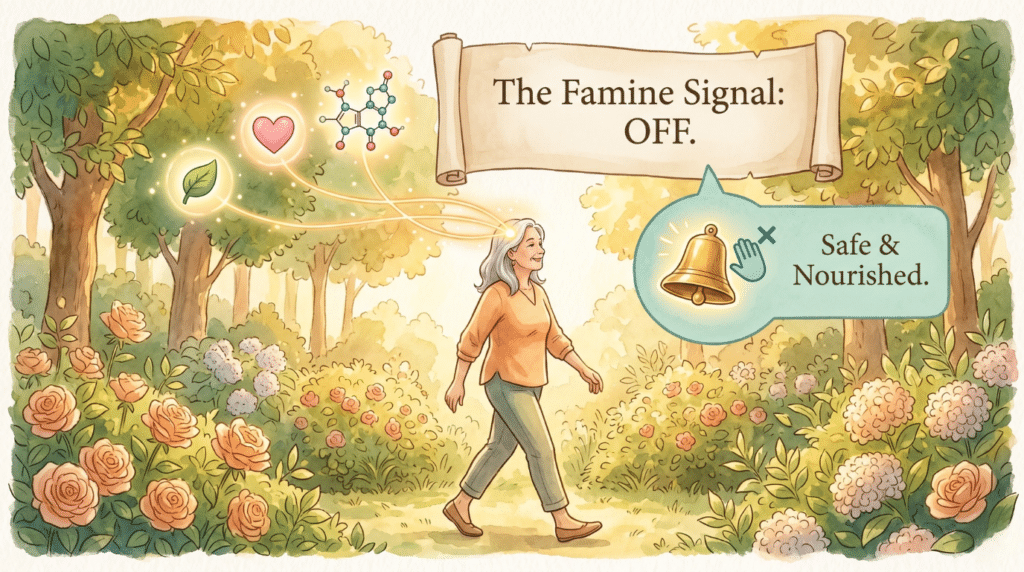
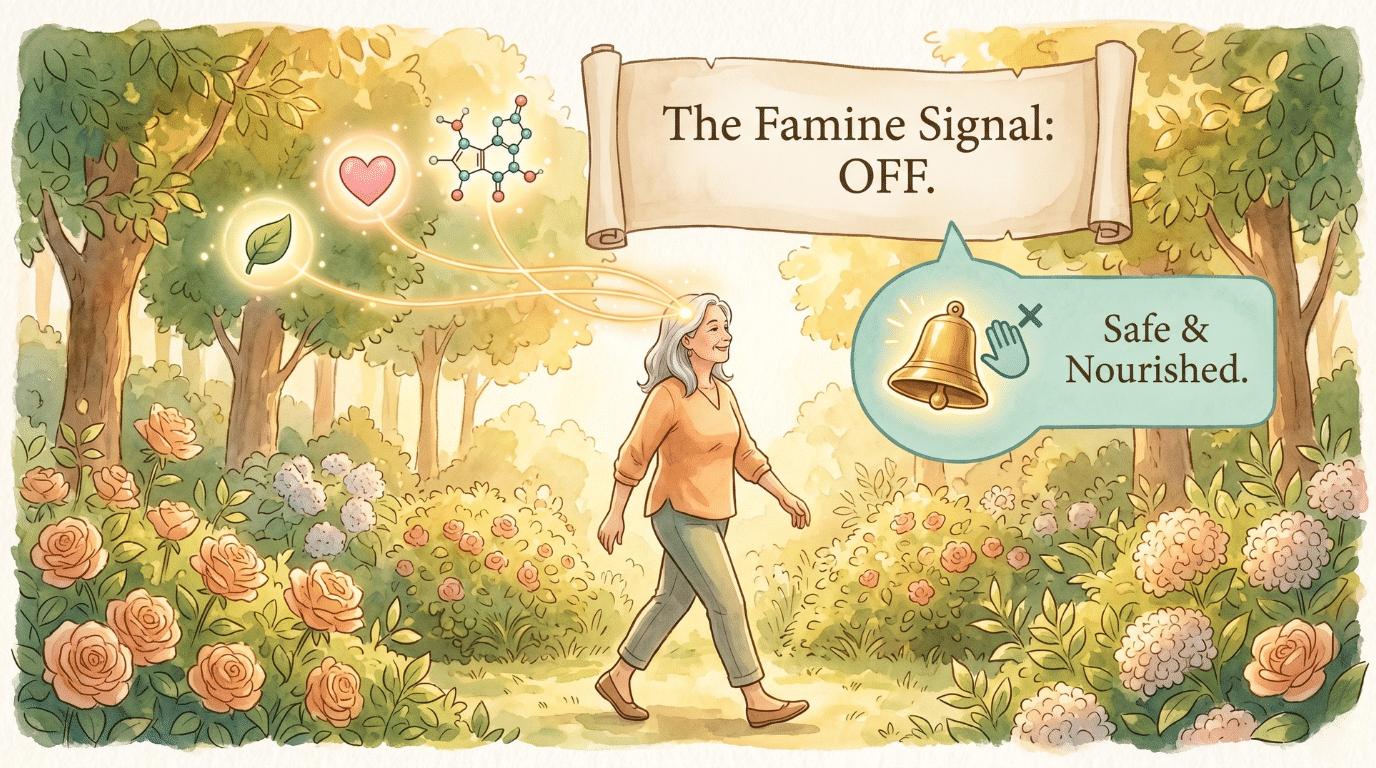
- The Famine Signal: When calories drop or nutrients become scarce, the hypothalamus reads this as a food shortage, not a diet plan. Its response is to raise your weight set point and slow your metabolism. This is the core reason that eating less so often backfires over time.
- The Temperature Signal: In cold climates and cold seasons, mammals bulk up. They store fat for insulation and energy reserves. Chronic stress sends the same hormonal message as a cold, dangerous winter. Your hypothalamus doesn't know the difference between a stressful job and a freezing tundra. It responds the same way to both.
Let's spend a moment on the Famine Signal, because this one is responsible for more diet failure than anything else.
Imagine you're sitting in a room. Slowly, quietly, the oxygen starts running out. Would you calmly decide to breathe less? Would you take a deep breath, consult a chart, and choose to inhale at a 20% deficit?
Of course not. You would gasp. You would panic. You would do anything to get more air.
You are not greedy. You are starving at a cellular level.
That's exactly what happens when your hypothalamus detects a nutrient deficit. It doesn't send a polite nudge. It floods your bloodstream with hunger hormones, drops your energy levels, and locks your attention onto food like a laser. That overwhelming, relentless drive to eat more isn't a personality flaw. It's a survival program running at full intensity.
The Science: When caloric intake drops, leptin levels fall rapidly. The hypothalamus interprets this as the beginning of a famine and immediately activates fat-storage and hunger-amplification responses, regardless of how much body fat a person is already carrying.
Now here's where modern life makes this even more complicated. Enter what Jon calls MT Calories, empty calories.
Processed food is calorie-dense but almost completely stripped of the actual nutrients your hypothalamus is scanning for. You can eat thousands of calories of refined, packaged food and still trigger the famine alarm. Your body received the energy. But it didn't receive the signal that says “we're safe, we're nourished, we're okay.”
You can be overweight and starving at the same time. That's not a contradiction. That's a description of how millions of people are living right now.
The Leptin Resistance Loop
Leptin is the hormone produced by your fat cells to tell the hypothalamus: “We have plenty of stored energy… stand down.” In a healthy system, more fat means more leptin, which means less hunger and a lower set point. But chronic inflammation and a diet high in processed foods can make the hypothalamus leptin-resistant, meaning it can no longer hear this signal clearly. The famine alarm keeps ringing. Hunger stays elevated. Fat continues to accumulate. And no amount of willpower overrides a hypothalamus that genuinely believes you are in danger of starvation.
Jon lived this for years. At his heaviest, he was eating enormous amounts of food and still feeling a relentless pull to eat more. He thought something was wrong with him. He thought he was broken.
He wasn't weak. Jon's hypothalamus was receiving faulty data and responding accordingly. The loop was broken, not his character.
Once you see it that way, everything changes. Because now you're not fighting yourself. You're troubleshooting a miscommunication. And that's a problem you can actually solve.
The Famine Response and Why Dieting Is the Worst Thing You Can Do
Here is the most important thing no one has ever told you about your diet.
The single most common piece of weight loss advice, eat less, move more, directly activates the biological system designed to make you fatter. Not slightly. Not eventually. Immediately and aggressively.
That's not a cruel joke. Once you understand what your hypothalamus is actually doing, it makes complete sense.
Let's walk through exactly what happens inside your body the moment you start restricting calories. This is the sequence no diet book ever bothers to explain.
The Famine Response Cascade: What Happens When You Diet
Step 1: Caloric restriction begins. Your hypothalamus detects a drop in incoming nutrients, not calories, nutrients.
Step 2: Leptin levels fall. Your fat cells produce less of this critical hormone, and the hypothalamus reads this as an early warning sign. Famine is coming.
Step 3: Ghrelin, the hunger hormone, spikes hard. This isn't a gentle nudge. It's a biological alarm. Your focus sharpens on food. Your willpower doesn't stand a chance against a full-scale hormonal assault.
Step 4: Your metabolism slows down. The body starts burning fewer calories at rest, rationing its energy like a generator running low on fuel.
Step 5: Fat-storage enzymes upregulate. Your body becomes measurably more efficient at converting whatever food arrives into stored fat. You gain more fat from the same calories than you did before.
Step 6: Cortisol rises. Stress hormones signal the body to hold onto fat, especially deep abdominal fat, as an emergency reserve.
Step 7: Weight loss stalls. Or reverses. Even while you're still dieting.
Sound familiar? This isn't bad luck. This is your hypothalamus doing its job with ruthless efficiency.
This is what Jon Gabriel calls the FAT Programs switching on. Your hypothalamus has read the situation, assessed the threat, and flipped every biological switch toward fat storage and fat retention. Every cell in your body is now working against the goal you're trying to achieve.
The Science: Research published in the New England Journal of Medicine tracked contestants from The Biggest Loser for six years after the show. Their resting metabolisms had slowed dramatically and stayed slow. Their hunger hormones remained elevated years later. The famine response doesn't just show up during a diet. It can linger long after the diet ends, making every subsequent attempt harder than the last.
This is not a malfunction. This is your biology working exactly as designed.
Your hypothalamus cannot tell the difference between your January diet and a genuine food shortage. It doesn't know you have a grocery store three minutes away. It only knows that incoming nutrients have dropped, fat stores are shrinking, and historically, that combination has meant one thing: survival is at risk.
So it responds accordingly. It makes you ravenous. It makes you exhausted. It slows your body to a crawl. And when you finally break, when the hunger becomes physically unbearable, it stores every calorie with extraordinary precision.
You didn't binge because you were weak. Your hypothalamus manufactured a biological emergency and your body responded the only way it knew how.
Jon experienced this loop for years. Eating less, feeling desperate, breaking, gaining it all back plus more. He wasn't failing at dieting. He was succeeding at triggering the famine response, every single time.
The heartbreaking part? The harder you diet, the stronger the response. Every aggressive caloric restriction teaches your hypothalamus that famines are a real and recurring threat in your world. It recalibrates. It raises your set point a little higher. It becomes a little more protective of your fat stores.
Chronic dieting doesn't just fail to work. It makes the underlying problem worse.
But here's what changes everything: the famine response can be turned off. Not by eating less. By giving your hypothalamus what it's actually asking for, safety, nourishment, and the right biological signals that the threat has passed.
That's a completely different conversation than counting calories. And it's the one your body has been waiting to have.
You don't have to figure out how to rewire your biology all on your own. To get the exact daily visualizations and mind-body tools Jon used, check out the 12-Week Total Transformation Program.