
Hannah was doing everything right. And her body was falling apart.
She had cut her calories. She had tried elimination diets. She had sat in the waiting rooms of three different specialists, filled out the same intake forms, and walked away with the same vague reassurances.
Her bloodwork was “borderline.” Her symptoms were “manageable.” She was given a cream for the rash. A referral for the fatigue. A shrug for the weight that kept climbing, no matter what she did.
She was exhausted. She was inflamed. She was frustrated in the quiet, grinding way that comes from trying everything and getting nowhere.
Sound familiar?
Here’s the question nobody had thought to ask her. Not the doctors. Not the nutritionists. Not the wellness blogs she’d read at midnight, desperate for an answer.
What if the problem wasn’t what she was eating? What if it was what she was feeling?
Not stress in the obvious, overwhelmed sense. Something deeper. A signal. A biological command her body had been receiving for years, one that was quietly instructing her immune system to stay on high alert, and her body to hold on to every pound like its life depended on it.
Because as far as her nervous system was concerned, it did.
This is the story of how Hannah stopped fighting her body and what happened when her body finally felt safe enough to heal.
Meet Hannah: A Story You Might Recognize
Hannah sat in her car in the parking lot of yet another specialist’s office, staring at a referral slip she didn’t want to fill.
She was 44 years old. She had a career she’d worked hard for, a family she loved, and a life that looked, from the outside, completely fine.
But inside? Her body was quietly falling apart.
Her joints ached in the morning before she even got out of bed. A patch of angry, inflamed skin had spread across her forearms, her dermatologist called it eczema, handed her a cream, and sent her home. The fatigue wasn’t the normal kind, the kind that a good night’s sleep fixes. It was bone-deep. The kind that makes you feel like you’re moving through wet concrete before noon.
And then there was the weight.
Hannah hadn’t changed what she was eating. But over the past three years, she’d gained almost 25 pounds, most of it sitting stubbornly around her midsection, in a way that felt different from weight she’d gained before. Harder. More fixed. Like her body had decided to hold on to it no matter what she did.
So she did more.
She cut her calories. She went gluten-free for four months. She tried intermittent fasting. Each approach gave her a flicker of progress, a few pounds, a little more energy, and then the plateau hit. And then the crash. And then she’d be back where she started, except more exhausted and more confused than before.
Her bloodwork kept coming back “borderline.” Not bad enough to explain how she felt. Not clean enough to dismiss it entirely. Just… borderline. She was given a low-dose thyroid medication, told to manage her stress, and sent home.
Manage her stress. As if she hadn’t thought of that.
Sound familiar?
The hardest part wasn’t the physical symptoms. It was what the symptoms were doing to her sense of herself. Hannah had always been someone who figured things out. Who put in the work. Who didn’t quit.
But no matter how hard she worked at this, nothing changed. And slowly, quietly, a belief started to form in the back of her mind.
“Maybe this is just how I’m going to feel for the rest of my life.”
She was wrong. But she had no way of knowing that yet.
The Science: When the nervous system is locked in a chronic stress state, the body interprets that signal as a survival threat, and responds by storing fat, suppressing immune regulation, and driving systemic inflammation. These aren’t separate symptoms. They’re the same biological response.
Hannah wasn’t broken. Her body was doing exactly what a body does when it believes it is under attack.
The problem wasn’t her willpower. The problem wasn’t even her immune system. The problem was the signal her nervous system had been broadcasting, quietly, constantly, without her awareness, for years.
And once she understood that, everything changed.
Why “Try Harder” Was Making Things Worse
Every restrictive diet Hannah tried sent her body one message: scarcity. Every punishing exercise routine sent another: danger. Her body responded the way any survival system would, it held on tighter. The harder she fought, the more her nervous system interpreted the fight itself as a threat. This is why willpower alone never works when your biology is working against you.
What the Doctors Weren’t Telling Her About Stress
When Hannah first heard this explained to her, she said something I hear all the time.
“But I don’t feel that stressed.”
And she meant it. She wasn’t lying. She wasn’t in denial. She had just been living under chronic stress for so long that it had stopped feeling like stress. It felt like Tuesday.
That’s the thing about chronic stress. It doesn’t always look like panic attacks and sleepless nights. Sometimes it looks like a full calendar, a glass of wine to unwind, a body that never quite feels right, and a nagging sense that you’re falling behind on something, you’re just not sure what.
Here’s what most people don’t know. Cortisol, your primary stress hormone, is not the enemy. In small doses, it is one of the most powerful anti-inflammatory compounds your body produces. Think of it as a fire extinguisher. A little cortisol puts out small fires. It keeps inflammation in check. It gets you through a tough morning.
But when the alarm never stops ringing? The fire extinguisher becomes the arsonist.
When cortisol floods your system day after day, month after month, your body does something counterintuitive. It stops listening to it. Just like cells can become resistant to insulin, your immune system can become resistant to cortisol’s anti-inflammatory signal. The message stops getting through. And when your immune system can no longer hear the “stand down” signal, it doesn’t stand down. It starts attacking.
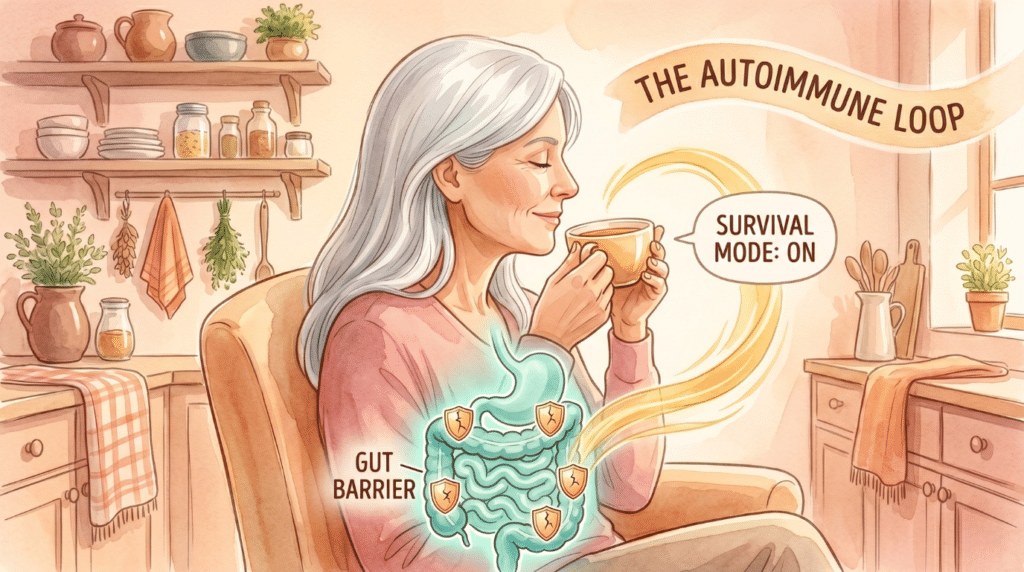
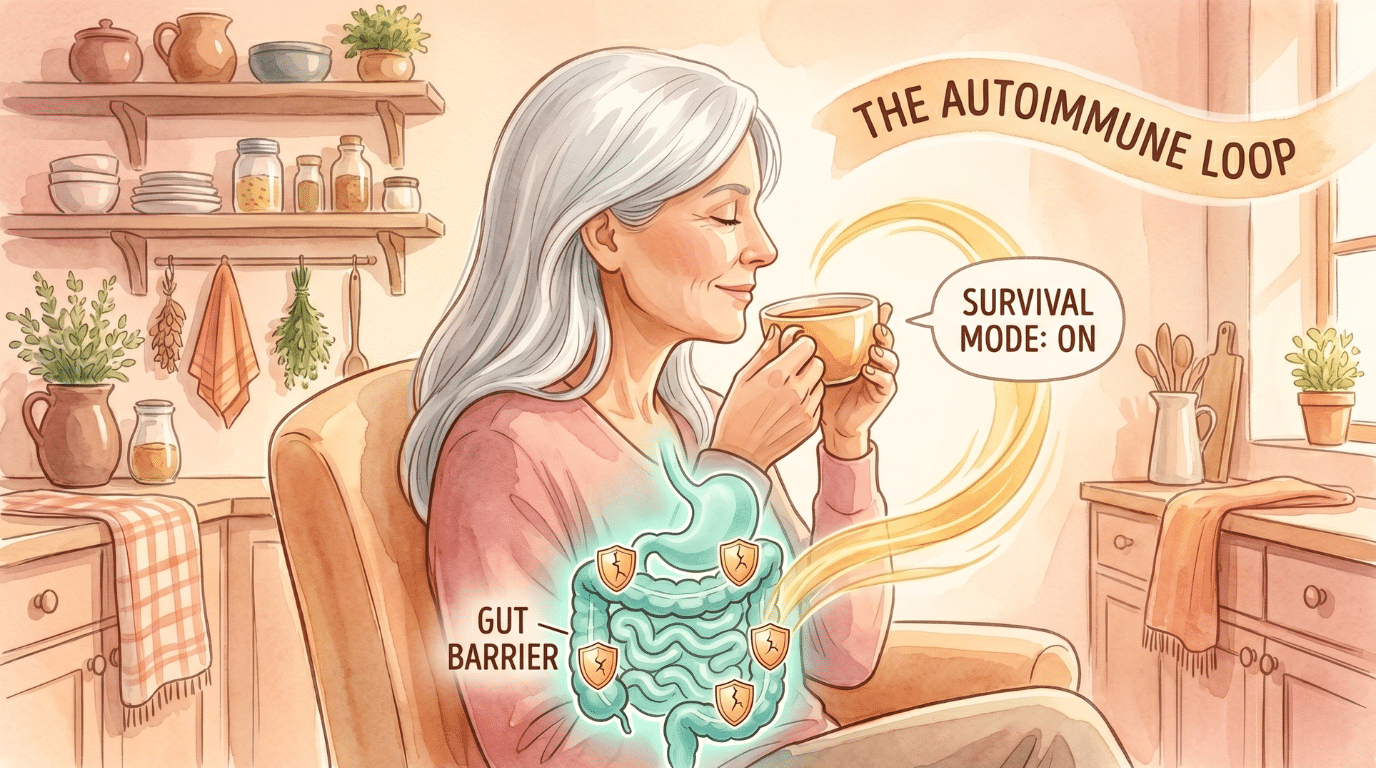
That’s the autoimmune loop. And it starts with a nervous system that never gets to rest.
The Science: Chronic cortisol elevation leads to glucocorticoid receptor resistance, meaning the immune system stops responding to cortisol’s anti-inflammatory commands. Without that regulation, immune cells become hyperactive and begin targeting the body’s own tissue, driving conditions like eczema, psoriasis, rheumatoid arthritis, and Hashimoto’s thyroiditis.
But it doesn’t stop there. Your body doesn’t just file cortisol under “stress.” It files it under survival threat. And when your body believes it is in a survival situation, the same way it would respond to famine, extreme cold, or prolonged danger, it activates what I call the FAT Programs. Ancient biological switches designed to keep you alive.
In survival mode, your body does the following:
- Breaks down muscle tissue for fast fuel
- Promotes visceral fat storage, especially around the belly
- Suppresses thyroid function, slowing your metabolism
- Dysregulates blood sugar, driving cravings and crashes
- Triggers immune system misfiring and systemic inflammation
Imagine you’re in a room that’s slowly filling with smoke. Every breath is a little harder. You don’t panic right away, you adapt. You breathe shallower. You move less. You conserve energy.
That’s exactly what Hannah’s body was doing. It wasn’t malfunctioning. It was surviving.
The Cortisol-Inflammation Connection
Cortisol in small amounts is protective and anti-inflammatory. But under chronic stress, cortisol resistance develops and the immune system begins operating without a brake. Fat storage increases. Inflammation spreads. The thyroid slows. These aren’t separate problems happening at the same time. They are one unified survival response, triggered by a nervous system that never got the all-clear signal.
Inflammation and weight gain aren’t two problems. They’re the same problem wearing two masks.
Every elimination diet Hannah tried. Every calorie she counted. Every specialist she visited. None of them were asking the most important question.
Not what is attacking your body.
But why does your body believe it needs to be attacked in the first place?
That question changes everything.
Why Her Immune System Was Attacking Her Own Body
Here’s a question Hannah had never been able to get a straight answer to.
Why was her immune system attacking her own body?
The doctors had given her a name for it. They had given her a prescription for it. But no one had ever explained what was actually happening, or why it started in the first place.
So let’s talk about it. Because once you understand this, everything starts to make a different kind of sense.
Think of Your Immune System as a Security Guard
When your nervous system is calm and regulated, your immune system is like a highly trained, well-rested security guard. It knows the difference between a real threat and a false alarm. It responds precisely. It doesn’t overreact. It protects you without destroying the building in the process.
But when your nervous system has been in survival mode for months, or years, that security guard becomes something else entirely.
Overworked. Sleep-deprived. Jumpy. Paranoid.
It starts seeing threats everywhere. It stops distinguishing between foreign invaders and your own tissue. And so it attacks. Your joints. Your skin. Your gut lining. Your thyroid. Your body becomes the enemy, not because your immune system is broken, but because it’s exhausted and overwhelmed and operating on a hair trigger.
That’s autoimmunity. Not a malfunction. A miscommunication.
The Gut Is Where It Gets Personal
Here’s what most people don’t know: approximately 70 to 80 percent of your immune system lives in your gut.
Your gut isn’t just digesting food. It’s running security operations around the clock.
When chronic stress floods your system, it compromises your gut lining, the thin, protective barrier that decides what gets absorbed into your bloodstream and what doesn’t. Under sustained stress, that barrier becomes permeable. Leaky.
Undigested food particles. Bacterial byproducts. Things that were never supposed to cross that barrier. They slip through.
And your immune system does exactly what it’s designed to do. It flags them as invaders. It mounts a response. Except now that response is happening inside your body, against particles that look a lot like your own tissue.
Systemic inflammation ignites. And it doesn’t stay in one place.
The Science: Chronic psychological stress increases intestinal permeability by elevating corticotropin-releasing hormone (CRH), which directly disrupts the tight junctions of the gut lining, creating the very conditions that drive autoimmune activation and systemic inflammation.
This is why Hannah’s rashes, her joint pain, and her fatigue weren’t separate problems. They were one problem, expressing itself in multiple places.
The Cycle That Keeps You Stuck
Here’s where it becomes a trap.
Stress triggers gut inflammation. Gut inflammation dysregulates the immune system. Immune dysregulation causes autoimmune symptoms. And being sick, dealing with pain, fatigue, brain fog, rashes, creates more stress.
Around and around it goes.
Hannah wasn’t failing to get better. She was caught in a loop that no elimination diet was ever going to break. Because the loop wasn’t starting with food. It was starting with her nervous system.
The Autoimmune Loop And What Drives It
Most autoimmune approaches treat the symptoms at the end of the chain. But the chain starts much earlier. When you understand the full sequence, the path forward becomes clear:
- Chronic stress activates the body’s survival response
- Sustained cortisol compromises gut lining integrity
- A permeable gut allows undigested proteins into the bloodstream
- The immune system mounts an inflammatory response, against your own tissue
- Autoimmune symptoms flare: rashes, joint pain, fatigue, brain fog
- Symptoms create more stress, which restarts the cycle
The exit isn’t at the end of the loop. It’s at the beginning.
When Hannah finally understood this, when she saw the whole chain laid out, something shifted in her.
Not hope, exactly. Something quieter than that. Something more like recognition.
This isn’t who I am. This is what’s been happening to me.
And that is a very different thing.
If you’re ready to stop fighting your body and actually start working with it, Jon Gabriel invites you to experience the complete step-by-step system inside the 12-Week Total Transformation Program.