
You’ve done the spin classes. You’ve tracked every calorie. You’ve set the 5 AM alarm and actually gotten up. You’ve said no to the bread basket, the birthday cake, the glass of wine on a Friday night.
And your body? Still stuck. Still the same.
Sound familiar? You’re not weak. You’re not lazy. You’re just missing something that nobody in the fitness industry ever told you about.
What if the missing ingredient wasn’t more effort? What if it was a completely different kind of practice, one you could do lying down, in the dark, in 10 minutes flat?
Here’s what the science actually says: neuroscience research on mental rehearsal shows that the brain builds the same neural pathways whether you physically perform an action or vividly imagine it. Your motor cortex doesn’t know the difference. Your nervous system responds to both as real.
This isn’t positive thinking. This isn’t manifesting. This is motor cortex science.
By the end of this post, you’ll understand exactly why your body has been fighting every effort you’ve made and how to change the one thing that actually controls your results, starting tonight.
The Science Behind Mental Rehearsal
Studies in the Journal of Neurophysiology show that vivid mental imagery activates the brain’s motor and sensory cortex in measurably similar ways to real physical experience. Your brain builds the circuit either way. Visualization isn’t a shortcut, it’s a direct line to your biology.
The Gym Isn’t Failing You. Your Nervous System Is.
At his heaviest, Jon Gabriel weighed over 400 pounds.
And he wasn’t sitting on a couch eating bonbons. He was trying. Dieting. Restricting. Exercising. Doing everything the conventional weight loss world told him to do. And his body kept fighting back, storing more fat, driving more cravings, resisting every single effort he made.
Sound familiar?
Here’s what nobody tells you when you sign up for that spin class or download another calorie-counting app: effort alone cannot override a nervous system that is wired to hold on.
Your brain holds a picture of you. Not the you in the mirror, the you it believes you are. Scientists call this the “body schema.” Jon calls it your blueprint. It’s the subconscious identity your body uses as its operating instructions. And right now, if you’ve been struggling with your weight for years, your blueprint is almost certainly coded with one message: store, protect, survive.
No amount of running changes that blueprint. The gym changes your muscles. It does not change your operating system.
Here’s where it gets cruel.
When you push your body hard, chronic exercise, aggressive calorie restriction, grinding through exhaustion, your body reads those signals not as “getting healthy” but as danger. The stress hormone cortisol spikes. And elevated cortisol is essentially a flare gun fired directly at your fat-storage systems.
The Cortisol Fat-Storage Loop
Here’s what happens in your body when exercise and restriction are driven by stress and desperation:
- Chronic effort + caloric restriction → cortisol spikes
- Elevated cortisol → FAT Programs activated
- FAT Programs active → metabolism slows, hunger hormones surge
- More hunger, slower burn → your body rebuilds the weight you lost
You can’t out-exercise a nervous system that thinks it’s in danger.
The body isn’t being stubborn. It’s being brilliant. It’s doing exactly what it was designed to do, protect you from what it perceives as famine and threat. The cruel irony is that the harder you fight your body, the harder your body fights back.
The Science: Prolonged caloric restriction and high-intensity exercise elevate cortisol levels, which directly increases fat-storage enzyme activity and suppresses leptin sensitivity, the hormone responsible for telling your brain you’re full and safe. The body, in essence, interprets your weight loss effort as a survival emergency.
Jon understood this firsthand. One afternoon in Australia, too heavy to move comfortably, exhausted from years of fighting his own biology, he lay down in a field and stopped fighting.
Instead of forcing, he imagined.
He pictured the life he wanted. The body he wanted. The feeling of moving through the world with ease. That moment, lying still, doing nothing physically, became the seed of everything that changed.
Because here’s the insight that changes everything: your body doesn’t change until your internal environment changes first.
The gym builds muscle. Visualization builds the blueprint those muscles grow into. One without the other is like laying bricks without an architect’s plan, you’ll exhaust yourself building something that keeps falling down.
The missing piece was never more effort. It was a different kind of signal entirely.
What Neuroscience Actually Says About “Imagining It”
Let’s get something straight right away.
Visualization is not wishful thinking. It is not a motivational poster strategy. It is not something you do while lighting a candle and hoping the universe delivers a smaller waistline.
It is a documented neurological process and the science behind it is far more radical than most people realize.
Here’s the study that changed everything for Jon, and should change the way you think about your own body.
Neuroscientist Alvaro Pascual-Leone at Harvard conducted a now-famous experiment with piano players. One group practiced a musical sequence physically, every day for five days. Another group only imagined playing the sequence, no hands on keys, just vivid mental rehearsal.
When researchers mapped both groups’ brains afterward, the neural changes were nearly identical.
The mental rehearsal group had built the same circuits. The same motor cortex expansion. The same neurological “memory” of playing the piano, without ever physically touching one.
The Science: According to research published in the Journal of Neurophysiology, the brain’s motor cortex responds to vivid mental imagery in measurably similar ways to real physical experience, meaning your nervous system literally cannot tell the difference between a vividly imagined action and a real one.
In plain English? Your neurons fired. Your brain built the circuit. Your body got the memo.
This is not a metaphor. This is your actual biology.
Science → Plain English → The Gabriel Method Term
The Science: Mental rehearsal activates the motor and sensory cortex, forming neural pathways identical to those created through physical practice.
Plain English: When you vividly imagine being lean, vital, and healthy, your brain begins wiring itself for that reality right now, tonight, before you’ve lost a single pound.
The Gabriel Method Term: This is what Jon calls SMART Mode, Super Mental Alert Reeducation Training. It is the specific brainwave state where this rewiring happens most powerfully.
SMART Mode is not casual daydreaming. It is a targeted, relaxed-alert state, what neuroscientists call the alpha/theta border. Think of it as the mental equivalent of fertile soil. In ordinary, stressed, busy-minded wakefulness, your subconscious is defended. Your inner critic is loud. New patterns bounce off.
In SMART Mode, the gates open.
3 Things That Happen in Your Brain During SMART Mode
1. Cortisol drops. Your body stops interpreting life as a threat. The stress chemistry that drives fat storage begins to quiet down.
2. The parasympathetic nervous system activates. This is your “rest and repair” state, the biological opposite of fight-or-flight. Your body shifts from survival mode into growth mode.
3. Your brain becomes plastic. In deep relaxation, the brain is literally more open to new patterning. Old identity circuits loosen. New ones form. This is the same state accessed in hypnosis, deep meditation, and those hazy moments just before you fall asleep.
You’ve been in this state before. You just haven’t been using it deliberately.
Think of it like a GPS system. Right now, your internal GPS is programmed with an old address, the identity of someone who struggles with weight, who fights their body, who can’t keep it off. No matter how many times you manually yank the wheel toward a different destination, the GPS keeps rerouting you back.
Willpower is you fighting the GPS.
SMART Mode visualization is you reprogramming the GPS.
That’s why Jon stopped fighting his body and started talking to it differently. Not with force. With intention. With vivid, emotionally resonant images of the life and body he actually wanted.
SMART Mode is where your new body gets built. Everything else, the gym, the food choices, the habits, those are downstream. They follow the blueprint. And right now, you have the power to redraw it.
FAT Programs, Safety Signals, and Why Your Body Holds On
Your body is not broken. It is not betraying you. It is doing exactly what it was designed to do, keeping you alive.
The problem is, it’s using a survival system that was built for a very different world.
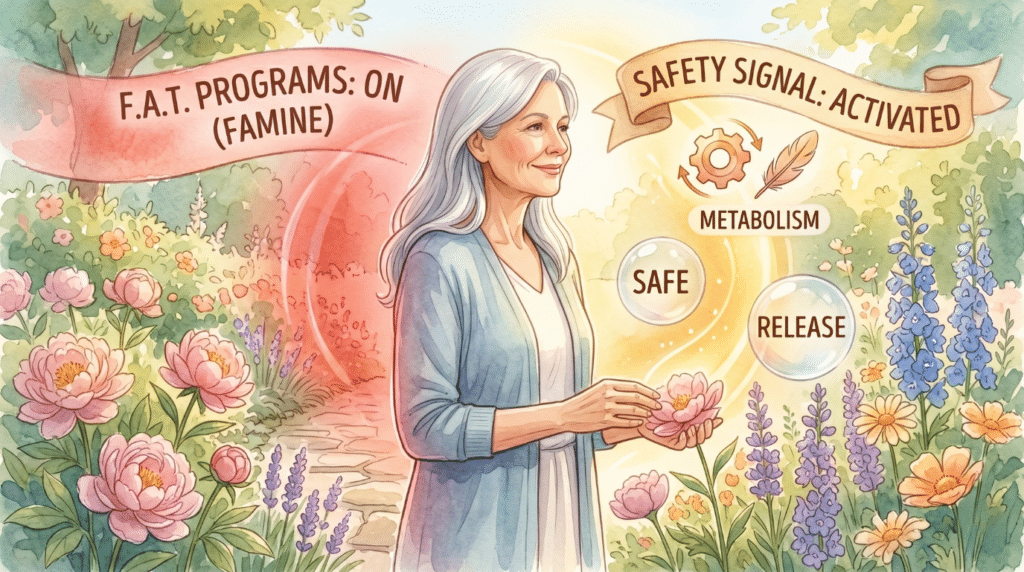
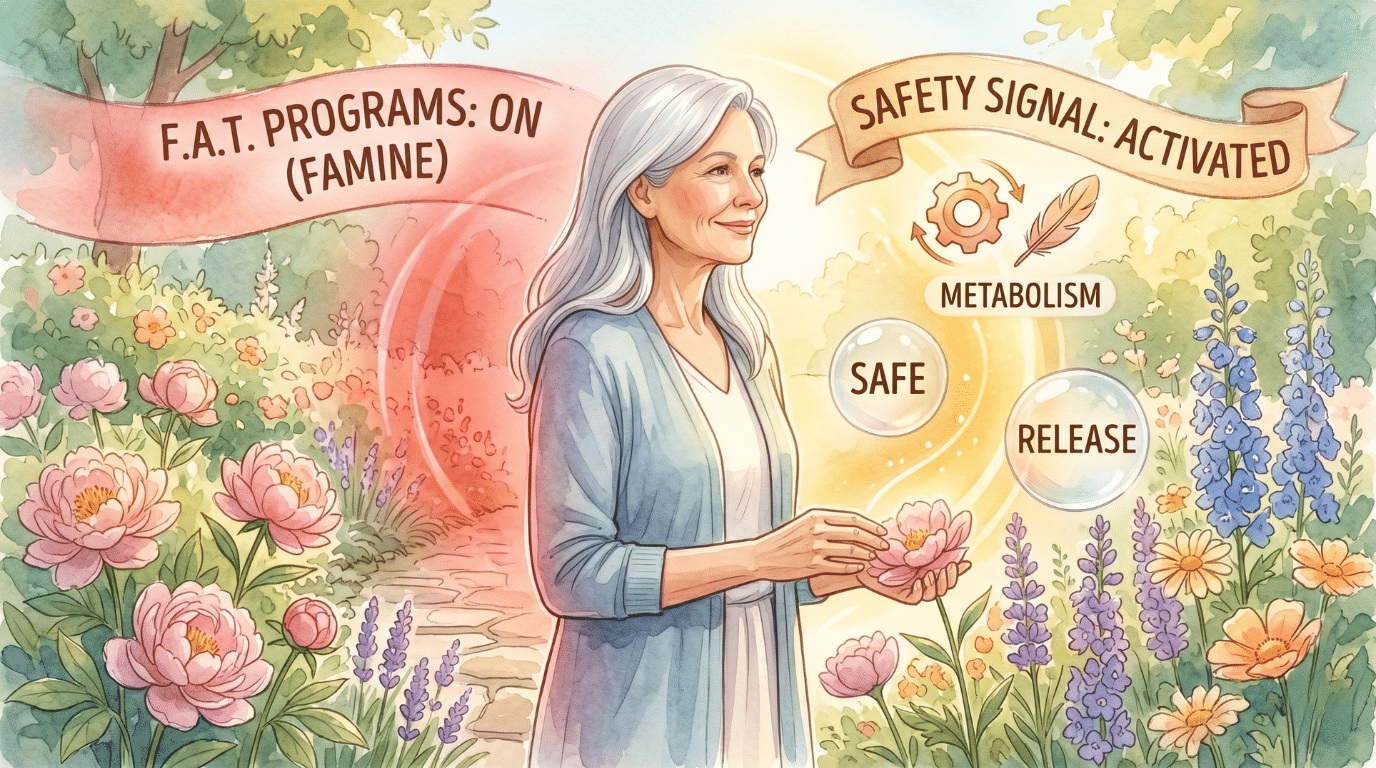
Deep inside your biology, you have what Jon Gabriel calls the FAT Programs. FAT stands for Famine And Temperature, ancient survival switches that evolved over hundreds of thousands of years to protect you from starvation and cold.
When these programs switch on, your body goes into full preservation mode. It is not subtle about it.
- Fat-storage enzyme activity spikes: your body hoards every calorie it can find
- Metabolism slows to a crawl: burning less feels safer than burning more
- Ghrelin (your hunger hormone) surges: you feel ravenous even when you’ve eaten
- Leptin signaling breaks down: your brain stops receiving the “I’m full” signal
- Cravings for calorie-dense foods become overwhelming: your body wants the highest-return fuel available
Sound familiar? That’s not weakness. That’s biology doing its job.
Here’s what most people don’t know: your nervous system cannot tell the difference between a real famine and a perceived one. It cannot distinguish between a genuine physical threat and a chronic, low-grade anxiety about your weight.
A tiger chasing you and a 1,200-calorie diet register the same way in your brain. Both look like danger. Both switch the FAT Programs on.
The Science: Chronic psychological stress elevates cortisol, which directly increases lipoprotein lipase activity, the enzyme responsible for pulling fat into fat cells. Your body responds to emotional threat signals the same way it responds to physical ones, triggering the same hormonal cascade that locks fat in place.
This is where it gets uncomfortable. Every time you look in the mirror and feel disgust. Every time you call yourself lazy. Every time you punish yourself for eating something “bad.”
Self-criticism is not motivation. It is a fat-storage trigger.
Each thought of shame sends a danger signal straight to your limbic system. Your body hears it loud and clear: we are not safe. And when your body believes it is not safe, it holds on to every ounce of fat it can.
Think of it this way. Imagine a room with very low oxygen. Your body panics. It gasps. It fights for every breath it can get. You cannot will yourself to breathe normally in that room. You cannot discipline your way out of it. You have to change the air.
A body living in a low-safety environment does the same thing with calories. It clings. It hoards. It panics. No amount of willpower changes that, until the environment changes first.
This is exactly what visualization does.
A vivid, emotionally rich image of your healthy, thriving, vital self sends the opposite signal. It tells your limbic system: we are safe. We are fed. We are okay. Cortisol begins to drop. Leptin sensitivity starts to recover. The FAT Programs begin, slowly but measurably, to switch off.
FAT Program ON vs. FAT Program OFF
When your FAT Programs are ON: Your body feels tense, hungry, and unsatisfied no matter how much you eat. Cravings feel urgent and uncontrollable. Losing weight feels like swimming upstream, exhausting, slow, and demoralizing. Every diet feels like deprivation, because to your nervous system, it IS deprivation.
When your FAT Programs are OFF: Your body feels calm, satiated, and relaxed around food. Cravings quiet down on their own. Your metabolism runs efficiently because it is no longer in conservation mode. Weight loss stops being a battle and starts being a natural byproduct of a body that feels safe enough to let go.
This is not magic. It is not wishful thinking. It is hormonal signaling through the imagination.
The visualization practice Jon teaches isn’t about pretending everything is fine. It’s about deliberately, consistently sending your nervous system the safety signals it needs to stop defending your fat stores and start releasing them.
Ten minutes of genuine, felt-sense safety can do more for your metabolism than an hour of anxious, cortisol-soaked effort on a treadmill.
Change the air. The breathing takes care of itself.
The Difference Between Wishing and Visualizing
Here’s where most people go wrong.
They close their eyes, think “I want to be skinny,” and then wonder why nothing changes. That’s not visualization. That’s wishing. And there’s a world of difference between the two.
Wishing comes from a place of lack. It starts with the feeling that something is wrong right now, that you’re broken, too heavy, not enough. When you wish to be thin, your brain is actually anchored in the image of what you don’t want. You’re feeling the frustration, the shame, the exhaustion of where you are. And your nervous system? It’s recording all of it.
You can’t attract a new body from the emotional frequency of hating your current one.
Think about it this way. If you visualize “not being fat,” your brain has to construct the image of being fat first and then try to negate it. The nervous system doesn’t process negatives well. It just sees the fat. It just feels the lack. And it keeps building more of the same.
The Science: Neuroscience research confirms that the brain responds to the emotional content of an image, not the logical intention behind it. If your visualization is saturated with the feeling of inadequacy and desire, your amygdala, the brain’s threat-detection center, stays activated. Cortisol stays elevated. The FAT Programs stay on.
True SMART Mode visualization works completely differently.
It’s not about wanting. It’s about being. Present tense. Fully embodied. Saturated with sensory detail and genuine emotion.
You’re not imagining someday. You’re stepping into the experience of right now, a version of right now where you already feel light, strong, and alive in your body.
What does that feel like in your chest? In your legs? What are you wearing? Who are you with? What does the air smell like? Can you feel the ground under your feet?
The more specific and sensory the image, the more real it becomes to your brain. And the more real it becomes, the stronger the neural signal and the more powerfully it overwrites the old blueprint.
The Three Rules of Effective Visualization
Before you close your eyes tonight, make sure your visualization hits all three of these marks.
Rule 1 Present Tense: You’re not visualizing the future. You’re inhabiting it right now. Speak and feel in the present. “I am strong. I feel light. This is my body.”
Rule 2 Sensory Saturation: Engage every sense. Sight, sound, touch, smell, taste. The more vivid and specific the image, the more neurons you recruit and the stronger the new circuit becomes.
Rule 3 Genuine Emotion: The feeling is the fuel. Not manufactured positivity. Real, quiet, bone-deep gratitude for the life you’re stepping into. Joy. Ease. Belonging in your own skin. That emotional charge is what makes the brain pay attention.
Jon didn’t visualize losing weight. He visualized living, running on the beach, feeling strong, being present with his kids. He didn’t focus on the problem. He focused on the life calling him forward.
That distinction changed everything.
Wishing keeps you in the problem. Visualization places you in the solution.
And your brain, and your body, will follow wherever you consistently, vividly, emotionally choose to live.
If you’re ready to stop fighting your body and actually start working with it, Jon Gabriel would like to invite you to experience the complete step-by-step system inside the 12-Week Total Transformation Program.