
You’re exhausted. Genuinely, bone-deep exhausted. But the moment your head hits the pillow, something switches on.
Your mind starts replaying that awkward conversation from this morning. Your jaw is clenched. Your shoulders are somewhere near your ears. You’re running through tomorrow’s to-do list like it’s an emergency briefing.
You wonder why you can’t sleep.
And maybe, if you’re really honest, you wonder why the scale isn’t moving. You ate well today. You skipped the afternoon biscuits. You did everything right. So why does your body feel like it’s holding on for dear life?
Here’s the thing most people never get told: this isn’t a sleep problem. It isn’t a willpower problem. It isn’t even a food problem.
It’s a biology problem.
Your nervous system doesn’t know the day is over. It’s still running a background program, threat detected, stay alert, hold your reserves. And a body stuck in that mode doesn’t release fat. It hoards it.
The good news? There’s a ritual, completely free, taking less than 20 minutes, that teaches your body it is finally, truly safe.
And when your body feels safe, everything changes.
Why “Tired But Wired” Is a Biology Signal, Not a Character Flaw
Chronic stress keeps your nervous system locked in “threat mode” long after the actual threat has passed. This isn’t weakness, it’s your ancient survival biology doing exactly what it was designed to do. The evening ritual below works with that biology, not against it.
Your Body Doesn’t Know the Day Is Over
It’s 10pm. You’re exhausted. You’ve been running since 6am, and your body should be winding down.
But it isn’t.
Your jaw is tight. Your shoulders are somewhere near your ears. Your mind is replaying that conversation from this afternoon, composing emails you haven’t sent yet, worrying about tomorrow before today is even finished. You’re lying in bed, completely spent and completely wired.
Sound familiar?
Here’s what most people don’t know: your nervous system doesn’t automatically clock out when you do. There is no internal alarm that goes off at the end of the workday and signals “all clear.” The stress of a difficult meeting, a tense phone call, a frustrating commute, it doesn’t evaporate when you walk through your front door. It accumulates. It layers. And by the time your head hits the pillow, your body is still running a background program called “threat detected.”
This is where the trouble starts.
Meet Cortisol, Your Body’s “Stay Fat” Signal
When your body perceives stress, any stress, it releases cortisol. Think of cortisol as your ancient alarm system. It was designed brilliantly, for a completely different world.
Thousands of years ago, cortisol surged when you faced a predator. It flooded your system, gave you explosive energy to run or fight, and then, when the threat passed, it dropped. The whole cycle lasted minutes.
Your body was never designed for what you’re dealing with now.
Fourteen hours of low-grade, relentless modern stress, emails, deadlines, financial worry, conflict, noise, comparison, keeps cortisol trickling into your system all day long. And chronically elevated cortisol sends one unmistakable message to every cell in your body: “We are not safe. Store fat. Do not release it.”
The Science: Cortisol directly activates fat-storage enzymes, particularly around the abdomen, while simultaneously suppressing the hormonal signals that would otherwise tell your body to burn fat for fuel. Chronic stress doesn’t just make you feel worse. It chemically locks your body into a fat-storage state.
This is not a flaw in your design. It’s a survival mechanism. A body that believes it is under threat holds onto every reserve it has. Fat is your body’s most powerful reserve. It will protect it fiercely.
Why Your FAT Programs Don’t Care About Your Diet
In The Gabriel Method, we talk about FAT Programs, the deep survival switches your body can turn on when it believes conditions are dangerous. Most people assume these programs are triggered only by dieting or food restriction.
They’re not.
Emotional stress. Physiological tension. A nervous system that never gets to exhale. These are some of the most powerful FAT Program activators there are. Your body doesn’t distinguish between the stress of famine and the stress of a difficult relationship. To your survival biology, stress is stress and the response is the same: hold on, protect, store.
This is why you can eat beautifully all day, whole foods, no sugar, plenty of water, and still feel completely stuck. The problem isn’t on your plate. It’s in your nervous system.
Consider someone like Sarah. She does everything right. She meal preps on Sunday. She walks every morning. She drinks her water. She hasn’t touched processed food in weeks. But the scale hasn’t moved. She lies in bed exhausted but unable to sleep. She wakes up foggy and already behind. She wonders what she’s missing.
She’s not missing a food. She’s missing a release.
Her evening, the hours that should be recovery, are quietly sabotaging everything she worked for during the day. Not because of what she ate. Because of what she never let go.
Why Stress Keeps You Stuck Even When You Eat Well
Chronic stress keeps cortisol elevated long after the stressor is gone. Elevated cortisol activates your body’s FAT Programs, the survival switches that signal “store fat, don’t release it.” No amount of clean eating can fully override a nervous system that believes it is still under threat. The evening hours are when your body should be powering down these programs. If you’re not actively helping it do that, the programs stay on, all night long.
Your body is not broken. It is not betraying you. It is doing exactly what it was built to do.
It just doesn’t know the day is over. Yet.
What “Resetting” Actually Means (And Why It’s Not What You Think)
Here’s what most people do at the end of a hard day.
They pour a glass of wine. They collapse onto the couch. They turn on something mindless, or something dramatic, and they scroll through their phone at the same time. An hour later, they’re half-asleep in front of the TV. They call this “winding down.”
It isn’t.
And this misunderstanding might be the single most expensive mistake you’re making for your health, your sleep, and your weight.
The Illusion of Rest
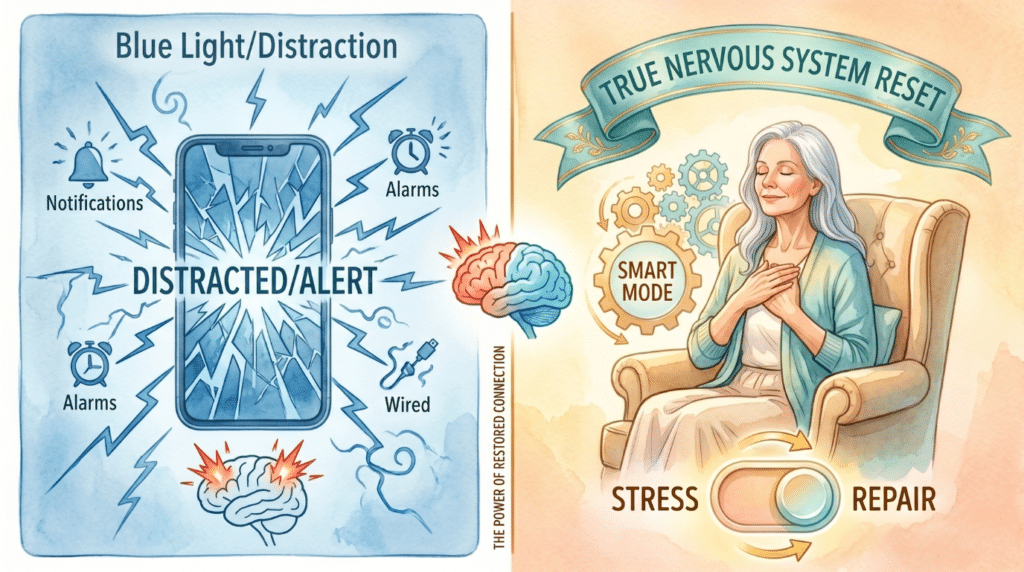
What you’re doing when you scroll, sip, and watch isn’t resting. It’s running at a lower speed. Your nervous system is still switched on. It’s still processing. It’s still reacting.
The blue light from your screen is actively suppressing melatonin, the hormone your body needs to initiate deep, restorative sleep. The emotional content you’re consuming, the news, the drama, the curated highlight reels on social media, is keeping your cortisol quietly elevated. Your body doesn’t know the difference between a stressful scene on a Netflix show and a real threat. It responds the same way.
You think you’re decompressing. Your nervous system thinks you’re still on duty.
Distraction Is Not the Same as Recovery
There’s a critical difference between distraction and recovery. Distraction temporarily numbs the stress. It pushes it to the background. But the stress is still there, unprocessed, sitting in your body like a browser tab you minimized but never closed.
Recovery is different. Recovery means your nervous system, specifically the parasympathetic branch, your “rest and digest” system, actually gets activated. Not just left alone. Actively engaged. This is not something that happens by accident. It requires intention.
The Science: When your parasympathetic nervous system takes over, your cortisol drops, your heart rate slows, and your brain shifts from high-alert Beta waves into the slower, calmer Alpha and Theta wave states, the same deeply receptive states associated with meditation, creativity, and genuine physical repair.
That shift doesn’t happen on the couch with your phone in your hand. It has to be invited.
The Destination: SMART Mode
Jon Gabriel calls this destination SMART Mode, the threshold state between wakefulness and sleep. It’s the hypnagogic edge. The place where your conscious mind quiets and your subconscious becomes extraordinarily receptive.
This is where the real work happens. This is where visualization lands deepest. This is where your body receives the message it has been waiting all day to hear: the threat is over. It is safe to repair. It is safe to let go.
The evening ritual isn’t about getting sleepy. It’s a guided descent into this state, deliberately, consistently, every night.
Reset vs. Numb: Know the Difference
Most evening habits keep your stress simmering. A true nervous system reset requires active downshifting, not passive consumption. Here’s how to tell them apart:
- ❌ Watching TV stimulates, does not restore
- ❌ A glass of wine suppresses REM sleep and disrupts cortisol recovery
- ❌ Scrolling your phone has blue light plus comparison culture equals cortisol fuel
- ✅ Actively engaging your parasympathetic nervous system, this is a real reset
Consider two people who had the exact same brutal Tuesday. Same traffic. Same difficult boss. Same spiraling to-do list.
Person A pours wine, watches the news, scrolls Instagram, and falls asleep on the couch. Person B spends 20 minutes doing the evening ritual you’ll read about below.
Three weeks later, Person A is still stuck, bloated, and waking up exhausted. Person B says something quietly remarkable: “I don’t know what changed. I wake up lighter. Calmer. I’m not even craving the things I used to crave.”
The food didn’t change. The nervous system did.
That’s the reset. And it starts tonight.
The Science of Safety and Why Your Body Must Feel Safe to Let Go
Here’s something most diets will never tell you.
Your body is not broken. It is not stubborn. It is not working against you. It is doing exactly what it was designed to do: protect you.
And right now, if you’re carrying extra weight that won’t budge no matter what you eat, there’s a very good chance your body is holding onto it on purpose.
Not out of spite. Out of survival.
This is the central truth at the heart of The Gabriel Method: your body will not release fat when it perceives a threat. Full stop. It doesn’t matter how clean your meals are. It doesn’t matter how disciplined you’ve been. If your nervous system ends the day running a low-grade alarm signal, your body reads that signal as danger and responds accordingly.
Fat is your reserve. Your emergency fuel. Your body guards it the same way you’d guard your savings account during a financial crisis. You don’t spend your savings when you’re scared. You hoard them. Your body does exactly the same thing with fat.
The Science: When cortisol, your primary stress hormone, stays chronically elevated, it directly interferes with leptin, the hormone responsible for telling your brain “we have enough, we’re full, we’re safe to release stored energy.” Chronically high cortisol essentially drowns out the leptin signal, leaving your body unable to hear its own “all clear” message, no matter how much you’ve eaten or how little you need.
This is why so many chronically stressed people feel hungry even right after a meal. It’s not weakness. It’s not greed. Their leptin signal is being overridden by the cortisol alarm blaring in the background.
Think of it this way. Imagine trying to have a quiet conversation in a room where a fire alarm is going off. You can’t hear each other. No information gets through. That’s what chronic stress does to your hormonal communication. The alarm is so loud, the right messages simply can’t land.
Jon Gabriel understood this viscerally. Before he developed The Gabriel Method, he tried every diet imaginable and failed. Not because he lacked willpower, but because he was living in a state of deep, unresolved stress. His body was in permanent threat mode. It didn’t matter what he put on his plate. His nervous system was running a program that said: “Dangerous times. Hold everything. Do not let go.”
When he finally addressed the stress, not the food, the stress, everything shifted.
That’s not a coincidence. That’s biology.
Why Safety Is the Missing Ingredient in Weight Loss
Your body operates on a simple but profound principle: safety first, everything else second. When your nervous system signals threat, your body prioritises survival, which means storing energy, suppressing digestion, and resisting fat release. Cortisol keeps this threat signal alive long after the stressful event is over. Leptin resistance means your hunger signals go haywire. And the result? You eat well, exercise, try harder and nothing moves. The missing ingredient was never another diet. It was the felt sense of safety that tells your body: the danger has passed. You can let go now.
So what does this mean for you, practically?
It means that what happens after dinner may matter more than what’s in it. The hours between your last meal and sleep are when your body either begins its repair and release cycle, or keeps spinning in threat mode until morning.
You get to choose which one happens. Starting tonight.
You don’t have to figure out how to rewire your biology all on your own. To get the exact daily visualizations and mind-body tools Jon used, check out the 12-Week Total Transformation Program.