
It's 9pm. You've done everything right today.
You tracked your calories. You skipped the bread at lunch. You drank the water. You said no to the birthday cake in the break room, even when everyone stared at you.
And now you're standing in front of the refrigerator, and your hand is reaching for something your conscious mind absolutely, clearly, one hundred percent does not want.
You know what you're doing. You're doing it anyway. That gap between knowing and doing is one of the most frustrating experiences a human being can have.
So you tell yourself the story you've been trained to tell: I have no self-control. I'm weak. I just need to try harder.
Here's what no one ever told you.
That moment at the refrigerator has nothing to do with your character, your commitment, or your willpower. It is pure, measurable biology. A structure in your brain roughly the size of an almond, the amygdala, is running a survival program that neuroscientists estimate is approximately one thousand times more powerful than the rational, conscious voice telling you to put the food back.
One thousand times. That's not a fair fight. That was never a fair fight.
This isn't a willpower problem. It never was.
The Power Imbalance Your Diet Plan Ignored
Your conscious mind processes roughly 40 bits of information per second. Your survival brain, the amygdala and limbic system, processes an estimated 11 million bits per second. When these two systems disagree about whether to eat, there is only ever one winner. Understanding this isn't an excuse. It's the beginning of actually solving the problem.
The Broken Promise of “Just Try Harder”
You've heard the message your entire life. Weight loss is simple. Eat less. Move more. Try harder. It's practically a cultural religion, the idea that your body is just a math equation waiting to be solved.
And here's the cruelest part of that message: it comes with a silent accusation buried inside it.
If it isn't working, the implication is obvious. You're not trying hard enough. You don't want it badly enough. Somewhere deep down, you're choosing this.
Sound familiar? That quiet, corrosive voice that shows up at 9pm, standing in front of the refrigerator, after you did everything right all day? The one that whispers, what is wrong with you?
Here's what's actually wrong: you've been given the wrong tool and blamed for the result.
Telling an exhausted, ashamed person to “just use more willpower” is like telling someone who's drowning to “just swim better.” The advice isn't helpful. It's not even relevant. It completely misses what's actually happening beneath the surface.
Jon Gabriel knows this feeling from the inside out.
At nearly 400 pounds, Jon wasn't lazy. He wasn't undisciplined. In the rest of his life, he was sharp, driven, and capable. He tried every program, every diet, every system that promised results if he just committed hard enough. And his body refused to cooperate, not because he was weak, but because he was fighting a biological war with a psychological weapon.
He was losing exactly the way the biology predicted he would.
The Science: Neuroscientists estimate that your amygdala and limbic system, the ancient survival centers of your brain, process approximately 11 million bits of information per second. Your conscious, rational mind? About 40 bits per second. That is not a fair fight. That has never been a fair fight.
This is the thing nobody tells you when they hand you another meal plan.
Your willpower lives in the prefrontal cortex, the newest, most “human” layer of your brain. It's where your plans live. Your goals. Your promises to yourself made on Monday mornings.
But fat storage? That's controlled by survival systems so ancient, they were already running when your ancestors were climbing trees. These systems don't think in terms of “beach season” or “fitting into those jeans.” They think in one language only: survive.
And your conscious mind is not their equal. Not even close.
Telling your prefrontal cortex to override your survival brain is like trying to stop a freight train with a Post-it note. The train doesn't notice. It doesn't slow down. It keeps going.
The Real Equation Nobody Talks About
The diet industry built its entire model on the assumption that your conscious mind is in charge of your body weight. It isn't. Your survival brain processes 275,000 times more information per second than your conscious mind. When these two systems conflict, the survival brain wins every single time. This isn't a character flaw. It's neuroscience.
The problem was never the person. The problem was the strategy.
Every time you white-knuckled through a craving and eventually caved, that wasn't failure. That was your 40-bits-per-second conscious mind getting steamrolled by 11 million bits of ancient survival programming doing exactly what it was designed to do.
Once you understand why willpower fails, not as a moral judgment, but as a biological fact, something important happens. You can stop reaching for the wrong tool. And you can start learning about the one that actually works.
Meet Your Animal Brain, The Real Decision Maker
Here's what most people don't know: you don't have one brain. You have three.
And only one of them cares about your diet plan.
Think of it like three layers stacked on top of each other, each one built over millions of years of evolution. Understanding these layers is the key that unlocks everything, why you eat when you're not hungry, why stress sends you straight to the pantry, and why trying harder has never actually worked.
Let's break it down simply.
The Reptile Brain (brainstem): This is the oldest layer. It runs your heartbeat, your breathing, your basic survival functions. You have zero conscious access to it. It's not taking requests.
The Mammal Brain (limbic system / amygdala): This is the emotional center. It processes fear, threat, survival drives, and emotional memory. This is where your FAT Programs live.
The Human Brain (prefrontal cortex): This is the rational, articulate part. It makes plans, sets goals, writes grocery lists, and promises to “start Monday.” This is where your diet plan lives.
Notice the problem? Your willpower is sitting in the top floor penthouse. Your fat storage controls are buried in the basement. And the basement doesn't take instructions from upstairs.
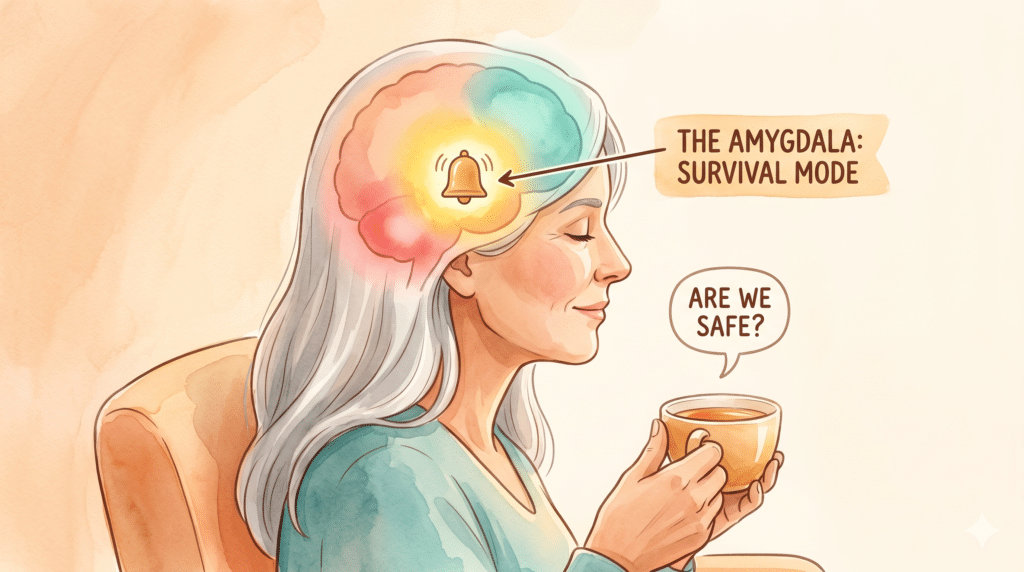
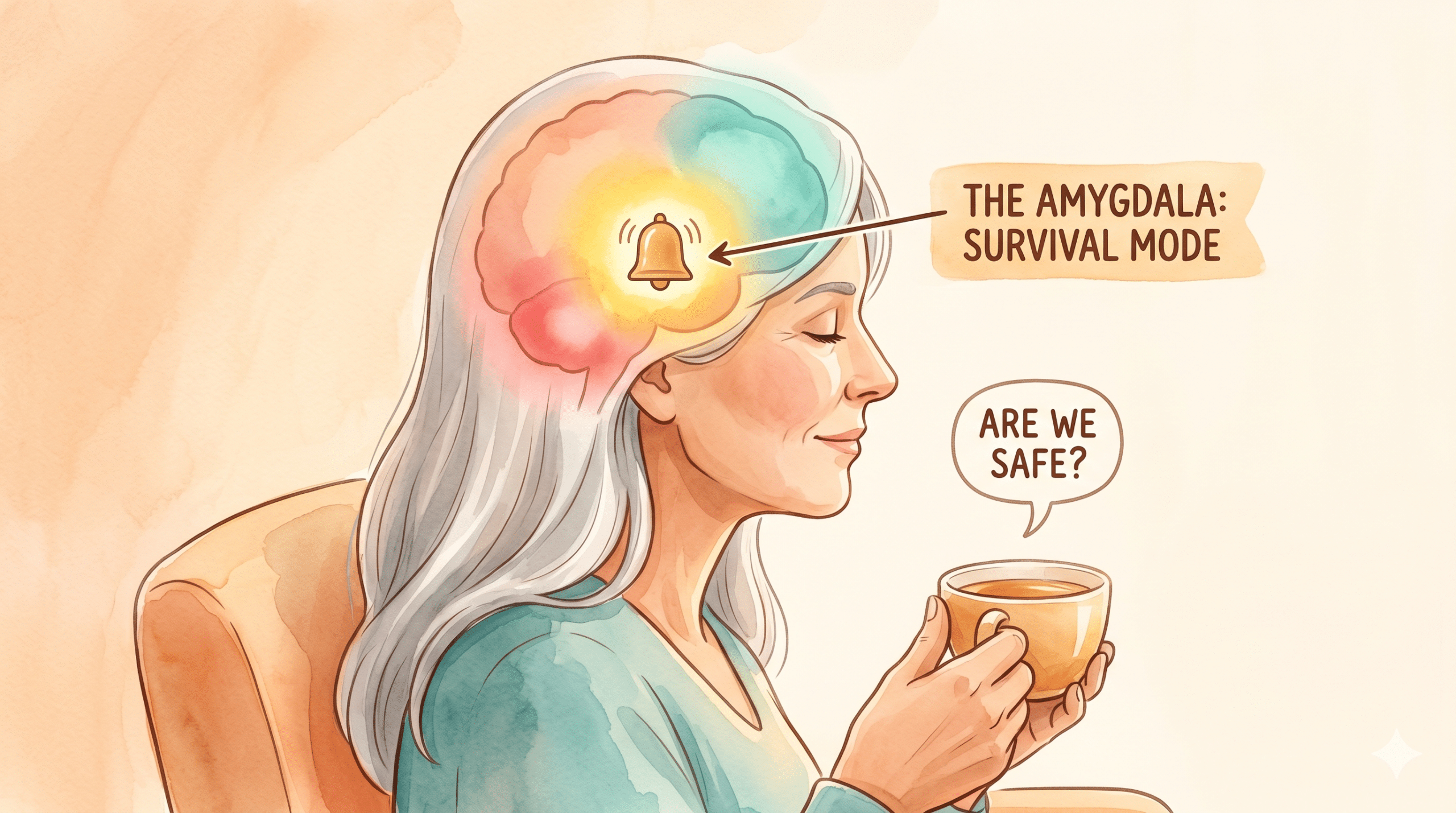
At the center of that mammal brain sits a small, almond-shaped structure called the amygdala. And it is running your show far more than you realize.
The amygdala is not evil. It's not working against you out of spite. It is doing exactly what it was designed to do, scanning your environment, every second of every day, asking one single question: Are we safe?
That's it. That's the whole job description.
The amygdala does not understand your diet plan. It doesn't process “I want to fit into my old jeans by summer.” It doesn't care about calories or macros or metabolic rates. It only speaks one language: threat versus safety. Famine versus abundance. Danger versus calm.
So when you restrict your food, grind through cravings on sheer white-knuckle force, and spike your cortisol by stressing about every meal, your amygdala isn't reading that as discipline. It's reading it as a crisis.
Sound familiar? This is exactly why stress eating isn't a character flaw. When the amygdala detects danger, it drives you toward the most calorie-dense food it can find. That's not weakness. That's a survival program doing its job with terrifying efficiency.
Think about it this way. Imagine you're in a room slowly running out of oxygen. Would you be “greedy” for wanting to breathe? Of course not. You'd be desperate, because your survival depended on it. Your body responds to nutrient restriction the exact same way. Restricting food doesn't tell the amygdala you're being disciplined. It tells the amygdala there's a famine happening right now.
And the amygdala responds to famine by doing one thing above everything else: storing fat.
Trying to override that signal with willpower is like trying to have a calm, polite conversation while the fire alarm is screaming at full volume. The alarm wins. Every time. You don't silence a fire alarm by ignoring it, you deal with the smoke that triggered it.
The Science: The amygdala and limbic system process approximately 11 million bits of sensory and survival information per second. Your conscious, rational prefrontal cortex processes roughly 40 bits per second. Willpower isn't losing the battle because you're weak, it's losing because it is mathematically, neurologically outgunned.
Your Brain's Three-Layer Survival Hierarchy
Your brain prioritizes survival over every other goal, including weight loss. The amygdala sits inside the mammal brain layer and acts as your 24/7 threat detector. When it senses danger, through stress, food restriction, or emotional pain, it activates FAT Programs that make your body hold onto fat more efficiently. No amount of conscious effort can override an active survival signal. The only solution is to address what's triggering the signal in the first place.
This is the insight that changes everything.
You cannot willpower your way past a famine signal. You have to turn the famine signal off.
And that requires a completely different approach than anything you've tried before.
What the Amygdala Is Actually Listening For
Your amygdala doesn't speak English. It doesn't read your food journal, understand your calorie targets, or care that your high school reunion is in six weeks.
It speaks signals.
Right now, in this moment, your amygdala is running a continuous threat assessment. It is scanning your internal environment, your hormones, your stress levels, your nutrient status, your emotional state and asking one question over and over: Are we safe enough to let go of stored fat, or do we need to hold on?
And here's where it gets important. Four specific signals are the loudest things your amygdala hears. If any of them are screaming, the fat stays. Full stop.
Signal One: Cortisol. Cortisol is your primary stress hormone. Under chronic stress, deadlines, relationship tension, financial pressure, even the stress of white-knuckling a diet, cortisol stays elevated. And to your amygdala, elevated cortisol means one thing: danger. It doesn't distinguish between “I'm stressed about a work presentation” and “I'm being chased by a predator.” Chronic stress reads as chronic threat. And chronic threat activates fat storage.
Signal Two: Leptin Resistance. Leptin is the hormone responsible for telling your brain, “We're fed. We're safe. We have enough.” When it's working properly, it's the body's natural off switch for hunger. But when you develop Leptin Resistance, which happens through years of processed food, poor sleep, and chronic inflammation, that message never arrives. Your brain keeps receiving silence where the “I'm full and safe” signal should be. So it keeps the alarm running.
Signal Three: Nutrient Deficiency. This is the one that blindsides most dieters. You can be eating plenty of calories and still be starving at the cellular level. Jon Gabriel calls these MT Calories, food that fills your stomach but delivers almost nothing your cells actually need. When your cells are nutrient-starved, the amygdala hears famine. It doesn't matter what the number on the scale says or how much food you ate today. If your cells aren't nourished, the alarm keeps ringing.
Signal Four: Emotional Safety. This one gets overlooked almost entirely. Unresolved trauma, chronic shame, and persistent anxiety aren't just psychological experiences. They are biological events. Your amygdala processes emotional threat the same way it processes physical threat. If you've been carrying shame about your body for years, if you've been at war with yourself, that is a constant low-grade alarm signal. It keeps the survival system activated.
The Science: When the amygdala detects any of these threat signals, it upregulates the enzymes responsible for fat storage, specifically triggering what Jon Gabriel identifies as the FAT Programs: the Famine Program and the Temperature Program. Your body doesn't just resist fat loss. It actively becomes more efficient at storing fat. The biology is working exactly as designed.
And here is the cruelest part of all of this.
Dieting activates the exact signal it is trying to fight.
Caloric restriction spikes cortisol. It depletes nutrients. It sends a famine signal straight to the amygdala. The amygdala responds by switching the FAT Programs on harder. Your body grips the fat tighter. You try harder. The signal gets louder. The body responds more aggressively.
You were never failing the diet. The diet was triggering your biology to fight you.
The Four Signals That Keep Your Body in Fat-Storage Mode
Your amygdala is listening for these four biological alarm signals. While any one of them is active, fat loss fights an uphill battle, no matter how hard you try or how little you eat.
- Elevated Cortisol: Chronic stress tells your amygdala danger is present, keeping fat-storage hormones switched on.
- Leptin Resistance: When the “I'm full and safe” signal can't reach your brain, hunger and fat storage have no natural off switch.
- MT Calories: Nutrient-empty food starves your cells even when your stomach is full, keeping the famine alarm active.
- Emotional Threat: Unresolved trauma, shame, and chronic anxiety register as biological danger signals, not just mental ones.
The path forward isn't trying harder. It's learning to speak the amygdala's language and turning these signals off one by one.
Want to dive deeper into this approach? Discover how to turn off your body's fat-storage programs for good by joining Jon Gabriel inside the 12-Week Total Transformation Program.