
What if you never had to go back into the pain to finally be free of it?
Maybe you've tried therapy. Maybe you've journaled until your hand cramped. Maybe you've done the affirmations, the breathwork, the deep dives into childhood wounds and you still wake up feeling like something heavy is sitting on your chest.
That's not failure. That's biology.
Here's what most people don't know: trauma doesn't live only in your memories. It lives in your body. In your nervous system. In the hormonal signals your cells are sending, right now, today, based on experiences your conscious mind may have long moved past.
You can intellectually understand your past and still have a body that hasn't gotten the memo.
That's exactly what The Gabriel Method is designed to address. Not by asking you to relive anything. Not by requiring you to excavate old wounds. But by speaking directly to the part of you that stored the pain in the first place, your body, and giving it something it may never have received.
A signal that says: you're safe now. You can let go.
Why Trauma Isn't Just in Your Head But in Your Fat Cells
Most people think of trauma as a psychological problem. Something that lives in memories. Something you talk through with a therapist until it loses its grip.
But here's what the science is starting to confirm and what Jon Gabriel discovered long before it became a mainstream conversation: trauma isn't just stored in your mind. It's stored in your body. In your nervous system. In your hormones. And yes, quite literally, in your fat cells.
This isn't metaphor. This is biology.
When your body perceives a threat, any threat, it triggers a cascade of survival hormones. Cortisol. Adrenaline. The whole fight-or-flight cocktail. And here's the part most people miss: your body doesn't distinguish between a car accident and a harsh comment from a parent when you were nine years old. Both register as danger. Both flip the same switch.
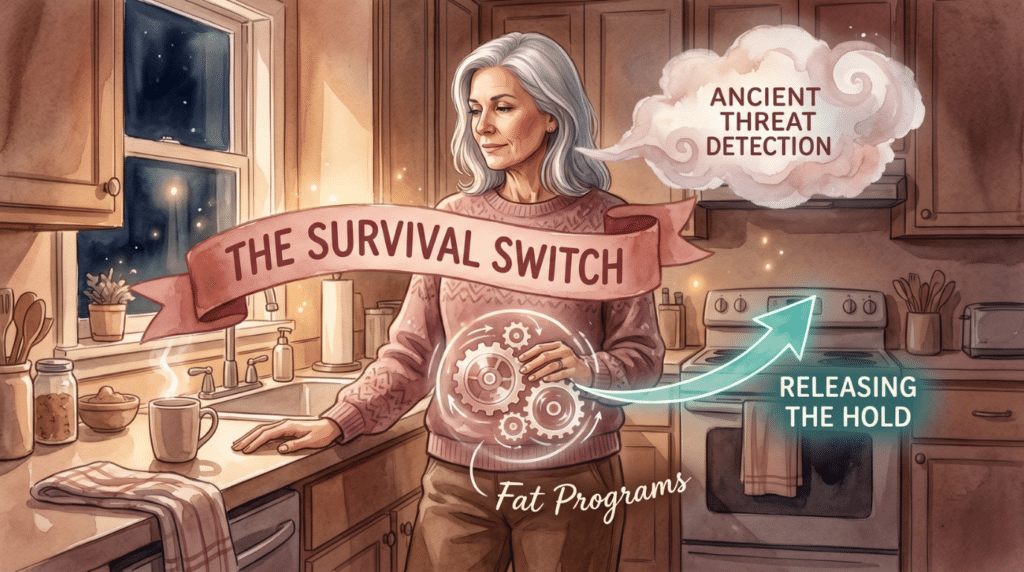
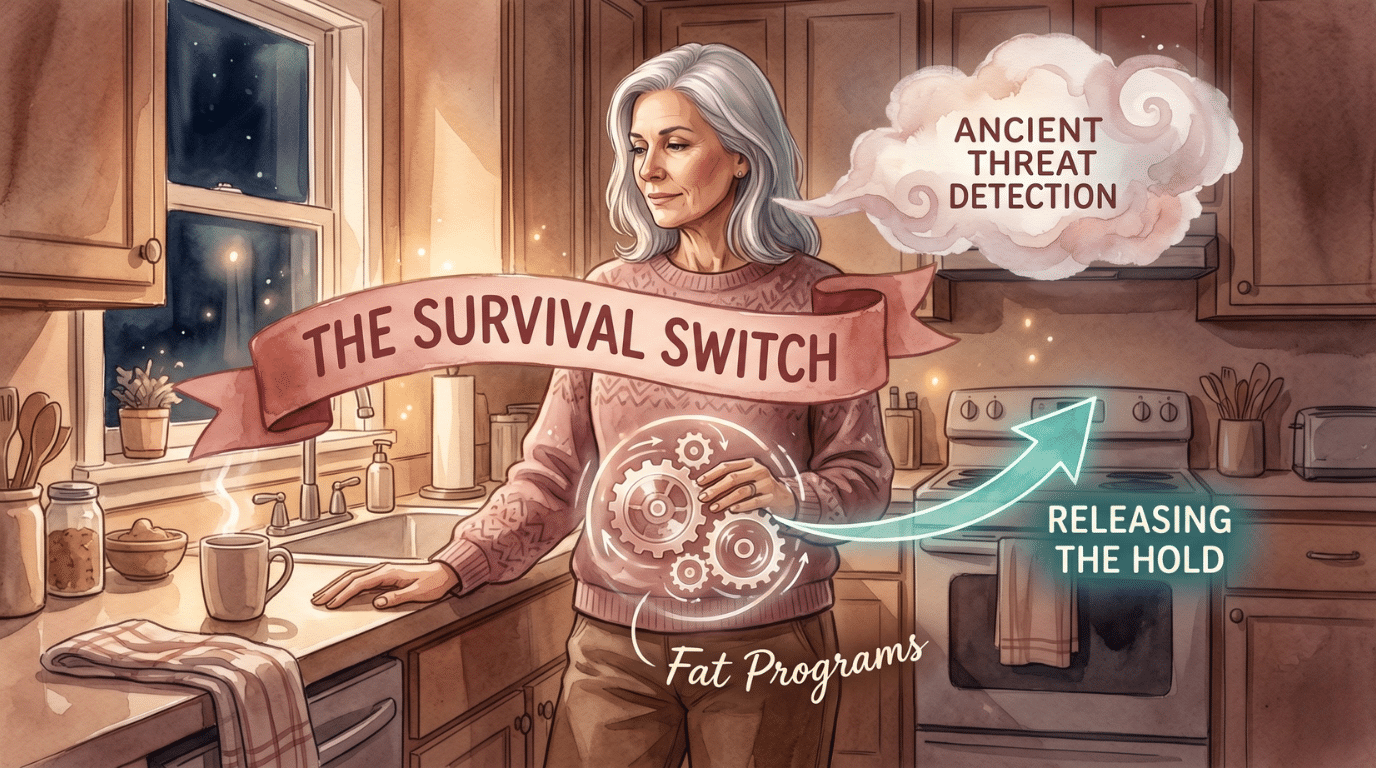
Jon calls these the FAT Programs. Not a judgment, an acronym. Famine and Temperature responses. Ancient survival code built into your nervous system over hundreds of thousands of years. When your animal brain detects a threat, the FAT Programs switch on. Your metabolism slows. Your body starts hoarding energy. It's doing exactly what it was designed to do.
The problem isn't the program. The problem is what happens when the threat never fully resolves.
Think of it this way. Your subconscious, your animal brain, your amygdala, is running a 24/7 threat-detection system. And if it logged a trauma, even decades ago, it keeps sending a low-level danger signal to your metabolism. A quiet, constant whisper: not safe yet. Hold on. Store more. Protect.
This is why some people do everything “right” and still can't shift the weight.
Take Sarah for example. She cleaned up her diet. She exercised consistently. She tracked, measured, and stayed disciplined. And she lost about 30 pounds before hitting a wall she couldn't explain. The last 20 simply would not move. It wasn't until she began working with SMART Mode visualization that something shifted. Without changing her food or her workouts, the weight began to release. Slowly at first. Then steadily.
Her body hadn't been resisting her. It had been protecting her. It just didn't know the danger had passed.
The Science: Fat cells don't just store energy, they store stress hormones. Cortisol and adrenaline can become embedded in adipose tissue, which is why some people experience unexpected emotional releases, sudden tears, shaking, vivid memories — when they begin losing weight rapidly. The fat was quite literally holding the emotion.
Jon knows this firsthand. At his heaviest, he weighed over 400 pounds. And when he finally began to understand his own body, he realized the weight wasn't primarily about food. It was about unresolved stress signals his nervous system had been running for years. Grief. Fear. A deep sense of unsafety that had nothing to do with calories and everything to do with a body trying desperately to survive.
His 220-pound transformation didn't begin with a diet. It began when he stopped fighting his body and started listening to what it was actually trying to say.
The Stress-Fat Storage Loop
Here's how unresolved trauma quietly drives weight retention, even when you're doing everything else right:
Perceived threat (past or present) → cortisol and adrenaline spike → FAT Programs switch ON → metabolism slows, fat storage increases → threat remains unresolved → FAT Programs stay ON indefinitely.
The exit isn't willpower. It isn't a stricter diet. The exit is a safety signal, delivered directly to the body, at the level where the program is actually running.
Here's what this means for you. If you've tried everything and the weight is still holding on, you are not broken. You are not weak. You are not failing.
Your body didn't fail you. It protected you. Now it just needs to know the danger has passed.
And the beautiful thing? You don't have to go back into the pain to give it that signal. You don't have to relive anything. You just have to speak a language your body already understands.
That's exactly what The Gabriel Method is designed to teach you how to do.
What “Unresolved Trauma” Actually Looks Like in the Body
When most people hear the word “trauma,” they picture something dramatic. A car accident. Abuse. A war zone. Something that justifies the weight of the word.
But here's what most people don't know: your nervous system doesn't grade on a curve.
Years of chronic criticism from a parent. Growing up in a home where love felt conditional. The slow, grinding shame of watching the number on the scale go up again after months of trying. Being told, directly or indirectly, that your body was a problem to be solved.
These are what researchers now call small-t traumas. They don't make the headlines. They don't feel “serious enough” to explain why you're still struggling. But they land in the body the same way. They register as threat. And your nervous system files them, quietly, efficiently, as unfinished business.
And then there's the dieting itself.
Every cycle of restricting, losing, and regaining weight is its own form of metabolic trauma. Your body experienced famine, even if it was self-imposed. It panicked. It slowed your metabolism, ramped up hunger hormones, and stored fat more aggressively the moment food became available again. Then you did it again. And again. Each time, your body updated its survival program: restriction is coming. Store more. Hold tighter.
Sound familiar? It's not failure. It's biology doing exactly what it was designed to do.
The Science: Chronic and repeated stress, including the stress of dieting, keeps cortisol elevated. Elevated cortisol signals the body to hold onto fat, particularly around the abdomen, because that stored energy may be needed to survive the next threat. The body cannot distinguish between emotional danger and caloric restriction. Both feel like emergency.
So how does unresolved stress actually show up day to day? Look for these patterns:
- Waking at 2 or 3am, mind already racing, that's cortisol spiking at the wrong time
- A low hum of anxiety that never fully switches off, even when life is “fine”
- Eating perfectly all day, then feeling completely out of control after dinner
- Hitting the same weight plateau, no matter what you try
- Feeling exhausted but wired, depleted but unable to rest
That evening eating pattern especially. Picture a woman who has been disciplined all day, genuinely disciplined. Then 9pm arrives, the house goes quiet, and something shifts. It doesn't feel like a choice. It feels like a switch flips.
Here's what's actually happening: the quietness of evening triggers her nervous system. The stillness feels unfamiliar. Vulnerable. And somewhere in her body's memory, nighttime was a time when she needed to be alert. So her animal brain reaches for the most calorie-dense food it can find, not because she's weak, but because that's what it learned to do when the danger signal fired.
Imagine you're in a sealed room and the oxygen is slowly thinning. You don't decide to panic. Your animal brain takes over and overrides everything else. That's the oxygen analogy in action. You don't choose to overeat at 10pm any more than you'd choose to gasp for air. Your nervous system is running its emergency protocol. The conscious, rational part of you doesn't get a vote.
The FAT Programs, your body's ancient famine and temperature-response code, are not broken. They are working perfectly. The problem isn't the program. It's the signal the program keeps receiving.
And for some people, that signal lingers even longer than it should. Research into the MTHFR genetic variance shows that certain people have a reduced ability to methylate and clear stress hormones from their system. Cortisol and adrenaline don't flush out as efficiently. They stay in the bloodstream, and in the cells, longer. This isn't a character flaw. It's a methylation pathway. And it can actually be supported nutritionally, which is something the Gabriel Method addresses directly through targeted nourishment.
But the first step, always, is simply recognizing what's happening.
Emotional eating isn't a character flaw. It's your nervous system trying to keep you alive using the only tools it knows.
Once you understand that, everything changes. Because you stop fighting yourself. And you start working with your body instead of against it.
Why Therapy Isn't the Only Path And Why Re-Living Can Re-Wound
Let's be clear about something important right from the start.
This is not an argument against therapy. Therapy can be profound, life-changing, and absolutely the right tool for many people. Jon Gabriel himself has spoken about the role of deep inner work in his own 220-pound transformation.
But here's the honest truth that doesn't get said enough: not everyone is ready, resourced, or able to access deep trauma therapy and that doesn't mean they can't heal.
There's also a subtler problem that even well-intentioned approaches can run into.
When you're asked to revisit a painful memory, to tell the story, to describe what happened, to go back in, your brain doesn't always register the difference between remembering and re-experiencing. The nervous system responds to the memory almost the same way it responded to the original event.
Which means, without the right conditions in place, re-telling the story can actually deepen the groove of the trauma rather than release it. You're reinforcing the neural pathway of fear, not filling it in.
It's like trying to erase a chalk line by tracing over it again and again.
The Science: Neuroscience research shows that memory reconsolidation, the process of actually updating a traumatic memory, requires the nervous system to be in a calm, regulated state during the recall. Without that safety signal, the brain files the memory away with the same threat-level tag it had before. The story gets re-stored, not resolved.
The body needs to feel safe in order to release. And sometimes, talking about what made you unsafe doesn't make your body feel safer, at least not right away.
This is where a different approach becomes not just useful, but necessary.
It's called bottom-up healing. And it flips the traditional model entirely.
Instead of working top-down, talk first, insight second, body follows, the protocol starts with the body. Regulate the nervous system first. Give it a genuine, felt sense of safety. Then the mind follows. Insights surface naturally. Emotional releases happen gently. Beliefs begin to shift without you having to force anything open.
The vehicle for all of this is something Jon calls SMART Mode, Super Mental Alert Reeducation Training.
SMART Mode is a specific state of consciousness. It's not sleep. It's not your normal waking awareness. It's the relaxed, receptive space in between, the place where your subconscious becomes accessible and changeable.
Sound familiar? It's the same threshold you cross just before you fall asleep, when the mental chatter fades and something quieter takes over. That state is a doorway.
In SMART Mode, new safety signals can be delivered directly to the part of the brain that's been running the threat program. Not through argument or willpower. Through felt experience.
Top-Down vs. Bottom-Up: The Key Difference
Most approaches to healing work from the mind down. The Gabriel Method works in reverse and that changes everything.
1. Body First: Breath, visualization, and somatic cues regulate the nervous system before anything else is asked of you.
2. Subconscious Access: SMART Mode opens the channel to the part of your brain running the FAT Programs, the part that conscious willpower simply cannot reach.
3. Safety Signal Installation: New signals, calm, safety, abundance, get “written” into the system at the level where the old threat programs live.
Here's why this matters so much for weight specifically.
Your FAT Programs aren't controlled by your conscious mind. You can decide to lose weight a thousand times. But if your subconscious is still running a danger signal, still broadcasting that it's not safe, that resources are scarce, that the threat hasn't passed, it will override every conscious intention you have.
Willpower operates in the prefrontal cortex. The FAT Programs live in the limbic system. You cannot think your way out of a survival program.
But SMART Mode can reach it. Gently. Without re-opening wounds. Without requiring you to go back into the pain.
That's not a shortcut. That's just working with your biology instead of against it.
If you're ready to stop fighting your body and actually start working with it, Jon invites you to experience the complete step-by-step system inside the 12-Week Total Transformation Program.