
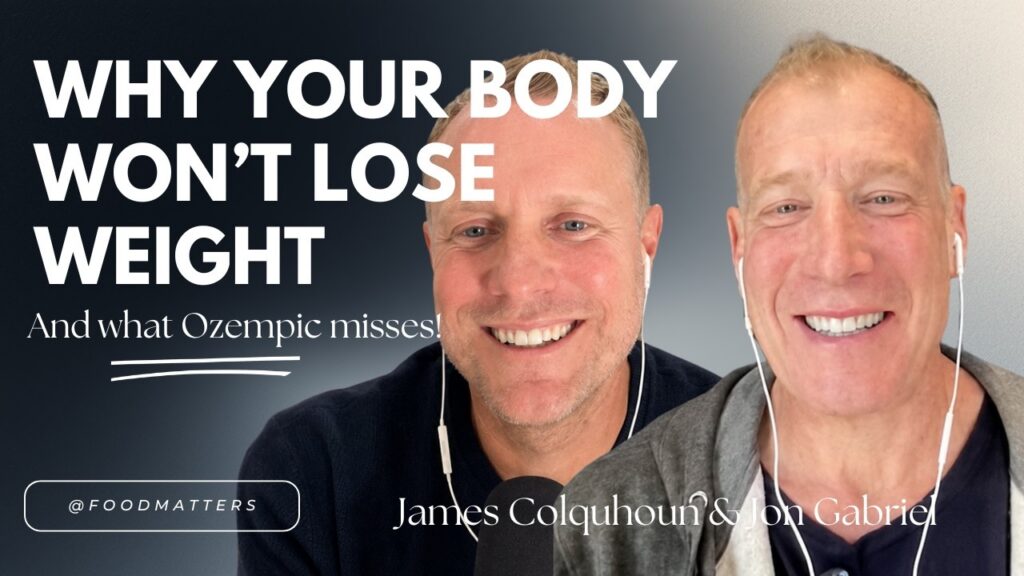
Want to watch the replay with Jon Gabriel and James Colquhoun? Jump straight to the video.
I got a message last week that said something I've heard thousands of times over the years.
"I've done everything right, and it still won't budge."
And then, a little further down, quieter: "I think my body is just broken."
It isn’t.
I want to say that clearly before anything else, because I lived inside that belief for years and it is the single most damaging thing you can believe about yourself.
Your body is not failing at losing weight. Your body is succeeding at something else. It is protecting you, using a survival program that made perfect sense for our ancestors and makes no sense at all in the life you're actually living. Until you find out which program is running, nothing you do on the outside is going to hold.
I'll tell you something now so you know what kind of article this is.
While I was losing the first 100 pounds, I once drove 60 miles to McDonald’s for lunch. 60 miles, there and back, for a burger.
That was how I spent the day.
I'm not proud of it and I'm not going to pretend otherwise. But I want you to sit with it, because it means the thing you think is disqualifying you probably isn't. I wasn't perfect. I wasn't close. And the weight came off anyway, because I'd finally started working on the right problem.
I sat down with James Colquhoun from Food Matters recently and we went deep on the biology of all of this. The conversation is below and I'd encourage you to watch it. But conversations are conversations, and I know what happens after you close the tab. You still have to figure out what to do on Monday.
So this article does the part the conversation couldn't. I'll give you the short version of the biology, then I'll help you work out which of the 5 blockers is yours, and then I'll give you the 4 practices I use myself.
The Question This Article Answers
Because that's the part almost nobody tells you. Everyone says address the root cause. Very few people help you find out which root cause you actually have.
Jump to a section of the conversation:
- 03:36 How I gained over 200 pounds while doing everything right
- 16:07 The stress and inflammation connection
- 21:59 Insulin resistance and leptin resistance, explained simply
- 29:00 What makes a body want to be thin
- 31:49 The 30-second exercise method
- 33:33 Why some people don't feel safe being smaller
- 39:33 What changes after you turn 55
- 43:18 My formula for evaluating any food
- 56:19 What GLP-1 drugs actually do
Disclosure: Jon teaches inside the Food Matters 90-Day Root Cause Healing Program and The Gabriel Method earns a commission if you enroll through the links on this page. We only recommend programs Jon is personally involved with.
The Short Version of the Biology
Every diet I ever tried felt like holding a volleyball under water.
You know what I mean. You push it down, you hold it there, and the second your arm gets tired it fires straight back up. I'd follow the rules to the letter, lose 10 pounds, hit the wall, binge, and a week later I'd be heavier than when I started.
This Wasn't a Discipline Problem
Lose 10, gain 15. Lose 10, gain 15. I scaled my way up like that through the 1990s until I was over 400 pounds.
And here's the thing that used to make me crazy about it.
There is a stereotype that overweight people are lazy and undisciplined. You've heard it. You've probably had it aimed at you, sometimes by a doctor, sometimes by someone who loves you and thought they were helping.
I did triathlons at university. I worked with Dr. Atkins personally. I went to the Pritikin Institute. I was running a Wall Street company at the time, which is not a thing undisciplined people tend to pull off. I followed every program I was given to the letter.
And I went to 400 pounds anyway.
So let me say plainly what 40 years of this industry has been built on. The lie is that your weight is a measure of your character. It is a convenient lie, because it means every failed diet is your fault rather than the diet's. It sells the next program, and the one after that, and it has never once had to answer for the fact that almost nobody keeps the weight off.
Discipline was never what was missing for me. What was missing was that I didn't understand what my body was actually responding to.
Your Body Has 2 Different Stress Programs
Acute Stress
About 30 secondsA tiger appears, you run or you don't make it.
Your body's adaptation is to be lean and fast, because if you're carrying an extra 100 pounds you're just tiger food for the whole family.
The body prioritizes speed.
Chronic Low-Grade Stress
3 or 4 monthsThink of a famine. Months of cold with not much food. You're not going to die today, but you might die in March.
Your body's adaptation is the opposite. Store fat. Get hungry. Slow down. Hold on to everything, because everything you're holding is what gets you to spring.
The body prioritizes survival reserves.
Your Body Reads Chemistry, Not Circumstances
Your body cannot see. It can't peek out through your eyes and check whether there's snow on the ground. All it gets is chemical signals.
The chemical signature of a real famine is very close to the chemical signature of a person worrying about making ends meet, lying awake at 3am, or working a job that never lets up.
So the body reads the signal and runs the famine program. It doesn't matter that there's a supermarket 4 minutes away.
The Biology: Biochemically, the chain looks like this. Chronic stress elevates cortisol. Cortisol tells your cells to stop responding to insulin and to stop responding to leptin. That's insulin resistance and leptin resistance, and all it really means is that a messenger is knocking on the door of the cell and the cell isn't answering.
How the Weight-Resistance Signal Builds
Hormones work like a military. There's a hierarchy. Cortisol outranks insulin, because cortisol is the one that keeps you alive when something is chasing you. So cortisol walks in and says don't listen to him right now, listen to me, we're busy.
When insulin and leptin can't get through, you get hungrier, your metabolism slows, you crave sweets, and you stop registering fullness. Put those together and you become extremely good at storing fat and increasingly unable to burn it.
Why Restriction Backfires
If your body already suspects a famine, and then you go on a restrictive diet, you have just handed it the proof. Now there really is less food coming in.
Your body goes, oh my God, we were right, we need this weight more than ever.
Why Inflammation Matters
Inflammation is the same message wearing different clothes. Think about a house with a leaking faucet in the kitchen. There's water on the floor every morning.
The house isn't falling down, but you're attending to that leak every single day, which means the laundry doesn't get done and the beds don't get made and everything else that keeps the house running gets pushed aside.
That's chronic low-grade inflammation. For a lot of us, dealing with it means holding on to weight.
The Oxygen Analogy
You can eat an enormous amount of food and still be starving.
Imagine you're in a room without much oxygen. You're going to breathe heavily no matter how hard you try not to, because you're taking in plenty of air and not getting what you need from it. Now imagine your doctor tells you to stop breathing so heavily. You could force it for 1 or 2 minutes. Then your body would take over.
That's what eating a standard modern diet does. Lots of food, very little nourishment reaching your cells. And a body that isn't getting nourished at the cellular level is a body that thinks it's in a famine, no matter what the scale says.
All of that is the mechanism. But knowing the mechanism didn't help me until I worked out which version of it was running in me. That took me years, and I want to save you the years.
The 5 Blockers, and How to Tell Which One Is Yours
These are the 5 blockers I look for, in myself and in the people I work with. Read through them and see which ones describe you. Most people find 1 that lands hard, and often a 2nd underneath it.
Your 5-Blocker Quick Scan
Sleep
Unrested mornings, snoring, headaches, or heavy caffeine dependence.
Digestion
Bloating, sluggishness after meals, or hunger returning quickly.
Chronic Stress
Wired at night, exhausted in the morning, and no real off switch.
Emotional Safety
Progress or attention triggers fear, sabotage, or a need to feel protected.
Age-Related Inflammation
After 55, recovery slows and approaches that once worked stop working.
Sleep
You wake up unrested no matter how long you slept. You snore. You get morning headaches. You need caffeine before you feel human. Someone has told you that you stop breathing at night.
Poor sleep raises cortisol, and cortisol drives the insulin and leptin resistance we just talked about. When I finally did a sleep study, I had one of the worst cases of sleep apnea anyone there had seen. And it was a closed loop. The weight of my neck was collapsing my windpipe while I slept, the bad sleep was raising my cortisol, the cortisol was driving cravings and fat storage, and the fat storage was making the apnea worse.
Ask your doctor for a sleep study. I know it's the least exciting item on this list. It is also the one I'd put first, and it's the one most people skip for years.
Digestion
You bloat after meals. You're hungry again 90 minutes later. You feel heavy or sluggish after eating. You've cleaned up your diet and honestly can't tell that it made a difference.
Nutrients that don't reach your cells might as well not have been eaten. This is the oxygen room. Your stomach is full and your cells are starving, so the famine signal keeps running.
Move 1 meal a day to something blended and nutrient dense, so your digestion gets a break and the nutrients actually get through. There's a whole section on how to do this below.
Chronic Stress
Wired at night, exhausted in the morning. No real off switch. Your weight gain started around a life event rather than a change in how you were eating.
This is the famine signature, straight up. My own weight gain started with stress. I was running a company on Wall Street and living at an emotional intensity I couldn't sustain, and my body responded exactly the way it was designed to.
A daily practice. 10 minutes. I've meditated for most of my life and it's the thing I'd give up last.
Emotional Safety
Someone tells you that you look amazing, and that's the week you fall apart. You have a history where being noticed didn't feel safe. Things start working and then you sabotage it without quite knowing why.
Some people don't feel safe being smaller, and there are good reasons for that. It might be a past experience with a predator. It might be that being visible in a marriage feels like a threat to something. For me, I grew up around a lot of physical bullying from bigger kids, and bigger felt safer. Then I ended up in a Wall Street environment that had that same hostile edge to it, and bigger still felt safer.
If that's what's running, no eating plan is going to override it. Your body will protect you and it will win.
I worked with a woman who had 11 children and a life that never stopped, and she could not lose weight no matter what she did. When she finally connected the weight to an abusive experience she'd had, she had a huge cathartic cry, and she went on to lose 110 pounds.
I use a visualization I call safe, strong and protected. You imagine an angel wrapping their wings around you, or a column of light around you, depending on what fits your beliefs. Something powerful that is always there. And you picture the weight melting off you while that protection stays.
Age-Related Inflammation
You're over 55 and everything that used to work has stopped working. Slower recovery. Joint pain. Puffiness. Weight that used to move and now doesn't.
When I turned 55, the rules changed on me and it was humbling. As you get older, your body loses some of its ability to clear out dead, lifeless cells. People call them zombie cells or senescent cells. They sit there pumping out inflammation, your fat cells pump out more inflammation on top of that, and you end up in a cascade you can't seem to get out of.
The good news is that it responds. I'm 62 now and my inflammatory markers are as low as my test could measure. My C-reactive protein came back at 0.1, where someone my age typically sits somewhere between 4 and 5. And when I had my biological age calculated from my bloodwork, it came out at 39.1 years.
I want to be honest that 1 person's bloodwork is not a study. It's 1 person's data. But it's the reason I can lift weights roughly once every 2 weeks at 62 and have my body respond the way it did when I was much younger. Inflammatory hormones suppress the hormones that build muscle and keep your skin elastic. Get the inflammation down and those come back online.
Ask your doctor to include CRP in your next blood panel. It's an ordinary test and it gives you a number to work against instead of a feeling.
If More Than 1 Blocker Fits
Start with sleep. Nothing else on this list responds properly while your sleep is broken. I learned that the hard way.
The 4 Practices
Add before you take anything away
For the first 2 weeks, don't remove a single thing from your diet. Just add.
This sounds too soft to work and it's the most important instruction in this whole article. Taking food away reads as famine. Adding food doesn't. And when you nourish yourself properly, the hunger changes on its own, which means you're not white-knuckling anything.
When I was losing the first 100 pounds, I was still eating junk. I once drove 60 miles to McDonald's for lunch, and I'm not proud of it but I'm not going to pretend otherwise either. What I did alongside it was add. Salads. Smoothies. Super greens. Genuinely nutrient dense things, every day.
What eventually happens is that you'll take a bite of something you used to want and get an instant rejection from your own body. That's when you're home free. Your body is working with you at that point instead of against you.
2 things to look for when you're choosing what to add:
Super greens where the grasses have been juiced. Go outside and try to eat grass. You can't. And if you can't eat grass in grass form, you can't eat it in powdered form either. That's why most green powders taste terrible and make you burp and feel nauseous. The good ones juice the grasses first, which means you're consuming the juice as a powder rather than the plant fibre.
Protein from sprouted nuts and seeds. A seed is designed not to be digested. That's the whole point of it. A bird eats an apple, the seed passes through undigested because it's full of enzyme inhibitors, and that's how the tree reproduces. So if you're eating seeds in any form, they need to be sprouted first or you're fighting the plant's design.
The 30-Second Exercise Reset
This is the one I'd most like you to take away, because it takes almost no time and most people have never heard it.
Stop thinking about exercise as calories in and calories out. Start thinking about it as a way to create a hormonal experience that tells your body which shape keeps you alive.
Here's how I do it:
- Warm up for 2 or 3 minutes. A bike, a walk, whatever you have.
- Sprint as hard as you can for 5 to 10 seconds.
- While you're sprinting, hold an image. You can imagine you're running from something, though for some people that's too stressful, so instead imagine you're running after food and you need to be fast to eat. Or just imagine you're in the best shape of your life and you're moving effortlessly and having fun with it.
- Recover completely.
- Repeat 2 or 3 times.
That's it. Under a minute of actual work.
Your brain doesn't fully distinguish between a real and an imagined experience, so the sprint plus the image sends a clear message: we move fast, we need to be lean, adjust accordingly. I told Dr. Mercola about this years ago and he does it every morning on the beach.
For some people, myself included, an hour on a treadmill would work against you. This won't.
Use the formula instead of a food list
People ask me constantly whether a food is good or bad. Is fat good or bad. Is halloumi good or bad. The answer is neither, and once you see why, you'll never need a food list again.
The benefit of what you're eating = (nutrient density × bioavailability × digestibility) ÷ toxins
Nutrient density alone isn't enough. Wheatgrass is dense with nutrients you cannot extract. If it isn't bioavailable it isn't doing anything for you.
Take halloumi. Store-bought halloumi starts as pasteurized cheese, and any processing makes a food less digestible by design, because the entire purpose of processing is to stop it breaking down. Then it's very salty, usually with table salt. Then you grill it in vegetable oil, which is processed and inflammatory. 3 decisions in and you've got something that causes an inflammatory response, and none of it is the halloumi's fault.
Now make it from raw cheese, salt it with a Himalayan or volcanic salt so you're getting trace minerals, and grill it in butter, ghee, tallow or coconut oil, fats that don't get corrupted at high temperatures. Same food. Completely different information going into your body.
Because that's what food is. It isn't calories and it isn't macros. It's information.
Give your digestion a rest
This is where everything I've learned in the last few years has landed.
2 Different Jobs for Your Digestive System
Why Digestion Becomes the Bottleneck
If your digestion is inflamed, and mine was for years, then even good food is a burden. Take a bite of a burger and you've got a solid mass that has to be broken down, starting in a stomach that probably isn't producing enough acid, especially as you get older. Eat it with bread, which is alkaline, and the little acid you are producing gets neutralized. Now it's just sitting there, and you haven't even reached the rest of digestion yet.
So the foods I eat now are chosen to be as digestion friendly as possible. Most of them are in some kind of liquid form. Super greens, sprouted protein, blended fruit. Nutritionally dense, highly bioavailable, and requiring almost nothing from my digestion.
The Frozen Fruit Workaround
Here's the trick I stumbled into. If you get the proportions right with enough frozen fruit, that mixture comes out of the blender at the consistency of a Wendy's Frosty. Thick enough to eat with a spoon, still liquid by the time it hits your stomach. Run it through a Ninja Creami and it becomes scoopable ice cream.
So my son, who is 10 and who I have to get on my hands and knees to beg to eat a vegetable, gets angry at me if I pick him up from school without a thermos of mango ice cream. And it's honestly the healthiest thing he eats all day. You can see it in how he moves.
What Changes When Cells Get Fed
That's the whole reason I wrote Eat Ice Cream Lose Weight. It's not a gimmick. It's a workaround for the exact problem that keeps most people stuck.
I'm never hungry now, and I eat far less than I used to. Not because I'm disciplined about it. Because my cells are actually getting fed.
What GLP-1 Drugs Don't Fix
I get asked about Ozempic constantly, so let me explain what these drugs are actually doing, and let me be fair about it.
First, where they sit in the story. Every generation gets a version of the same promise, and the promise is always that the problem is your appetite. Amphetamines in the 1950s. Fen-phen in the 1990s. Stomach stapling. Now this. The tool changes and the assumption underneath never does, which is that if we could just get you to want less food, the problem would be solved.
That assumption is the lie I was talking about earlier, wearing a lab coat. Your hunger was never the problem. Your hunger is a readout. It's your body telling you what it thinks it's living through.
Now to the drug itself.
GLP-1 drugs like semaglutide are shaped similarly to glucagon-like peptide 1, a hormone your body already makes. They're not GLP-1. They're shaped enough like it that the cells looking for that shape respond as though the real thing showed up. And one of the messages GLP-1 carries is that you've had enough to eat.
Your own GLP-1 clears out of your body in about 2 minutes. These are designed to stay for a long time. So you get that message continuously.
Now, anytime you flood the body with a message, the body adapts. 2 ways.
First, it produces less of its own. In the 1960s and 1970s, bodybuilders started taking testosterone and it worked, their muscles grew. What they discovered is that their bodies stopped producing testosterone on their own. So they had to cycle on and off and on and off.
Second, and this is the one I think matters more, the receptors themselves become desensitized. Go to a loud concert and you can't hear properly afterwards, because the cells in your ears have protected themselves. Play guitar long enough and you lose sensitivity in your fingertips, because you've built calluses. Receptor cells do the same thing when they're overstimulated.
So my concern, and I want to be clear that this is my reasoning as a biochemist looking at how the body behaves, is that you can end up on both ends of the problem. Producing less of the signal, and hearing less of it. Which is precisely the shape of insulin resistance and leptin resistance.
What I do know is that people report getting hungry when they come off, and that a lot of people regain the weight. And the reason usually given is the one I'd give too. The set point was never addressed. So the set point is still there, waiting, exactly where it was.
There's also something you can see on people's faces. Muscle loss, skin that starts to slide. That fits the mechanism. If your inflammation hasn't come down, your body still isn't producing the hormones that build muscle or keep elastin in your skin. You're just not hungry. So you get all the damaging effects of the inflammation while eating less.
Here's the honest version of my position. I understand the appeal completely. I want instant results and I don't want to do anything either. Nobody has to defend that to me.
What the Drug Does Not Address
But I am not telling you to stop taking anything. If you're on a GLP-1, that is a conversation for you and your prescriber and nobody else. What I'm telling you is that whichever of those 5 blockers is yours, the drug isn't touching it. So it will still be there afterwards.
Your 1st Week
Your 7-Day Starting Plan
Go back through the 5 blockers and name yours. Just 1 to start. If more than 1 fits, take sleep.
Book the appointment your blocker calls for. The sleep study. The blood panel with CRP on it. Make the call.
Add 1 nutrient-dense thing every day, and take nothing away.
Do the 30-second sprint. Sit for 10 minutes a day.
And one last thing, because I don't want you measuring the wrong thing.
Don't weigh yourself this week. What moves first is your energy, your sleep, and how hungry you are between meals. Those are the signals telling you the chemistry is shifting. The weight follows the chemistry. It has always worked in that order, for me and for everyone I've worked with, and it never works the other way around.
One more thing before you go.
If you know someone who has tried everything and been told they just need to try harder, send this to them. That sentence has done more damage to more good people than any food ever has, and they may have been carrying it for 30 years without anyone telling them it was false.
Frequently Asked Questions
How do I know which root cause is mine?
Work through the 5 blockers above and see which set of signs describes your actual daily experience. Most people recognize themselves in one immediately. If several fit, start with sleep, because the others don’t respond properly while your sleep is disrupted.
What if I want help working through this properly?
I teach the weight release module inside the Food Matters 90-Day Root Cause Healing Program, which takes you through gut, hormones, sleep, nervous system and inflammation as a sequence rather than a pile of information. It includes a 1-on-1 call at the start to work out where your body should begin, live monthly coaching, and an internationally accredited certification at the end if you want it. Details here.
Why do I gain the weight back after every diet?
Because a restrictive diet confirms the famine your body already suspects. You lose weight in the short term, your body doubles down on its survival response, and the weight comes back with interest. The rebound isn’t a failure of willpower. It’s the program working correctly.
What is a weight set point?
It’s the weight your body is actively defending. When your set point is high, your body will use hunger, fatigue and a slowed metabolism to bring you back up to it. Change the signals your body is reading and the set point moves.
Can stress alone cause weight gain?
Yes. Chronic stress elevates cortisol, cortisol drives insulin and leptin resistance, and that combination produces hunger, cravings, a slower metabolism and blunted fullness signals. My own weight gain started with stress before anything about my diet changed.
Does Ozempic address the root cause?
No. It suppresses appetite by mimicking a hormone. Whatever is driving your set point up is still driving it up while you’re on the medication. That’s the most common explanation for why weight tends to return afterwards.
Should I stop taking my GLP-1?
That decision belongs to you and your prescribing doctor. Nothing here is medical advice and nobody should change medication based on an article. What you can do in the meantime is start addressing the underlying blocker, so there’s something in place if and when you do come off.
Is fasting safe?
When I did my 21-day water fast I saw a doctor every single day, and that was on Dr. Fuhrman’s explicit instruction. Fasting is not something to improvise. If you’re interested in it, do it with medical supervision, and don’t start there anyway. Start by adding.
Why did weight loss get harder after 55?
Your body becomes less efficient at clearing out senescent cells, and those cells generate inflammation continuously. Add the inflammation from fat cells and you get a cascade that’s hard to interrupt. The approach is the same, the inflammation just needs more direct attention.
Do I have to give up the foods I love?
No, and please don’t try to at the start. Add first. What tends to happen is that once your cells are properly nourished, you take a bite of something you used to want and your body rejects it on its own. That shift is worth waiting for. It holds, and forcing it never does.
About Jon Gabriel
Jon Gabriel lost more than 220 pounds without dieting, pills or surgery, and has kept it off for over 20 years. He holds a bachelor of science in economics from the Wharton School at the University of Pennsylvania, where he also completed extensive coursework in biochemistry and performed research for the biochemist Dr. Jose Rabinowitz.
He is the author of The Gabriel Method, an international bestseller translated into 16 languages and sold in 60 countries, along with Visualization for Weight Loss, Fit Kids Revolution and Eat Ice Cream Lose Weight. He has been featured in the documentaries Hungry for Change and Transcendence.
This article is for educational purposes and is not medical advice. It does not replace a relationship with your doctor. Speak with a qualified physician before making changes to your diet, before fasting, and before making any change to prescribed medication.
Adapted from a Food Matters Live conversation between Jon Gabriel and James Colquhoun.