
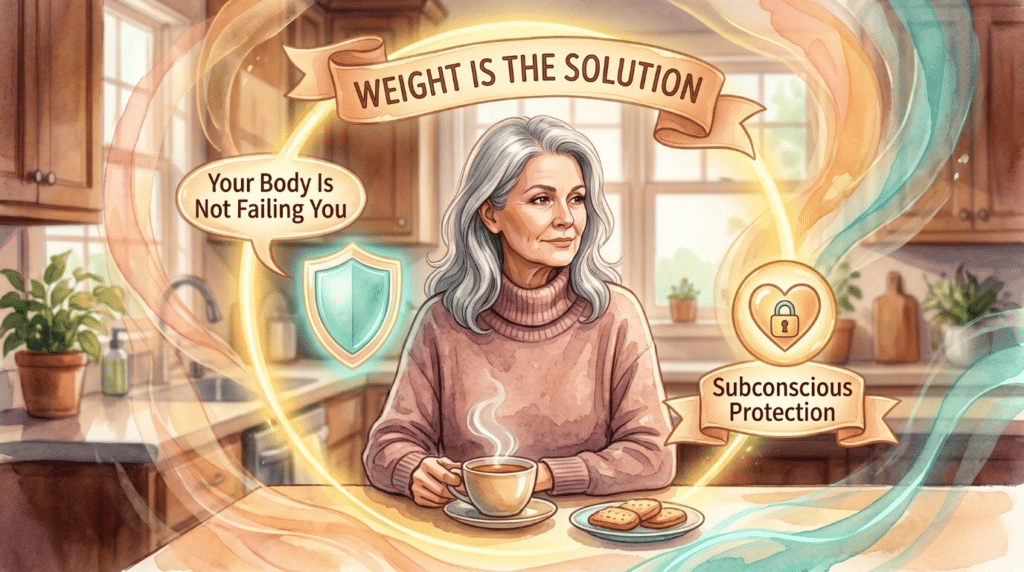
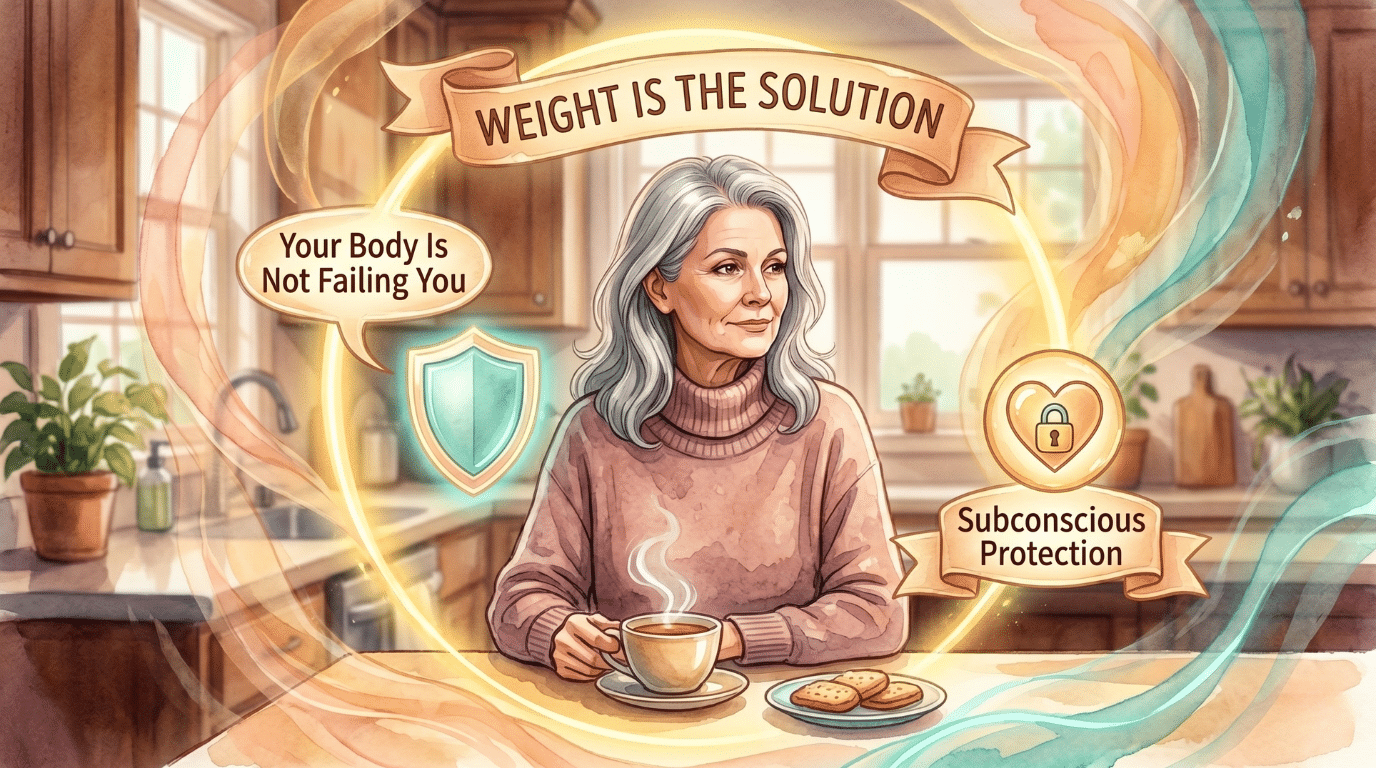
You are not lazy. You are not broken. You do not have a willpower problem.
That story you’ve been telling yourself, the one where you just need more discipline, more motivation, or better genes, it’s not true. And deep down, some part of you has always known that.
Here’s what nobody is telling you: your body is not failing you. It is protecting you.
Right now. On purpose. With everything it has.
Your body is one of the most sophisticated survival systems ever created. It has kept human beings alive through ice ages, famines, wars, and unimaginable loss. It does not make random mistakes. When it holds onto weight, there is a reason.
The weight is not the problem. The weight is the solution.
A solution to something your subconscious believes is threatening your survival. Something it learned, maybe a long time ago, that being smaller, more visible, or more successful in the world is somehow dangerous.
Sound familiar? Maybe not consciously. But somewhere underneath the diets and the guilt and the exhaustion, something in you just exhaled.
That exhale matters. That’s where we start.
The Weight Is a Message, Not a Mistake
Jon Gabriel lost over 220 pounds without dieting, because he stopped fighting his body and started listening to it. The first thing he discovered: his body was holding weight for a reason. Finding that reason changed everything.
You Haven’t Failed. Your Body Has Been Succeeding.
You tracked every calorie. You dragged yourself to the gym when you were exhausted. You said no to the birthday cake, the office donuts, the glass of wine on Friday night.
And the scale didn’t move.
Or it did move… up.
So you did what most people do. You looked in the mirror and told yourself a story. You called yourself lazy. Weak. Undisciplined. You figured that other people can do this, so the problem must be you.
Sound familiar?
That story is wrong. And it has been costing you everything.
Here’s what nobody in the diet industry is telling you: your body is not broken. It is not betraying you. It is not working against you.
It is protecting you.
Think about that for a moment. Every time the scale refused to budge, every time you felt like your body was fighting your best efforts, it wasn’t sabotage. It was loyalty. Your body was doing exactly what it was built to do.
Meet Sarah.
Sarah has been “struggling with her weight” for twenty years. She’s done every diet, low carb, low fat, high protein, the one with the shakes, the one with the points. She exercises. She sees her doctor. She is not lazy. She is exhausted.
But something in her doesn’t want to change. Something keeps pulling her back.
For years, she called that something weakness. A lack of willpower. A character flaw she couldn’t fix.
It wasn’t any of those things. It was wisdom. A very old, very scared kind of wisdom.
The Science: Your body carries biological survival programs, sometimes called FAT Programs, inherited over hundreds of thousands of years of human evolution. These programs were designed to protect your ancestors from famine, extreme cold, and physical danger. When your brain perceives a threat, any threat, these programs can switch on and instruct your body to store fat, conserve energy, and hold on for dear life.
Here’s the part that changes everything: your subconscious beliefs are one of the most powerful triggers for these programs.
Your environment activates them. Your stress activates them. And the stories you carry, the ones you may not even know you’re telling yourself, can activate them just as powerfully as a real famine ever could.
Your body cannot tell the difference between a physical threat and an emotional one. It only knows one thing: danger is danger.
So when your body holds onto weight, it is not failing you. It is doing its job with absolute precision. It believes it needs the weight. It believes the weight is keeping you safe.
The question, the one that unlocks everything, is this:
What does your subconscious believe the fat is protecting you from?
What Are FAT Programs?
FAT stands for Famine and Temperature. These are ancient biological survival programs hardwired into your nervous system. When your brain detects a threat, whether it’s starvation, extreme cold, chronic stress, or a deeply held subconscious fear, these programs activate automatically. They slow your metabolism, increase fat storage, and make your body resistant to change. They were lifesaving tools for your ancestors. But when they’re triggered by modern stress and buried emotional beliefs, they become the invisible wall standing between you and the body you want.
You are not the problem.
You never were.
The program running in the background, the one you didn’t know was there, that’s what we need to talk about.
Meet Your Subconscious Bodyguard
Deep inside your brain, there is a part of you that has one job.
Not to make you happy. Not to make you thin. Not to help you fit into those jeans by summer.
Its job is to keep you alive.
This is your animal brain. The oldest, most primitive part of your neurology, the amygdala and the limbic system, and it has been doing this job since long before language existed. It doesn’t think in words. It thinks in feelings. In impulses. In sudden waves of anxiety you can’t explain, in cravings that hit out of nowhere, in an inexplicable resistance every time you get close to your goal weight.
It is constantly scanning. Constantly asking one question: Are we safe?
Here’s the thing nobody tells you.
This part of your brain does not know what year it is. It doesn’t know that the danger is over. It doesn’t know that the person who hurt you is gone, that you are no longer that child, that the world you live in now is fundamentally different from the world where it learned its lessons.
It only knows what it was taught. And it acts on that information every single day.
The Science: The amygdala processes emotional memory and threat response faster than the conscious mind can intervene, often triggering survival behaviors like fat storage, food-seeking, and stress eating before your rational brain even registers what’s happening. This is not a willpower problem. It is a wiring problem.
So here’s the subconscious logic, laid out plainly:
If being smaller, more visible, more attractive, or more successful once led to pain, then your animal brain will do everything in its power to stop you from becoming those things again.
That is your subconscious bodyguard.
It is not trying to ruin your life. It is trying to save it. It’s just working from a memo that’s twenty, thirty, maybe forty years out of date.
Think of it this way. Imagine a night watchman who was hired during a crisis, a real emergency, a time when locking the doors and keeping everyone inside was exactly the right call. He did his job brilliantly. He kept everyone safe.
But nobody ever told him the crisis was over.
So he’s still there. Still locking the doors every night. Still keeping the windows shut. Still running the same protocols, because as far as he knows, the danger is still real. He’s not malfunctioning. He’s not your enemy. He is the most loyal employee you have. He just desperately needs a new briefing.
Your subconscious is that night watchman.
And the only way to update his information, the only way to hand him that new briefing, is to speak to him in a language he actually understands. Not logic. Not willpower. Not another diet plan.
The animal brain speaks in imagery, emotion, and sensation. And that is exactly what visualization delivers.
What Is SMART Mode?
SMART stands for Super Mental Alert Reeducation Training. It is a deeply relaxed, highly focused state, similar to meditation or hypnosis, in which the subconscious mind becomes genuinely receptive to new information. Your conscious defenses soften. The front door opens. And for the first time, you can walk directly into the room where your animal brain is running the show and hand it a completely different set of instructions. Think of SMART Mode as the software update your bodyguard has been waiting for. The crisis briefing that finally says: it’s safe now. You can open the windows.
This is not magic. This is not positive thinking.
This is neuroscience. This is working with the brain instead of fighting against it.
And once you understand that your subconscious bodyguard is the one running your weight, not your fork, not your willpower, not your metabolism, everything starts to make a different kind of sense.
The Four Beliefs That Make Your Body Hold On
Your subconscious is not random. It is not chaotic. It is running a very specific program, based on very specific conclusions it drew, usually a long time ago.
And when it comes to weight, those conclusions almost always sound like one of these four things.
Read them slowly. Not as a checklist. As a mirror.
1. “If I’m attractive, I’ll be targeted.”
This one lives in the body of survivors. Of assault. Of harassment. Of violation in any of its forms.
The subconscious is nothing if not logical. It watched what happened. It connected the dots. Your body drew attention. The attention led to harm. So the solution, from the animal brain’s perspective, is devastatingly simple: change the body. Make it less visible. Make it safer.
The weight becomes armor. Not metaphorical armor. Actual, physical armor that your nervous system is actively maintaining because it believes, at its deepest level, that your survival depends on it.
If this one lands for you, please hear this: what happened to you was never your body’s fault. But your body has been trying to protect you ever since. That’s not broken. That’s loyal.
2. “If I succeed, people will expect too much and I’ll fail publicly.”
This one is quieter. Sneakier. It doesn’t show up as fear. It shows up as self-sabotage that you can’t quite explain.
Maybe early in your life, you achieved something. You were praised. The bar was raised. And then you fell short and the shame that followed was devastating. Your subconscious filed that away immediately.
Being visible invites expectations. Expectations invite failure. Failure invites humiliation.
So the safest thing, the kindest thing your animal brain knows how to do, is keep you small. Keep you under the radar. If no one expects much, no one can be disappointed.
The weight keeps the expectations manageable. It keeps you safely invisible. And it costs you everything.
The Science: Research in psychoneuroimmunology shows that the brain cannot distinguish between physical threats and social threats, humiliation and physical danger activate the same survival circuitry. Your subconscious is not being dramatic. It is being precise.
3. “If I’m healthy and happy, someone will take it away.”
This belief grows in unpredictable environments. Volatile households. Sudden losses. Childhoods where good things had a way of disappearing without warning.
The subconscious learns the cruelest lesson: don’t get comfortable. Don’t let yourself have good things. Because when they’re gone, it will hurt worse.
So it pre-empts the loss. It quietly dismantles your progress before anyone else can. The weight becomes a way of arriving at the disappointment on your own terms, before life gets there first.
Sound familiar? You get close to your goal and something always seems to pull you back. That’s not weakness. That’s a protection strategy.
4. “I don’t deserve to be well.”
This is the one nobody wants to say out loud.
It’s the quietest belief of all four. And often the most deeply rooted.
It comes from years, sometimes decades, of absorbing messages that said: you are too much. You are not enough. You do not get to have this. Those messages came from parents, from culture, from religion, from people who were supposed to protect you and didn’t.
You may not consciously believe it anymore. But your subconscious received those messages like instructions. And it has been following them ever since, with ruthless, tireless efficiency.
Which Belief Is Running Your Body?
Most people carry more than one of these beliefs at the same time. They layer. They reinforce each other. And they operate completely below your conscious awareness, which is exactly why willpower, calorie counting, and discipline will never be enough to override them. You cannot out-discipline a subconscious survival program. You have to update the program itself.
Here is the most important thing to understand about all four of these beliefs:
None of them are true.
They were never facts. They were conclusions, drawn by a younger, more vulnerable version of you, doing the best they could with the information and the pain they had at the time.
They were survival strategies. And they worked. They got you here.
But you don’t need them anymore. And recognizing yourself in one of these beliefs is not a wound reopening.
It is a door opening.
That’s where everything changes.
If you’re ready to stop fighting your body and actually start working with it, Jon Gabriel would like to invite you to experience the complete step-by-step system inside the 12-Week Total Transformation Program.