
Your brain doesn't go quiet when you fall asleep. It gets to work.
Most people treat sleep like a daily timeout. You close your eyes, the lights go out, and nothing much happens until morning. But that's not what's going on inside your brain at all. While you're asleep, your mind is sorting, filing, rehearsing, and literally rewiring itself based on the emotional content you fed it before you drifted off.
Maybe you've tried visualization before. You sat at your desk, closed your eyes for a few minutes between meetings, pictured yourself thinner, healthier, more confident and felt absolutely nothing. No shift. No spark. Just a mild sense of embarrassment for trying.
That feeling is valid. And here's the thing: the visualization wasn't the problem. The timing was.
Visualization isn't just a mindset tool you pull out when you need a motivational boost. It's a biological process. And your brain has a specific window, a specific sleep phase, where it is literally designed to receive new patterns and rehearse them as reality.
In this post, you're going to learn exactly when that window opens, why your brain responds to it so powerfully, and how you can use it tonight.
Sleep Is an Active Biological Process
Far from being downtime, sleep is when your brain consolidates memories, strips emotion from stress, rehearses future scenarios, and decides which patterns to reinforce. What you feed your mind right before sleep becomes the raw material for all of it.
You're Not “Just Daydreaming”, You're Sending Signals to Your Survival Brain
Let's be honest. If you've ever rolled your eyes at the idea of visualization, you're in good company.
You've probably been told to “think positive” at some point in your life. Maybe multiple times. And if thinking positive actually worked the way people claimed, you wouldn't be here reading this.
That skepticism? It's completely earned. And this isn't that.
This isn't positive thinking. This is signal biology.
Here's what's actually happening inside your body every moment of every day. Your brain is running a constant, automatic scan of your environment, internal and external, asking one fundamental question: Am I safe right now?
Every thought you think, every image you hold in your mind, every story you repeat to yourself, your brain runs it through that filter. Is this a threat? Is this real? Should I be storing energy right now, or releasing it?
This is where the FAT Programs come in.
Your body carries ancient survival software that has been running in the background since the dawn of human existence. This software was built for one purpose: keeping you alive during famines, droughts, extreme cold, and predator attacks. When it detects a threat, real or imagined, it flips a switch. It tells your body to hold onto fat, slow your metabolism, and conserve every calorie it can.
The problem? Your survival brain doesn't know the difference between a genuine threat and a stressful thought. It responds to imagined danger the same way it responds to real danger.
The Science: Brain imaging studies consistently show that visualizing an action activates the same neural pathways as physically performing that action. To your nervous system, a vivid mental image isn't just a thought, it's a signal.
Your brain cannot fully distinguish between a vividly imagined experience and a real one. This is not a metaphor. This is neuroscience.
Think about what that means. If you spend your days replaying stress, imagining worst-case scenarios, or seeing yourself as someone who will always struggle with their weight, your brain treats those images as data. Real data. And it responds accordingly.
This is exactly what Jon Gabriel lived for years at 400 pounds. It wasn't a lack of willpower. It wasn't laziness. His brain was running a survival program that had decided, at a deep biological level, that being large meant being safe. No diet could override that program, because no diet was speaking the right language.
Visualization was the tool that finally did.
When you visualize deliberately, with clarity, emotion, and consistency, you're doing three specific things at a biological level:
- Activating the same neural pathways as the behaviors and identity you're imagining
- Sending safety signals to your survival brain, telling it the threat is gone
- Beginning to overwrite the FAT Programs with a new set of instructions
There's a specific brain state where those new instructions land the deepest. Where your subconscious becomes most open, most receptive, and least defended. Jon calls it SMART Mode, Super Mental Alert Reeducation Training.
We'll get into exactly what that is. But first, consider this:
If visualization is a biological signal, and your brain has a dedicated state where it processes those signals most deeply, when do you think the best time to send them actually is?
How the FAT Programs Work Against You
Your body's survival software doesn't respond to logic, it responds to signals. Chronic stress, negative self-talk, and fear-based thinking all register as threat signals, keeping your FAT Programs switched on. Deliberate visualization works because it sends the opposite signal: safety. And when your survival brain finally believes you're safe, it stops holding on for dear life.
What Actually Happens in Your Brain While You Sleep
Here's something most people never learn in school: sleep is not one thing.
It's not just you lying there, unconscious, waiting for the alarm to go off. Your brain is cycling through completely different phases all night long and each phase has a radically different job to do.
Understanding this changes everything about how you think about visualization.
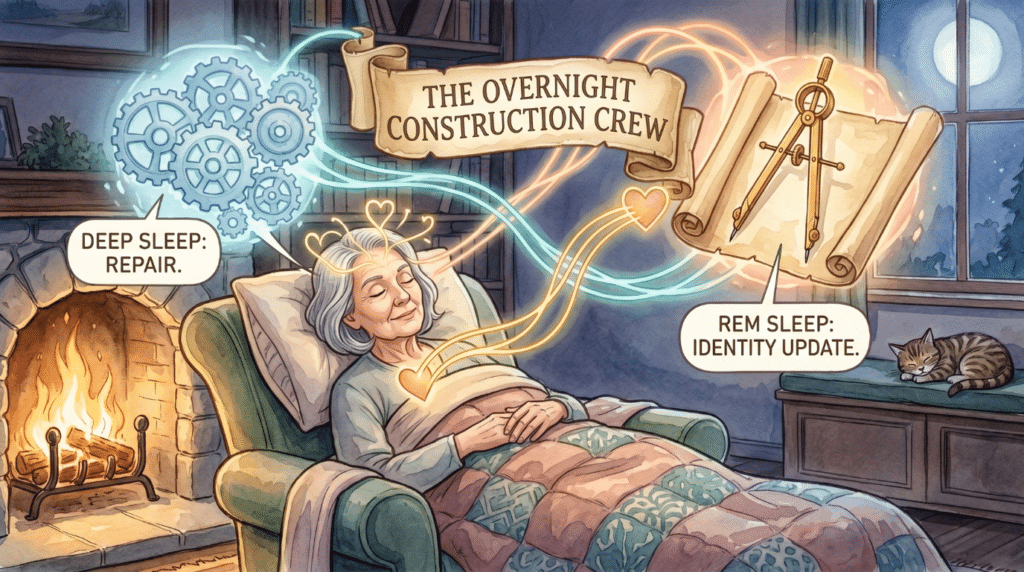
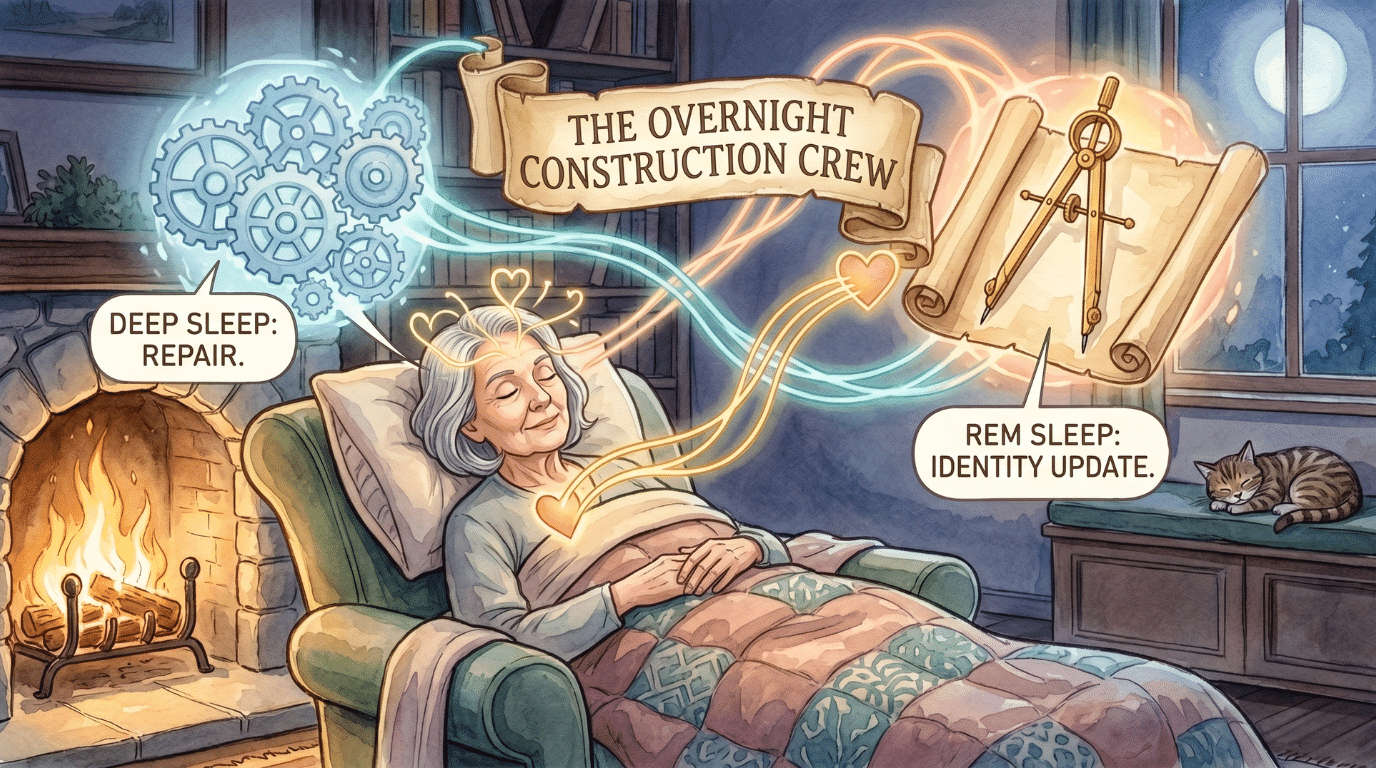
Phase One: Your Body's Maintenance Crew
The first major phase is deep sleep, also called slow-wave sleep. This is your body's physical repair window.
During deep sleep, your body releases growth hormone, rebuilds muscle tissue, clears out metabolic waste, and handles all the biological housekeeping it couldn't do while you were busy being alive. Think of it as the maintenance crew coming in after hours, fixing the pipes, repainting the walls, making sure the whole building holds together.
This phase is critical. But it's not the phase we're here to talk about.
Phase Two: The Architect Takes Over
The second major phase is REM sleep, Rapid Eye Movement. And this is where things get fascinating.
If deep sleep is the maintenance crew, REM sleep is the architect. It's not fixing what already exists. It's looking at the blueprints and deciding what the building is going to become.
During REM, your brain is doing something extraordinary. Here's what's actually happening:
- It replays experiences from the day, especially the emotionally charged ones
- It strips the raw emotion from difficult memories, which is why sleep genuinely helps with grief, stress, and anxiety
- It rehearses new behaviors and future scenarios, almost like a dress rehearsal
- It integrates new information into long-term memory and into your sense of identity
Read that last one again. Into your sense of identity.
The Science: During REM sleep, your brain's hippocampus and amygdala work together to consolidate emotionally significant experiences into long-term memory, effectively “updating” your self-concept and your emotional relationship with your own body based on the material it processes.
Now here's where this connects directly to why you might be stuck.
Your survival brain, the part that runs what Jon calls the FAT Programs, is highly active during REM. It's reviewing the emotional data from your day and making decisions about what patterns to reinforce. What feels safe. What feels like a threat. What kind of body is appropriate for the environment you're living in.
It's updating its programming every single night.
The REM Briefing Window
REM cycles don't stay the same length all night. Your first REM phase might last only 10 minutes. But by the end of the night, a single REM cycle can stretch to 45–60 minutes. The majority of your total REM sleep happens in the second half of the night, meaning the processing runs deep, and it runs long. What you seed into your brain before you close your eyes becomes the raw material for all of it.
Think about what most people feed their brain right before sleep. Late-night news. Doomscrolling. A stressful recap of everything that went wrong today. Anxious thoughts about tomorrow.
That's the dossier they're handing to their overnight processing team. A stack of threat signals, stress hormones, and emotional alarm bells.
Now imagine doing the opposite.
Imagine closing your eyes with a clear, calm, vivid picture of yourself, healthy, energized, living in a body that feels like home. That image doesn't disappear when you drift off. Your brain picks it up and goes to work on it.
Bedtime visualization isn't just a relaxation technique. It's you personally delivering the blueprint to your brain's overnight construction crew.
And your brain, given the right instructions, is an extraordinary builder.
The SMART Mode Connection and Why the Drowsy Window Is the Most Powerful
Have you ever noticed that your most brilliant ideas seem to arrive right before you fall asleep?
You're lying there, eyes closed, drifting. And suddenly, the perfect solution to a problem you've been wrestling with for days just appears. Clear as a bell. Out of nowhere.
That's not a coincidence. And it's definitely not “just your imagination.”
What you're experiencing is one of the most powerful neurological states your brain ever enters. Scientists call it the hypnagogic state, the transitional zone between wakefulness and sleep. And it's been deliberately exploited by some of history's greatest creative minds.
Thomas Edison used to nap in a chair holding steel ball bearings in his hands. The moment he drifted off, the balls would drop, the noise would wake him, and he'd immediately write down whatever images or ideas were flooding his mind. Salvador Dalí did almost the exact same thing with a key and a plate on the floor. These weren't eccentric rituals. These were strategic attempts to capture what happens in that drowsy window, because both men knew it was extraordinary.
So what's actually happening in there?
As you drift toward sleep, your brain begins shifting its electrical activity. During the day, when you're alert, analytical, stressed, scrolling, problem-solving, your brain runs primarily on beta waves. Beta is fast, logical, and defensive. It's also the home of your inner critic. The voice that says this will never work and you've tried this before and who are you kidding.
But as you approach sleep, beta gives way to alpha and theta waves. These are slower, more associative, more open. Your analytical mind starts to step back. The critic gets quiet. The gates come down.
And that's when something remarkable becomes possible.
The Science: Theta brainwaves, the dominant frequency in the hypnagogic state, are the same waves associated with deep hypnosis, meditation, and accelerated learning. In this state, the subconscious mind is significantly more open to receiving and integrating new patterns, beliefs, and images than at any other point during waking life.
This is exactly the state that Jon calls SMART Mode, Super Mental Alert Reeducation Training.
SMART Mode is not a metaphor. It's a specific, identifiable neurological condition. A state of relaxed, focused awareness where your subconscious, the part of your brain actually running your FAT Programs, becomes highly receptive to new instructions.
Think about what that means for a second.
During the day, your conscious mind is standing guard. It filters everything. Every new belief, every new image of yourself healthy and vibrant, your inner critic intercepts it, scrutinizes it, and often rejects it before it ever reaches the deeper layers where real change happens.
But in SMART Mode? That gatekeeper steps away from the door.
The visualization you send in that drowsy window doesn't have to fight past layers of skepticism and self-doubt. It lands directly in the subconscious, where your survival programming lives, where your FAT Programs run, where the real work of identity and habit formation actually happens.
Your Brain's Most Receptive Window
The hypnagogic state, that 5 to 15 minute drowsy window before sleep, produces alpha and theta brainwaves that bypass your critical, analytical mind. During this window, the subconscious is open, receptive, and actively looking for patterns to reinforce overnight. A clear, calm visualization of your ideal self delivered in this state isn't wishful thinking. It's a direct signal to the part of your brain that controls your metabolism, your hunger, and your body's deepest survival programs.
Jon discovered this not as a theory, but as a lived experience. When he was at 400 pounds, his brain had been receiving one signal for years, a signal of stress, danger, and scarcity. His body held onto weight because it genuinely believed it needed to for survival.
When he began using SMART Mode visualization at bedtime, sending consistent, calm, vivid images of himself healthy and free, he wasn't just “thinking positive.” He was intercepting his own survival software at the most vulnerable moment it ever has, and rewriting it one night at a time.
That drowsy window is available to you every single night. The question is what you're putting into it.
Want to dive deeper into this approach? Discover how to turn off your body's fat-storage programs for good by joining Jon Gabriel inside the 12-Week Total Transformation Program.