
It’s midnight. You’re scrolling through your phone, reading reviews on an appetite suppressant you found on Amazon. The before-and-after photos look real. The five-star reviews are specific. Someone named Karen from Ohio lost 23 pounds in six weeks.
You think: this time will be different.
Maybe you’ve been here before, standing in the pharmacy aisle, staring at the fat blockers. Or hiding a box of meal-replacement shakes at the back of your pantry so nobody asks questions. Or taking that new stimulant that’s supposed to kill your appetite and “torch” your metabolism.
Sound familiar?
Here’s what nobody told you: that pill, the one you’re hoping will finally solve this, may be the exact reason your body is holding on tighter than ever.
This is not about willpower. It is not about discipline. It is not about you failing again.
It’s about ancient biology colliding with modern marketing and your body doing exactly what it was designed to do.
Think of it like oxygen. If someone slowly drained the air from your room, you wouldn’t decide to panic. Your body would just do it. Automatically. Urgently. That’s exactly what’s happening every time you restrict, with a pill, a shake, or a skipped meal.
By the end of this post, you’ll understand why your body has been working against every diet you’ve ever tried and what it actually needs instead.
The Promise They Sold You
You’ve seen the ad. Maybe it was late at night. Maybe you were scrolling your phone, tired and frustrated, and something stopped you mid-scroll. A before-and-after photo. A testimonial that sounded exactly like your story. A promise that felt different from all the others.
So you tried it.
Maybe it was an appetite suppressant. A fat blocker. A metabolism-boosting pill with a name that sounded vaguely medical. Maybe it was a meal replacement shake, clean, convenient, controlled. Whatever it was, you went in with hope. Real hope.
And here’s the thing, it probably worked. For a little while.
The scale dropped. Maybe five pounds, maybe eight. You felt like you’d finally cracked the code. You told yourself this was different. This time you’d found the thing that actually worked for your body.
Then it stopped.
The weight loss slowed, then stalled completely. Your cravings came back, harder than before. You felt exhausted. Irritable. Obsessed with food in a way that felt almost embarrassing. And then, almost inevitably, the weight came back. Sometimes all of it. Sometimes more.
Sound familiar?
This is not your failure. This is the standard outcome. It happens to almost everyone who goes down this road, and it has nothing to do with your discipline, your character, or how badly you want it.
Here’s what the diet industry doesn’t put on the label: the products they sell you are designed, however unintentionally, to trigger the exact biological problem they claim to solve.
The Science: Diet pills, appetite suppressants, fat blockers, and meal replacement shakes all share one common biological outcome, they reduce the calories or nutrients available to your cells. And when your cells sense that incoming nutrition is dropping, your body activates its ancient survival response. Every single time.
Think about what these products actually do. A fat-blocking pill prevents your gut from absorbing dietary fat. An appetite suppressant stops you from eating enough. A 200-calorie shake replaces a 600-calorie meal. The delivery method is different. The marketing is different. The price point is different.
But the biological message is identical.
Your body does not read the label. It doesn’t know you’re “trying to be healthy.” It only reads one signal: “Nutrients are scarce.”
It’s not your fault. Your body is not broken. It’s actually doing exactly what it was built to do.
Your body has one job when it senses restriction: survive.
And it is extraordinarily good at that job. Better than any diet pill ever invented.
The Cruel Irony of Diet Products
Every major category of diet product, fat blockers, appetite suppressants, meal replacements, stimulant-based pills, works by reducing the nutrients or calories reaching your cells. To your body, this is indistinguishable from a famine. The very act of using these products sends the signal that triggers your body to hold onto fat more aggressively. The solution becomes the problem.
Understanding why this keeps happening, the actual biology behind it, is the first step toward doing something that works with your body instead of against it.
So let’s go deeper. Let’s talk about what’s really running the show.
Meet Your FAT Programs
Here’s what the diet industry will never tell you.
Your body has a built-in survival system, one that is older than civilization, older than agriculture, older than the concept of “dieting” itself. It has one purpose: keep you alive when food runs out.
Scientists call it different things. Jon Gabriel calls it what it is: your FAT Programs.
FAT stands for Famine And Temperature, the two ancient signals that tell your body to store fat and hold on to it for dear life. These aren’t modern inventions. They evolved over hundreds of thousands of years, back when a bad winter or a failed hunt wasn’t an inconvenience. It was a death sentence.
Your ancestors survived because their bodies got very, very good at storing energy when times were lean. The ones who couldn’t store fat efficiently? They didn’t make it. You are literally the descendant of the best fat-storers in human history.
That’s not an insult. That’s your inheritance.
The problem is that those same programs are still running. Right now. In your body. And they cannot tell the difference between a famine in prehistoric Europe and a diet you started on Monday.
The Science: When your FAT Programs activate, your body simultaneously slows your resting metabolism, increases the activity of fat-storage enzymes (like lipoprotein lipase), and floods your brain with hunger signals, particularly for high-calorie, high-fat foods. This is not a coincidence. This is a coordinated biological strategy designed to help you survive starvation.
Think about a bear before winter. It doesn’t decide to eat everything in sight. It doesn’t sit down and make a plan. Its hormones compel it. Ghrelin surges. Leptin drops. The drive to consume becomes overwhelming, not because the bear lacks discipline, but because its survival programming has taken the wheel.
The same hormones live in you. When your body senses restriction, you become that bear. Driven by something far more powerful than willpower.
This is why diets so often end in a binge. It isn’t weakness. It isn’t failure. It is a programmed biological override that has kept your species alive for millennia.
And it’s worth knowing that Famine isn’t the only trigger. Temperature does it too. Prolonged cold exposure, chronic illness, even extreme stress, these can all flip the same switch. Your body reads any threat to survival as a reason to store more fat. But the one most of us trigger every single day, without realizing it, is the Famine signal.
FAT Programs don’t care that it’s 2025. They think it’s the Ice Age.
This is ancient software running in a modern world. And no amount of motivation, meal prep, or willpower can override a program that was written into your DNA before your species could even write.
Signs Your FAT Programs Are Active
Your body sends signals when it’s fighting against you. Do any of these sound familiar?
- You eat very little but still gain weight or can’t lose any
- You feel cold all the time, even in warm rooms
- You obsess over food even when you’re not physically hungry
- You lose weight on a diet, then regain it all, plus more
- You feel exhausted no matter how much sleep you get
If you’re nodding at this list, your FAT Programs aren’t a theory. They’re already running. The next question is: what’s activating them?
The answer might be the very thing you bought to fix the problem.
Why Your Brain Cannot Tell the Difference
Here’s the part nobody in the diet industry wants you to understand.
Your brain has a control center, the hypothalamus, and it has one job when it comes to your metabolism: monitor the incoming flow of usable nutrients. Not calories. Not points. Not macros on an app. Actual, bioavailable nutrients arriving at your cells.
That’s it. That’s the whole system.
And here’s where it gets uncomfortable: your hypothalamus does not monitor your intentions. It doesn’t know you’re “being good.” It doesn’t know you’re trying to fit into those jeans by August. It doesn’t know you swallowed a pill that cost you $60 a bottle.
It only knows one thing: are nutrients arriving, or aren’t they?
So when you take a fat-blocking pill, the kind that proudly advertises it “blocks up to 30% of dietary fat”, what’s actually happening inside your body? Your cells are receiving 30% less of the fat-soluble vitamins your body depends on. Vitamins A, D, E, and K. Essential fatty acids your brain and hormones need to function. Gone. Blocked. Unavailable.
Your hypothalamus gets the message immediately: “Nutrient availability is dropping. Activate Famine Response.”
Same story with an appetite suppressant. You’re not hungry, so you don’t eat. You feel like you’re winning. Meanwhile, your cells are running low on fuel and sending increasingly urgent signals upstairs. The hypothalamus doesn’t congratulate you on your discipline. It declares an emergency.
A meal replacement shake that gives you 200 calories instead of the 600 your body was expecting? Same signal. Same response. Same FAT Programs switching on.
The delivery mechanism is completely irrelevant. The cellular outcome is all that matters.
The Science: The hypothalamus responds to nutrient scarcity, not caloric math. When fat-soluble vitamins and essential fatty acids are blocked or absent, the brain interprets this as the early stages of famine and activates hormonal fat-storage responses, regardless of how many calories were technically consumed.
Think about it this way.
Imagine you’re sitting in a room and someone is slowly, quietly turning down the oxygen level. You don’t make a decision to panic. You don’t choose to gasp. Your body just does it, automatically, urgently, and completely beyond your control.
That’s your hunger response. That’s your cravings. That’s the moment at 10pm when you’ve “been so good all day” and suddenly you’re standing in front of the refrigerator not knowing how you got there.
When your cells are starved of real, usable nutrients, your body gasps for food the same way a person gasps for air. It’s not greed. It’s not weakness. It’s survival.
And here’s where it gets even more frustrating.
Empty calories don’t fix the signal. If your diet pill lets you eat 1,200 calories a day of processed food, crackers, low-fat snacks, diet versions of things, your cells are still starving. Because those calories carry almost no nutritional weight. The quantity is there. The quality isn’t. And your hypothalamus knows the difference, even when the calorie counter on your app doesn’t.
What Your Hypothalamus Actually Hears
Every one of these looks different on the outside. Inside, they send the exact same signal to your brain’s metabolic control center:
- A fat-blocking pill that removes 30% of absorbed dietary fat
- An appetite suppressant that keeps you from eating until dinner
- A 500-calorie meal replacement day
- A low-fat, low-calorie diet built on processed packaged food
The message your hypothalamus receives in every single case: “We are starving. Store everything. Slow everything down. Survive.”
Your brain doesn’t speak “diet.” It speaks nutrients.
And until you start speaking the same language, every pill, every plan, and every restriction is just sending the same famine signal, in a different wrapper.
The Cruel Feedback Loop and How Dieting Makes You Fatter Over Time
Here’s the part nobody in the diet industry wants you to know.
Every time you diet, every time you restrict, suppress, block, or skip, and your FAT Programs activate, your body takes notes.
It learns. It adapts. And the next time restriction shows up, it responds faster, harder, and more aggressively than before.
This is why your second diet was harder than your first. Why your third diet barely worked at all. Why you can eat the same calories as someone half your size and still gain weight. You’re not imagining it. Your biology has been trained by every diet you’ve ever done.
And it was trained to survive, not to stay slim.
The Hormone That Stops Listening
Your body has a hormone called leptin. Think of it as your internal fuel gauge. When you have enough fat stored, leptin rises and sends a clear signal to your brain: “We’re good. You can stop eating now.”
It’s an elegant system. Or it should be.
But when your FAT Programs run for extended periods, through repeated dieting cycles, chronic restriction, years of on-again-off-again deprivation, your brain stops hearing leptin’s signal clearly.
Imagine trying to have a quiet conversation in a room where the music keeps getting louder. At some point, you just stop hearing the other person.
That’s leptin resistance. Your brain stops registering the “enough” signal. So it keeps pushing you to eat. Keep storing. Keep preparing for the famine it believes is coming.
The Science: Leptin resistance raises your body’s fat set-point, the weight your body defends as its “safe” level. Each diet cycle can push that set-point higher, meaning your body now fights to maintain more fat than it did before you started dieting.
This is how chronic dieters end up heavier than people who never dieted at all. The tool meant to fix the problem creates a bigger one.
When Cortisol Joins the Fight
It gets worse. Because restriction isn’t just a nutritional stressor, it’s an emotional and physiological one.
Every skipped meal, every white-knuckled craving, every weigh-in that doesn’t go your way, these activate your stress response. Cortisol floods your system. And cortisol, over time, does two devastating things: it drives fat directly into your abdominal region, and it impairs insulin sensitivity.
When your cells stop responding normally to insulin, blood sugar regulation breaks down. More glucose gets stored as fat. Energy levels crash. Cravings for sugar and refined carbs go through the roof.
So now you have leptin resistance telling you to keep eating, and insulin resistance making sure more of what you eat gets stored as fat. Both triggered by the very diets you did to lose weight.
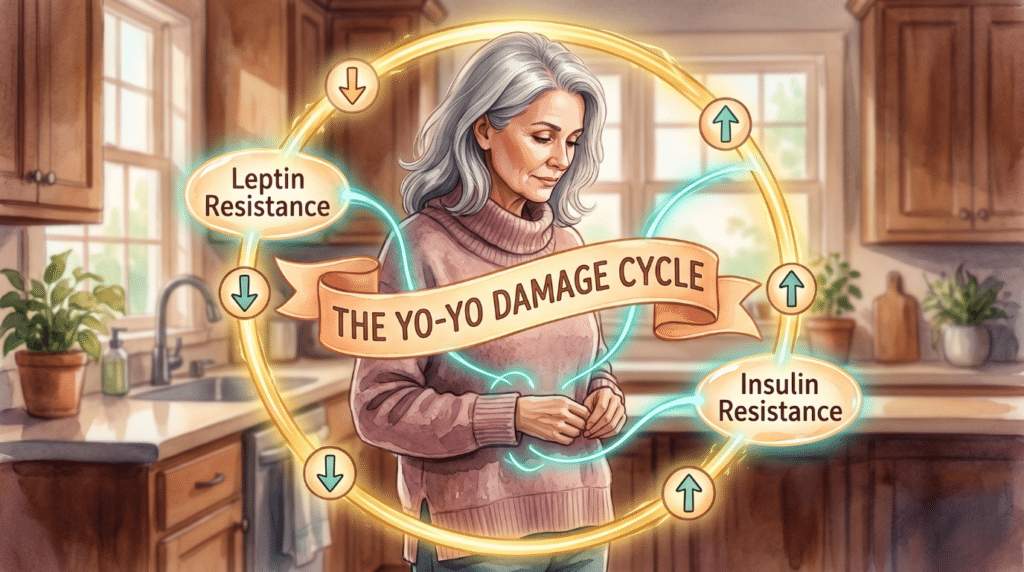
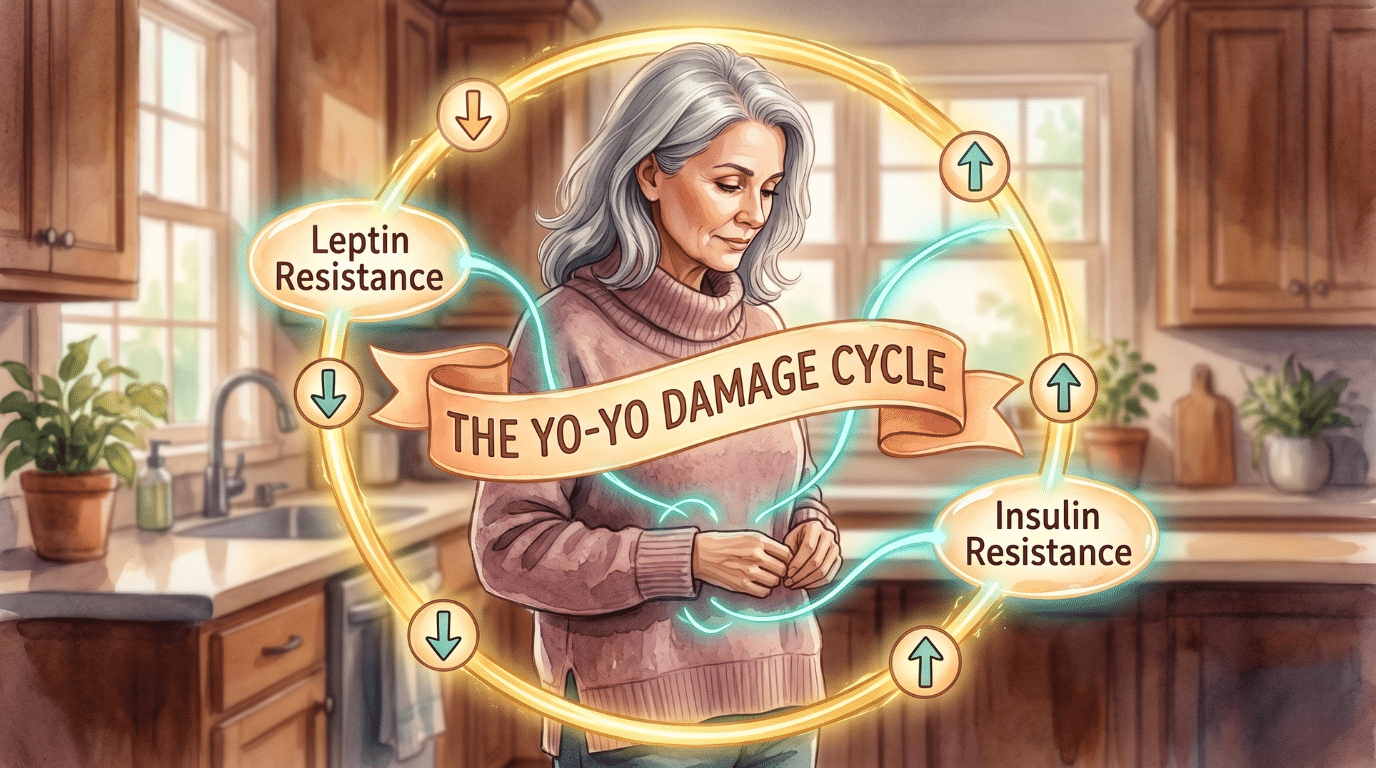
The Yo-Yo Dieting Damage Cycle
Every restriction cycle makes the next one harder. Here’s how the damage compounds over time:
- Restriction activates FAT Programs, slowing metabolism and increasing fat-storage hormones
- Extended restriction creates leptin resistance, your “stop eating” signal gets muffled
- Chronic dieting stress spikes cortisol, driving insulin resistance
- Your fat set-point rises, your body now defends a higher weight as “normal”
- You regain the weight, plus a little more, and the next diet has to work twice as hard
Sound familiar? It should. This is the experience of almost every long-term dieter.
And here’s the part that should make you genuinely angry: none of this is your fault. You were handed tools, pills, shakes, restriction plans, that triggered this exact cascade. You followed the instructions. The instructions were wrong.
The solution isn’t more restriction. It isn’t a stronger pill or a stricter plan. It’s learning to switch off the FAT Programs entirely, to send your body a signal of safety instead of scarcity. To work with your biology instead of constantly fighting it.
Because you can’t out-willpower ancient survival code. Nobody can.
But you can give your body a reason to stop running it.
Want to dive deeper into this approach? Discover how to turn off your body’s fat-storage programs for good by joining Jon Gabriel inside the 12-Week Total Transformation Program.