
What if the thing keeping you sick — and keeping you overweight — wasn't what you were eating? What if it was something you were still carrying?
Karen contacted me the morning after our session. I still remember reading her message.
She said she didn't know how to explain it. She'd woken up and 90% of her symptoms were gone. Not reduced. Not “a little better.” Gone. After one night. After one visualization.
She was stunned. I wasn't.
Not because I'm arrogant about what's possible. But because I've seen this before. More times than I can count. And once you understand what was actually happening inside Karen's body that night, you won't be stunned either.
Her body wasn't broken. It was protecting her. The symptoms weren't random. They were her nervous system doing exactly what it was designed to do — holding on, guarding, keeping her safe from something it had decided was a threat.
And the moment she gave it permission to let go?
It did.
In this post, I'm going to show you exactly why forgiveness works biologically — what it actually does inside your nervous system — and how you can experience the same kind of release Karen did.
Karen's Story — What Actually Happened That Night
Karen was exhausted. Not tired-after-a-long-day exhausted. Bone-deep, nothing-is-working, I've-tried-everything exhausted.
She had been living with a body that felt like it was constantly fighting her. Chronic pain. Persistent inflammation. The kind of fatigue that sleep doesn't fix. She'd been through the doctors, the tests, the treatments. She'd adjusted her diet. She'd pushed through. And yet her body kept sending the same distress signals, over and over, like an alarm she couldn't find the source of.
Sound familiar?
When Karen came to work with me, she wasn't looking for a miracle. She was looking for something — anything — that made sense. Because nothing had, up to that point.
We did a visualization session together. A forgiveness visualization, specifically. I guided her into SMART Mode — a deeply relaxed, receptive state where the subconscious mind opens up and becomes available in a way that normal waking awareness doesn't allow. And in that space, Karen did something she hadn't been able to do consciously: she let go.
I won't tell you exactly what she released. That's hers. But I will tell you that something shifted in the room. You can feel it when someone's nervous system exhales for the first time in years. There's a quality to it. A kind of quiet that lands differently than ordinary quiet.
The next morning, Karen reached out to me.
Ninety percent of her symptoms were gone.
Not reduced. Not “I'm feeling a little better.” Gone. Overnight.
The Science: When unresolved emotional trauma keeps the nervous system locked in chronic stress, the body maintains a state of low-grade inflammation and hormonal disruption. A genuine safety signal — delivered at the subconscious level through embodied forgiveness — can downregulate that stress response rapidly, sometimes within hours.
I know what you're thinking. One visualization? Overnight? That sounds impossible. I would have thought the same thing once.
But once you understand the biology, it stops being a miracle. It starts being completely logical.
Here's the thing about Karen's reaction that has stayed with me: she was shocked. Genuinely disoriented by her own body's response. And I understand that. When you've been suffering for long enough, relief starts to feel suspicious.
I wasn't shocked. Not because I'm special or because I have some gift Karen doesn't. But because I've seen this more times than I can count. The body holds onto symptoms the same way it holds onto weight. Both are forms of protection. Both dissolve when the body finally feels safe.
That gap — between Karen's disbelief and what I've witnessed again and again — is the entire point of this post.
Her body wasn't broken. It wasn't attacking her. It was protecting her, the only way it knew how.
And the moment she gave it permission to stop? It did.
Why Overnight Healing Isn't as Rare as You Think
When symptoms are driven by a chronically activated stress response — not structural damage — the body can reorganize quickly once it receives a genuine safety signal. Karen's case is dramatic. But the underlying mechanism is the same one operating in every person whose body is stuck in protection mode. The speed of change depends on how deeply the nervous system believes the threat is over. That belief lives in the subconscious. And that's exactly where forgiveness visualization goes.
Your Body Isn't Broken — It's on a Mission
Here's the most important thing I can tell you about Karen's story — and about your own body.
Your body has never done anything wrong.
Not once. Not ever.
Everything your body has done — every symptom, every pound it's held onto, every night of disrupted sleep, every unexplained ache — made complete sense at some point. Your body was doing exactly what a brilliant, loyal survival machine is supposed to do.
It was protecting you.
This is one of the foundational principles of The Gabriel Method. The body doesn't malfunction randomly. It responds to data. And when the data it's receiving says “danger,” it activates every protective mechanism it has available.
Fat storage is one of those mechanisms. So are inflammation, fatigue, hormonal disruption, and a dozen other symptoms people spend years fighting.
We call these FAT Programs — the survival switches your body flips when it perceives a threat. And here's the part that surprises most people: your nervous system cannot tell the difference between physical danger and emotional danger.
A famine looks the same as a toxic relationship that's been slowly draining you for years. A predator looks the same as unresolved grief you've been carrying since childhood. To your body's survival system, a threat is a threat. And it responds accordingly.
The Science: When the nervous system detects danger — physical or emotional — it triggers a cascade of protective responses including cortisol release, fat storage, and systemic inflammation. The body cannot distinguish between a physical threat and a chronic emotional one. Both flip the same survival switch.
Karen's symptoms weren't random. They weren't bad luck. They were her body's best attempt to shield her from something it had decided, somewhere deep in her nervous system, was still dangerous.
Her body was on a mission. It just didn't know the mission was over.
“If you're in a room with no oxygen, you gasp. You aren't greedy for air. You're starving for it. When your nervous system is starving for safety, it gasps in the only way it knows how — symptoms, weight gain, inflammation. It's not dysfunction. It's desperation.”
That image stops people cold. Because they've spent years being angry at their body. Blaming it. Trying to punish it into compliance with extreme diets and brutal workout schedules and sheer willpower.
And the whole time, their body was just desperately trying to keep them safe.
Why Your Body Stores Fat — And Why It Isn't Your Fault
FAT Programs are survival mechanisms, not character flaws. Your body activates fat storage and protective symptoms when it perceives danger — including the “danger” of unresolved emotional trauma, chronic stress, and deep-seated fear. These programs were designed to save your life. The problem isn't that they activated. The problem is that nobody told them the threat was gone.
So if willpower hasn't worked — now you know why. You can't logic your way out of a survival program. You can't shame your body into feeling safe. You can't punish it into releasing weight or symptoms it's holding onto for protection.
You don't need to fight your body. You need to update the data.
That's what happened with Karen. She didn't force anything. She didn't push through pain or white-knuckle her way to healing.
She gave her nervous system new information. She showed it — not told it, but showed it — that it was finally safe to let go.
And her body, being the loyal and responsive protector it had always been, exhaled.
If you've been fighting your body for years — hating it, punishing it, trying to override it with willpower — I want you to hear this.
Your body has been on your side the whole time. It just needed better information.
What Is Forgiveness Actually Doing Inside Your Body?
Here's what most people don't know about forgiveness. It's not a moral decision. It's not a choice you make with your mind. And it has absolutely nothing to do with whether the person who hurt you deserves it.
Forgiveness is a biological event.
And when it happens — really happens, in your body, not just in your thoughts — your nervous system responds in ways that can change everything. Including your symptoms. Including your weight.
Let me explain what's actually going on under the surface.
When you carry unresolved emotional pain — resentment, shame, grief, anger — your nervous system doesn't file it away neatly. It treats it as an active threat. Your body cannot tell the difference between the memory of something painful and something painful happening right now. To your nervous system, the threat is always present. Always real. Always dangerous.
So it does what it's designed to do. It activates your stress response. It pumps cortisol into your bloodstream. It keeps you on high alert, day after day, year after year, quietly running in the background like a program you forgot to close.
And here's where it gets important:
- Unresolved emotional pain → chronic stress response
- Chronic stress response → elevated cortisol and inflammation
- Inflammation → symptoms, weight gain, hormonal disruption
That's not a theory. That's the chain reaction happening inside Karen's body — and possibly inside yours.
The Science: Chronically elevated cortisol suppresses immune function, drives systemic inflammation, and signals the body to store fat as a survival mechanism — the same biological pathway triggered by physical famine, activated instead by unresolved emotional stress.
Unforgiveness isn't a character flaw. It's a biological state. Your nervous system is stuck in danger mode. And no amount of willpower, positive thinking, or clean eating fully resolves that — because the signal driving it is still running.
The Smoke Alarm Analogy
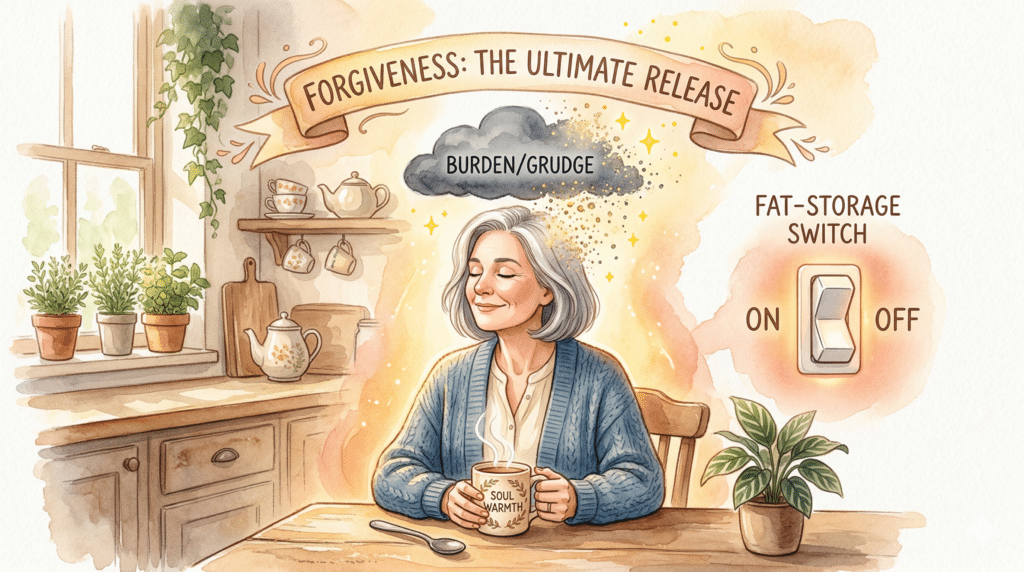
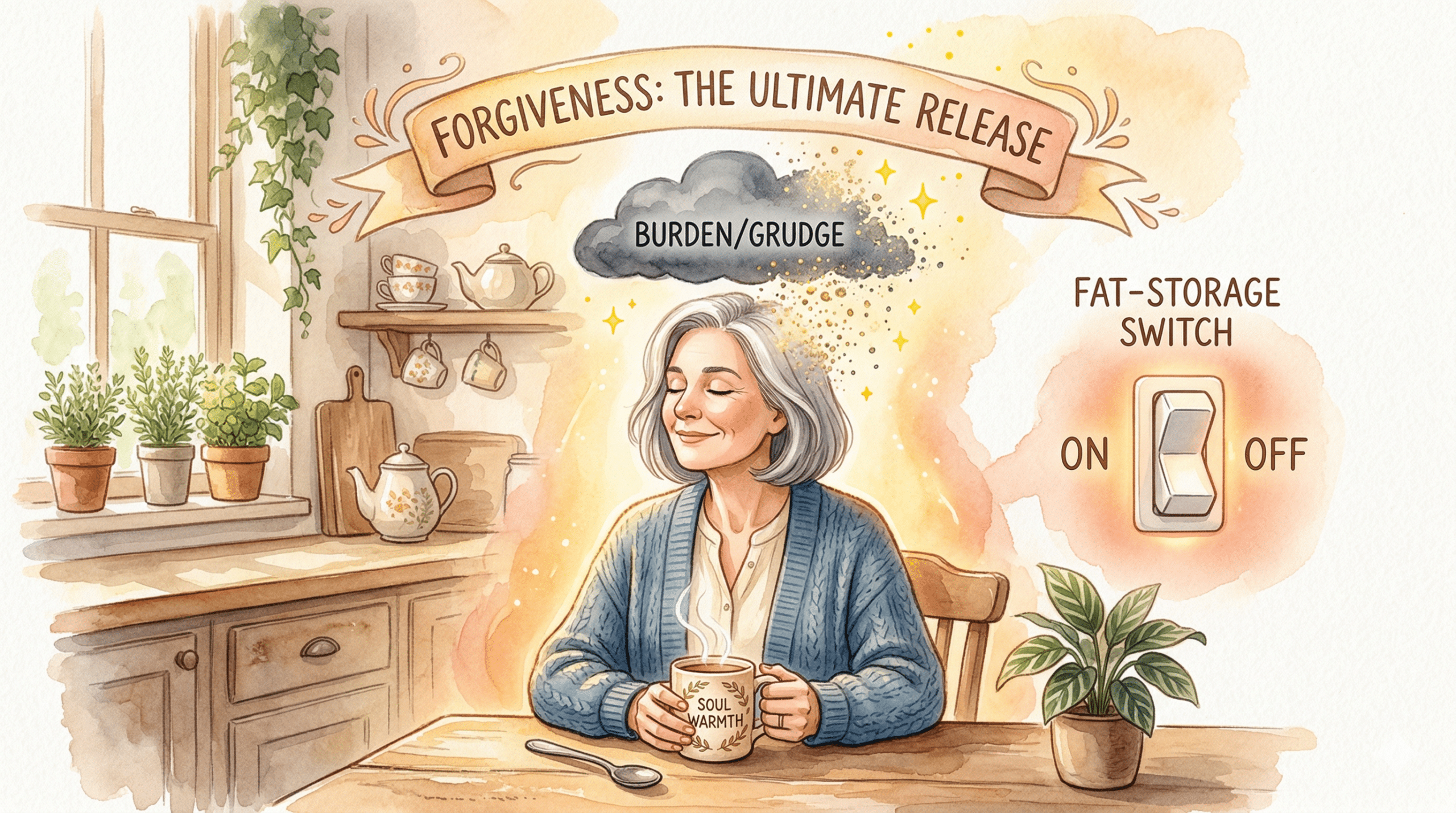
Your nervous system is like a smoke alarm. Once it goes off, it keeps blaring — even after the smoke clears — until someone walks through the house, confirms it's safe, and presses the reset button. Forgiveness is that reset. It doesn't mean saying the fire didn't happen. It means telling your nervous system the fire is out. And once it believes that — once it really believes it — the alarm stops. The cortisol drops. The inflammation recedes. The symptoms that were never really random start to resolve.
That's what happened to Karen overnight.
Her 90% improvement wasn't mystical. It was her nervous system exhaling for the first time in years. The danger signal finally went quiet. And her body — loyal, responsive, always listening — immediately began to shift.
Now here's the part most people miss. You can decide intellectually to forgive someone. You can say the words. You can mean them. And nothing changes.
That's because the part of your brain running your symptoms — running your FAT Programs, your inflammation, your hormonal chaos — is not your conscious mind. It's your subconscious mind. And it doesn't respond to logic. It doesn't care what you've decided. It only responds to what you feel.
This is the difference between intellectual forgiveness and embodied forgiveness. One happens in your head. The other happens in your cells. Karen didn't just think about forgiving. She felt it — in a deeply relaxed state where her subconscious mind was fully open and listening.
And that's a completely different thing.
This isn't about letting anyone off the hook. It's about letting yourself out of the prison their actions put you in. Because right now, while you're carrying that weight — emotional and physical — they've moved on. You're the one still paying the price. In cortisol. In inflammation. In a body that's desperately trying to protect you from a threat that no longer exists.
You deserve to press the reset button.
SMART Mode — The State Where Healing Actually Happens
Here's the question I get asked most after I share Karen's story.
“Okay, but what exactly did you do with her?”
Fair question. Because “visualization” is one of those words that sounds soft. Vague. Like something you'd read on a motivational poster and forget by Tuesday.
What I guided Karen through was something very specific. Something with a mechanism. I call it SMART Mode — Super Mental Alert Reeducation Training.
Let me break down what that actually means.
SMART Mode is a deeply relaxed, highly receptive brainwave state. Think of that floaty, borderless feeling you get in the last few moments before sleep — when your body is completely still but your mind is still gently aware. That's the neighborhood. That's where we're going.
In that state, something remarkable happens. Your subconscious mind becomes fully accessible.
And that matters more than most people realize.
Here's why. Your conscious mind — the part reading these words right now — is where your logic lives. Your reasoning. Your willpower. Your “I know I should forgive this person” thoughts.
But your FAT Programs don't live there. Your chronic symptoms don't live there. Your survival patterns, your emotional holding, your nervous system's decade-old threat assessments — those live in your subconscious.
And your subconscious does not speak logic. You can't think your way into it. You can't argue with it. You can't white-knuckle it into changing its mind.
Sound familiar? That's why willpower diets fail. That's why “just deciding to feel better” doesn't work. You're knocking on the wrong door.
SMART Mode gets you to the right door.
The Science: During deep relaxation, your brain shifts from beta waves — the fast, analytical state of ordinary waking consciousness — into alpha and theta waves. In alpha and theta, the critical, filtering function of the conscious mind quiets down. The subconscious becomes receptive to new input. This is the same neurological window that makes hypnotherapy, deep meditation, and sleep learning possible. It's not mystical. It's measurable.
Now here's the part that makes SMART Mode different from just “relaxing.”
In this state, visualization isn't pretend. It's felt.
Your nervous system cannot reliably distinguish between a vividly imagined experience and a real one. When you are fully immersed in a mental scene — emotionally engaged, sensorially present — your body responds as if it is actually happening. Heart rate shifts. Cortisol responds. Neurotransmitters fire.
This is the mechanism. This is why Karen's forgiveness visualization didn't just change her thoughts. It changed her physiology.
What Entering SMART Mode Actually Feels Like
People always expect it to be harder than it is. Here's what you'll actually notice:
Step 1: Your body gets heavy. Not uncomfortable — just settled. Like you've finally stopped holding yourself up.
Step 2: Your breathing slows on its own. You're not forcing it. It just finds a quieter rhythm.
Step 3: A gentle sense of detachment arrives. Thoughts still come — but they feel further away. Less urgent. Less loud.
Step 4: You feel safe. This is the signal. This is your nervous system dropping its guard. This is where healing becomes possible.
Karen didn't need years of therapy to get there. She needed the right state, the right guidance, and the willingness to feel something real.
One session. One night. Ninety percent of her symptoms — gone.
That's not a miracle. That's what happens when you finally knock on the right door.
You don't have to figure out how to rewire your biology all on your own. To get the exact daily visualizations and mind-body tools Jon used, check out the 12-Week Total Transformation Program.