
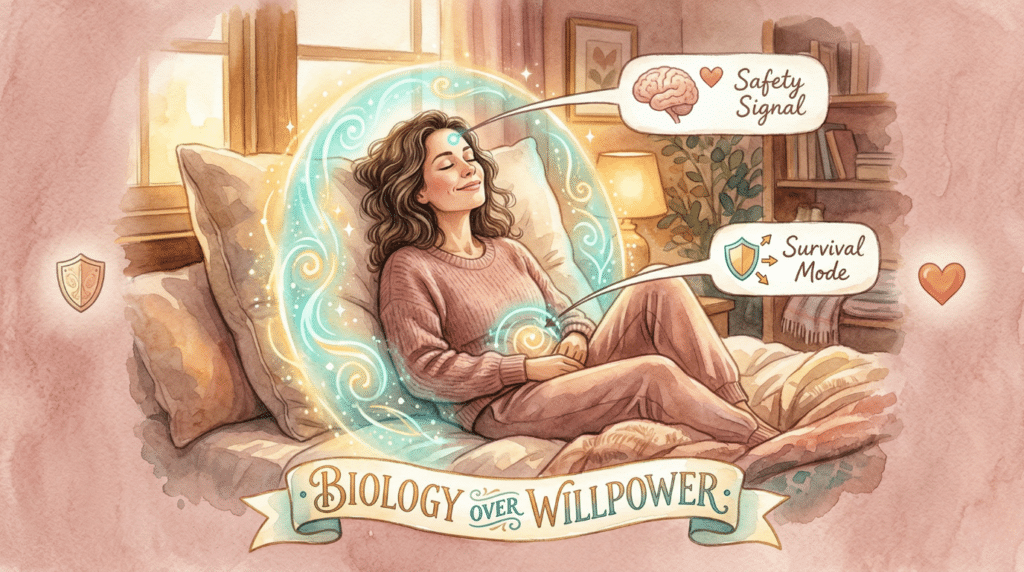
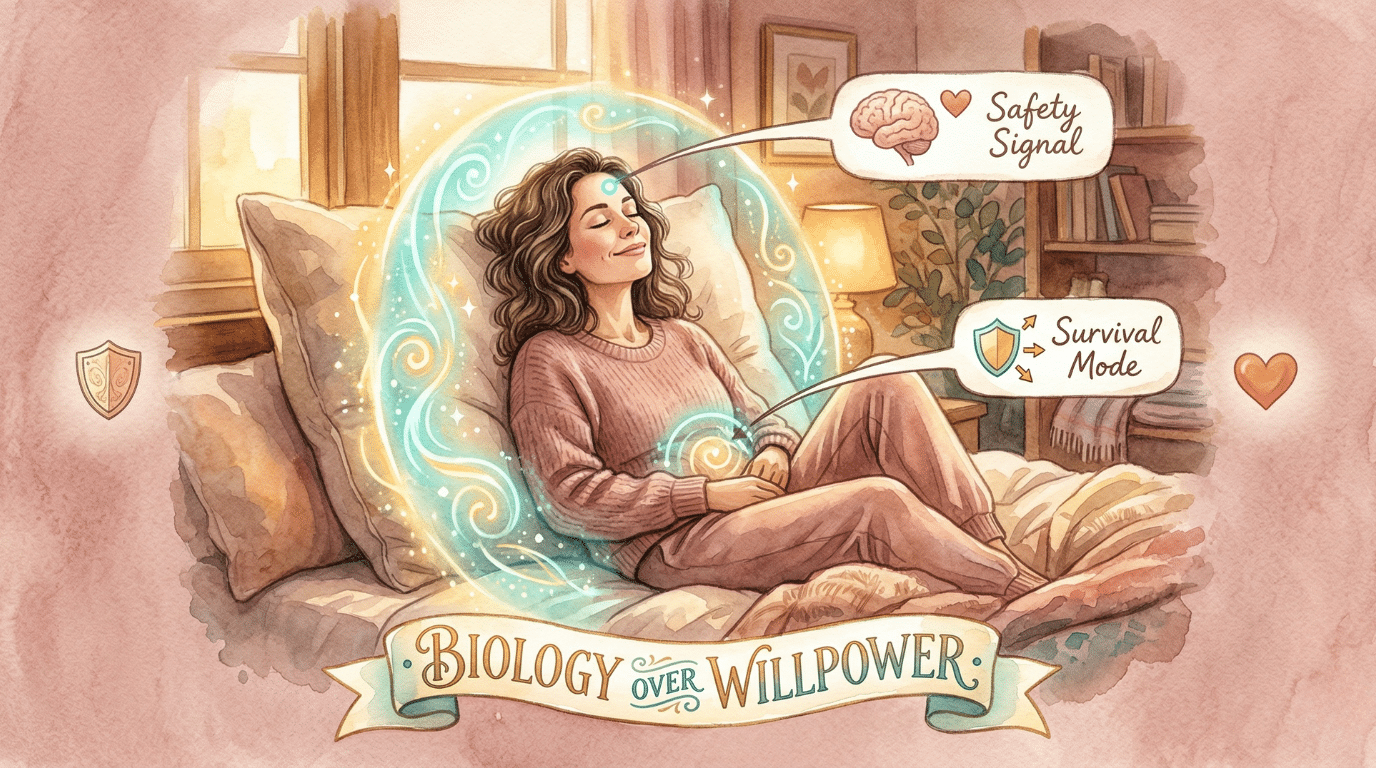
You’re doing everything right. Eating less. Moving more. Cutting out the foods you love. And yet every morning, you look in the mirror and the belly is still there. Maybe it’s even a little bigger than last month.
Sound familiar? You’re not imagining it. And you’re not failing.
But here’s the question nobody is asking you: What if the problem isn’t what you’re eating? What if the problem is what you’re feeling?
There’s a hormone called cortisol. You don’t need to know the biology yet, just know this: it’s your body’s emergency fat-storage signal. It’s ancient. It’s intelligent. And it was designed to save your life in a crisis.
The problem? Your body can’t tell the difference between a genuine emergency and a brutal week at work. Between a predator and a painful relationship. Between real danger and the low-grade, relentless pressure of modern life.
So it does what it was built to do. It holds on. Especially around your middle.
What You’ll Understand By The End Of This Post
Exactly why your midsection holds on to fat and what you can actually do about it. Not another diet. Not more willpower. The real biological reason, and the real solution.
You’re Not Failing. Your Biology Is Protecting You.
You’ve been doing the work. Cutting calories. Skipping dessert. Getting to the gym even when you’re exhausted. And still, you pull on your jeans in the morning and feel that familiar frustration settle in your chest.
The belly is still there. Maybe it’s even bigger than last year.
And somewhere in the back of your mind, a voice whispers the cruelest possible explanation: Maybe I’m just not trying hard enough.
Here’s what I need you to hear right now, and I need you to really let it land:
It’s not your fault. It’s your biology.
That’s not a consolation prize. That’s not something I say to make you feel better before delivering bad news. It is the actual, biological truth and once you understand it, everything changes.
Jon Gabriel carried 220 pounds on his frame for years. He tried every diet. He pushed himself hard. He wasn’t lazy. He wasn’t weak. But he was something that no diet in the world addresses: chronically stressed. His body wasn’t broken. It was doing exactly what millions of years of evolution designed it to do. It was keeping him alive.
That’s the shift that changes everything. Your body is not your enemy. It is an extraordinarily intelligent survival system. And right now, it has flipped on what Jon calls FAT Programs, ancient biological switches designed to protect you in times of threat.
Think of FAT Programs as your body’s emergency response protocol. When the brain detects danger, it sends a signal: Store fat. Hold on to every calorie you can. We might need it later. This system kept our ancestors alive through brutal winters, famines, and predator attacks.
There are two primary triggers that flip these switches on.
The first is Famine is when the body perceives it isn’t getting enough food or nutrients. The second is Danger is when the body perceives a threat to survival.
Here’s where it gets important for you specifically.
In the modern world, “danger” is rarely a predator. But your nervous system doesn’t know that. A demanding boss. A strained marriage. A pile of bills. Three nights of bad sleep in a row. To your ancient brain, these register as survival-level threats.
Your amygdala doesn’t know you’re just stuck in traffic. It thinks you’re running from a lion.
The Science: The amygdala, your brain’s threat-detection center, cannot distinguish between physical danger and psychological stress. Both trigger the same hormonal cascade, the same fat-storage response, and the same survival programming.
You are not weak. You are stressed. And there’s a massive difference.
The body stores fat when it feels unsafe. Full stop.
It doesn’t matter how many salads you eat. If your nervous system is locked in threat-mode, your biology will fight to hold onto every pound, especially around your midsection.
And when your body thinks there’s a lion? It does something very specific with your fat. It moves it.
What Are FAT Programs?
FAT Programs are your body’s built-in survival switches, activated when the brain perceives famine or danger. They’re not a malfunction. They’re an ancient protection system. When FAT Programs are switched ON, the body prioritizes fat storage over fat burning, slows metabolism, and increases hunger signals. The key to lasting weight loss isn’t fighting harder against your body. It’s giving your body the signals it needs to switch these programs OFF.
Meet Cortisol and Your Body’s Emergency Fat-Storage System
Cortisol is not your enemy.
That’s the first thing to understand. Cortisol is a hormone released by your adrenal glands the moment your brain perceives a threat. And it is, genuinely, one of the most brilliant emergency systems your body has ever developed.
The problem isn’t cortisol. The problem is that your body was never designed to live in a permanent emergency.
Here’s what happens when cortisol floods your system in an acute stress situation. Your blood sugar spikes giving you instant fuel to fight or run. Your heart rate climbs. Blood gets shunted away from your digestive system and toward your muscles. Your immune function takes a back seat. Non-essential systems go offline.
In that moment, your body is a perfectly engineered survival machine.
All of that is perfect… if the threat lasts 90 seconds. A predator chases you. Cortisol fires. You run. The danger passes. Your body resets.
But what if the threat lasts 90 days? What if it’s been 90 years of accumulated stress… a difficult marriage, a demanding job, financial anxiety, chronic poor sleep? The cortisol never gets the signal to stand down. And that changes everything.
The Science: Chronic cortisol keeps blood sugar continuously elevated. Elevated blood sugar means elevated insulin. And elevated insulin is your body’s primary fat-storage signal, keeping you locked in fat-storing mode around the clock, even when you’re eating well.
Here’s where it gets even more specific. Your body doesn’t just store fat randomly when cortisol is chronically high. It makes a deliberate choice about where to put it.
It chooses your belly.
Visceral fat, the deep abdominal fat that wraps around your organs, is metabolically active and positioned close to the liver. From a survival standpoint, that’s prime real estate. Your body can convert it to energy fast when it needs to.
Cortisol doesn’t just make you fat. It tells your body exactly where to put the fat, and it chooses your belly because that’s the quickest place to access it in a crisis.
Think of it like a fat thermostat. Cortisol sets the dial. And under chronic stress, that dial is pointed directly at your midsection.
Then there’s leptin. This is where things get really important.
Leptin is the hormone that tells your brain two critical things: I’m full and I’m safe. When leptin is working properly, your appetite regulates naturally and your body feels no urgency to store emergency fat reserves.
Chronic cortisol disrupts leptin signaling. Your brain stops receiving the message. So it keeps sending out hunger signals. It keeps your FAT Programs switched on. Leptin Resistance means your body’s “I’m full and I’m safe” signal has gone offline. And no amount of willpower overrides a broken signal.
What Cortisol Does to Your Body Under Chronic Stress
1. Raises blood sugar continuously, keeping your metabolism in emergency mode.
2. Keeps insulin elevated (fat-storage mode ON), your body cannot burn fat while insulin is high.
3. Directs fat specifically to the abdominal region, strategic, not random.
4. Disrupts leptin (your fullness and safety hormone), hunger signals never switch off.
5. Suppresses thyroid function, your metabolic engine slows down.
6. Breaks down muscle tissue for glucose, less muscle means a slower metabolism still.
Cortisol and insulin are partners in fat storage. And chronic stress keeps both of them elevated.
So the belly fat isn’t random. It isn’t a character flaw. It isn’t proof that you lack discipline.
It’s strategic. Your body put it there on purpose.
The question isn’t how to burn it through sheer force of restriction. The question is: how do you convince your body the emergency is over?
The Modern World Is a Stress Machine (And Your Body Hasn’t Caught Up)
Here’s a question worth sitting with: When did you last feel genuinely, completely relaxed?
Not just distracted. Not just tired enough to fall asleep. Actually safe. Calm. Without a background hum of worry about money, relationships, deadlines, health, or what tomorrow looks like.
For most people, the honest answer is: they can’t remember.
And that’s the problem. Chronic stress has become so normal that we’ve stopped recognizing it as stress at all. It’s just… life. It’s just how things are. But your body hasn’t accepted that memo. Your body is still reading every one of those pressures as a survival threat and responding accordingly.
This is why the belly fat stays. Even when the diet is clean. Even when you’re hitting the gym. The threat signals keep coming, and your body keeps responding the only way it knows how.
The Stressors You’d Never Connect to Your Waistline
When most people think about stress, they picture big, obvious things. A job loss. A divorce. A health scare. But your body doesn’t have a threshold for “big enough to count.” It responds to all of it.
Here are the stress signals that are quietly keeping your cortisol elevated and your belly fat locked in place:
- Emotional stress: Difficult relationships. Loneliness. Unresolved grief or trauma. Chronic anxiety that you’ve just learned to live with. Your body reads all of it as danger.
- Physiological stress: Poor sleep. Inflammatory foods. Environmental toxins like pesticides and plastics. Even over-exercising, too much intense cardio without recovery sends a stress signal just as real as any argument or deadline.
- Nutritional stress: Eating food that’s high in calories but stripped of actual nutrients. Jon Gabriel calls these MT Calories, empty calories that fill your stomach but starve your cells. Your body registers this as a famine. And famine means: hold on to every gram of fat you have.
- Psychological stress: The inner critic. The shame spiral every time you look in the mirror. The relentless pressure of feeling like you’re failing at your own body. That voice in your head is not motivating you, it is biologically working against you.
The Science: Chronic psychological stress, including body shame and negative self-talk, elevates cortisol just as powerfully as physical threats. Your brain cannot distinguish between a perceived danger and a real one. Every harsh thought you direct at yourself is a signal that the environment is unsafe, and your body responds by tightening its grip on abdominal fat storage.
Sound familiar? Because this list describes most people’s Tuesday.
The Cruelest Irony: Dieting Makes It Worse
Here’s the part that stops people cold.
Every time you go on a restrictive diet, you send your body a famine signal. Cortisol rises. Insulin rises. Your body reads the calorie restriction as proof that food is scarce and it responds by clinging harder to the exact fat stores you’re trying to lose.
Extreme dieting doesn’t just fail. It actively reinforces the FAT Programs your body is running.
Jon lived this, trying every approach that conventional wisdom offered and the harder he pushed, the more his biology pushed back. Not because he lacked willpower. Because his body was doing its job. It was protecting him from what felt, biologically, like a threat to his survival.
The Hidden Stress Signals Keeping You Stuck
These everyday experiences all elevate cortisol and keep your body’s fat-storage programs switched on, even when you’re “eating right” and exercising:
1. Chronic poor sleep: Even one week of disrupted sleep significantly raises cortisol and drives abdominal fat storage.
2. Nutrient-poor food (MT Calories): Your cells are starving even when your stomach is full, triggering a famine response.
3. Negative self-talk: Body shame and self-criticism register in the brain as a genuine threat signal.
4. Restrictive dieting: Calorie restriction signals scarcity. Your body’s response is to hold on tighter, not let go.
5. Loneliness and disconnection: Social isolation is one of the strongest cortisol triggers the human body knows.
The takeaway isn’t hopeless. It’s actually the opposite.
Once you understand that belly fat is a stress response, not a character flaw, the entire strategy changes. You stop fighting your body. You start working with it. You start asking a completely different question, not “how do I force this fat off?” but “how do I show my body that it’s safe?”
That question changes everything.
If you’re ready to stop fighting your body and actually start working with it, Jon Gabriel would like to invite you to experience the complete step-by-step system inside the 12-Week Total Transformation Program.