
You've been eating less for a week. You're doing everything right: smaller portions, skipping the bread, saying no to dessert. And somehow, you are more obsessed with food than you have ever been in your entire life.
Every conversation gets hijacked by thoughts of what you could be eating. You walk past the kitchen and feel like a prisoner walking past the exit. By day three, you're not just hungry. You're consumed.
Sound familiar? Here's what nobody tells you: that's not weakness. It's not a lack of willpower. It's not some personal failing you need to push through.
It's your body doing exactly what it was designed to do.
Here's the part that changes everything: the more weight you lose, the harder your body fights to get it back. There is a hormone driving this biological tug-of-war. It's called leptin. And most diet advice, the calorie counts, the meal plans, the “just eat less and move more” crowd, never mentions it once.
By the end of this, you'll understand exactly why this keeps happening to you. And more importantly, you'll know exactly what to do instead.
The Hormone Nobody Told You About
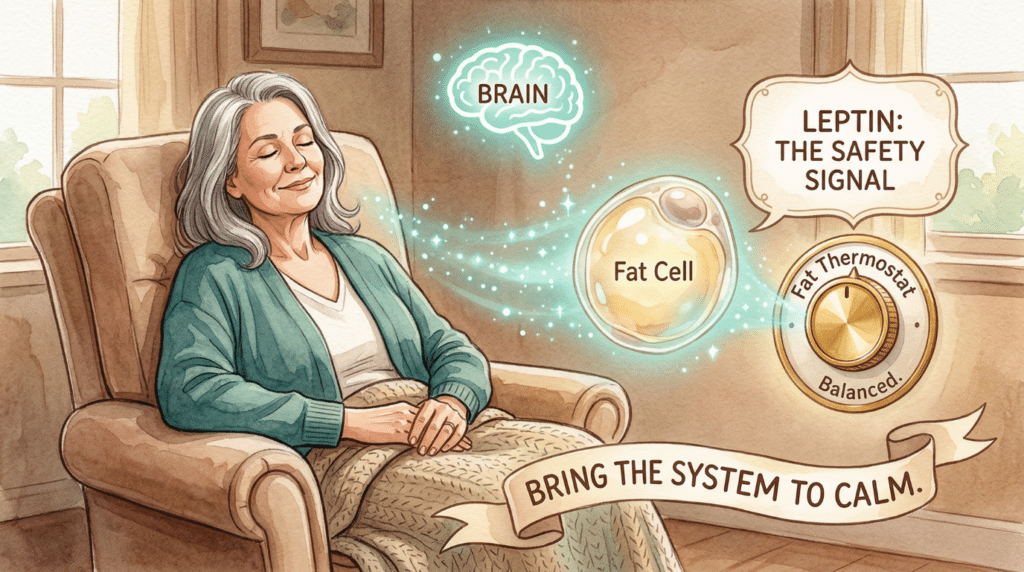
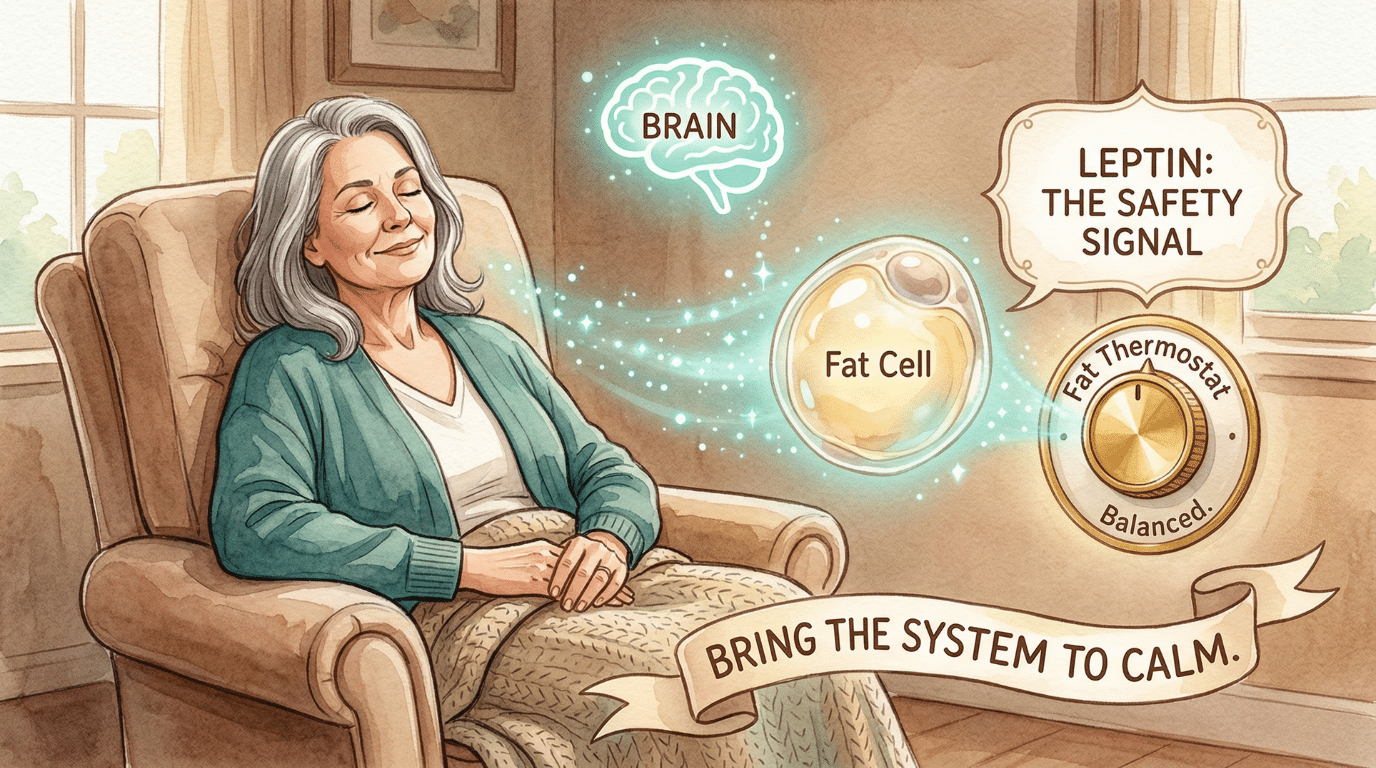
There is a hormone living inside your fat cells right now. It has one job: to tell your brain whether you are safe or starving.
Its name is leptin. And it is almost certainly the reason every diet you have ever tried eventually fell apart.
Here is how it is supposed to work.
When your fat cells are full, they release leptin into your bloodstream. That leptin travels up to the hypothalamus, the part of your brain that controls hunger, metabolism, and energy use. The brain reads the signal and says: “Good. We have plenty of stored energy. Turn off the hunger. Keep the metabolism running.”
Think of it as your body's built-in Fat Thermostat. When the tank is full, the thermostat keeps everything calm and balanced. Hunger stays manageable. Energy stays high. Life feels relatively normal.
It is an elegant system. When it works.
The problem starts the moment you go on a diet.
When you cut calories, your fat cells begin to shrink. And as they shrink, they release less leptin. Less leptin in your bloodstream means only one thing to your brain, not “great, the diet is working.” To your brain, dropping leptin means one thing: the food supply is disappearing.
Your brain cannot tell the difference between a structured weight loss plan and a genuine famine. It only knows what the leptin signal is telling it. And when that signal drops, it fires every alarm it has.
Hunger spikes. Metabolism slows. Fat storage enzymes switch on. Your body starts hoarding every single calorie it can find.
The Science: Research shows leptin levels can drop by 50% or more within just a few days of caloric restriction often before any significant fat loss has even occurred. Your body does not wait to confirm a famine. It panics immediately.
How the Leptin Alarm Works Against You
Low Leptin Signal → Brain reads “Famine” → Hunger increases → Metabolism slows → Fat storage enzymes activate → Cravings intensify → Diet collapses
Jon Gabriel lived this for years. At over 400 pounds, he tried diet after diet, restriction plans, calorie counting, programs that promised results if he just had enough discipline. And every single time, within days, the hunger became unbearable. Not uncomfortable. Unbearable.
He did not fail those diets because he was weak. He failed them because his biology was working exactly as designed. Every time he restricted food, his leptin levels dropped, his brain triggered the famine alarm, and his body fought back with everything it had.
The diet was not fixing the problem. The diet was the problem.
This is the part that nobody tells you. The hunger you feel on a calorie-restricted diet is not a character flaw. It is not poor willpower. It is a biological survival alarm going off at full volume. You cannot white-knuckle your way through a system that has been evolving for 200,000 years to keep you alive.
You were never fighting food. You were fighting your own biology.
The problem was never your appetite. The problem was the signal your body was getting.
The FAT Programs: Your Body's Survival Switch
Leptin dropping is the trigger. But something much bigger responds to that trigger.
Your body has an ancient, hardwired survival system built into it. Scientists call parts of it by different names. Jon Gabriel calls it the FAT Program and once you understand what it is, everything about your struggles with weight will start to make sense.
There are two main things that activate the FAT Program: Famine and Temperature (cold). When your body detects either one, it doesn't deliberate. It doesn't check your calendar. It flips a switch and that switch turns your body from a fat-burning machine into a fat-storing machine. Aggressively, efficiently, and without asking your permission.
Dieting is the number one trigger for the Famine FAT Program.
When you eat less, your body doesn't think, “Great, we're finally making progress.” Your body thinks, “The food supply has disappeared. Winter is coming. Store everything you can.” It cannot tell the difference between a calorie-counted meal plan in July and a genuine famine on the African savanna 200,000 years ago. The signal looks identical. The response is identical.
Your biology is running ancient software on a modern problem. And that software is very, very good at keeping you alive.
The Science: When the FAT Program activates, your body triggers a full hormonal and enzymatic cascade, upregulating fat-storage enzymes like lipoprotein lipase, downregulating fat-burning enzymes, slowing thyroid function to reduce your metabolic rate, spiking cortisol (which drives fat specifically to your belly), surging ghrelin (your hunger hormone), and dropping leptin even further. Every single lever in your biology moves in the same direction at once toward storing more fat.
What Happens Inside Your Body When You Diet
The moment your body detects reduced calorie intake, the FAT Program triggers a rapid biological cascade. Fat-storage enzymes ramp up. Fat-burning enzymes shut down. Your thyroid slows your metabolism to conserve energy. Cortisol rises, pushing fat toward your abdomen. Ghrelin spikes, making you ravenous. Leptin falls, removing your fullness signal entirely. The result is a body that is biologically optimized in the wrong direction.
And here is where it gets cruel.
If you break the diet, which your body is screaming at you to do, you don't just return to where you started. Your body overshoots. It stores more fat than it lost, just in case the famine returns. This is the biological engine running underneath every yo-yo dieting story you've ever heard. It's not failure. It's your survival system doing exactly what it was designed to do.
Think of it like a thermostat that's been rewired. If you keep sneaking into your house and manually cranking the heat down, the thermostat doesn't give up. It learns to fight back harder. It defends a higher temperature with more aggression every time you interfere. Every diet you've ever been on has done this to your FAT Program thermostat. It has raised the set point it's defending and sharpened its tools for getting back there.
The more diets you've been on, the more efficient your body has become at storing fat. That's not a character flaw. That's adaptive biology.
Jon Gabriel lived this. By the time he was carrying over 400 pounds, he had tried restriction after restriction. Every time he cut back, the hunger became something beyond ordinary willpower. He wasn't weak. His FAT Program had simply been activated so many times that it had become extraordinarily efficient at what it does. The dieting wasn't solving the problem. The dieting was the problem.
This is the reframe that changes everything. Dieting doesn't just fail to work long-term. Dieting actively trains your body to store fat faster and hold onto it harder with every passing cycle. Each round of restriction followed by rebound is a rep in the gym for your fat-storage system.
So the question isn't: “Why can't I stick to a diet?” The real question is: “How do I turn off the FAT Program?”
Leptin Resistance, When the Signal Gets Blocked
Here's where it gets even more frustrating.
Everything we've talked about so far, leptin dropping, the FAT Program activating, hunger going haywire, that's what happens when you diet and your leptin levels fall. But there's a second problem. And for many people, it's actually the bigger one.
What if your leptin isn't low at all? What if it's sky-high and your brain still can't hear it?
That's leptin resistance. And it changes everything.
The Broken Radio Analogy
Think about it this way. Leptin is a signal. Your brain is the receiver. In a healthy system, the signal gets through clearly, the brain reads it, and hunger shuts off.
But leptin resistance is like trying to pick up a radio station with a broken antenna. The signal is broadcasting loud and strong. Your fat cells are producing plenty of leptin. The message is being sent.
Your brain just can't receive it.
So what happens? Your brain thinks you're starving. It triggers hunger. It slows your metabolism. It activates the FAT Program even though you have more than enough stored energy. Even though, on paper, your leptin levels look completely fine.
Sound familiar? This is why so many people feel constantly hungry no matter how much they eat. It's not greed. It's a broken signal.
The Science: Research shows that in people who are overweight, leptin levels can be up to four times higher than in lean individuals, yet the hunger and fat-storage signals behave as if leptin is nearly absent. The receptors in the hypothalamus become desensitized, meaning more and more leptin is required just to produce the same basic response.
This is almost identical to what happens with insulin resistance. Your pancreas pumps out more and more insulin, but your cells stop responding. The system floods itself trying to compensate and eventually breaks down entirely.
Leptin resistance works the same way. More signal. Less response. More hunger. More fat storage.
Why Leptin Resistance Develops
Leptin resistance isn't random. Several factors drive it and most of them are things your current diet culture is probably making worse, not better.
Chronic inflammation: Inflammatory signals in the brain physically block leptin from binding to its receptors.
High fructose intake: Fructose appears to impair leptin signaling directly, making the brain less sensitive over time.
Chronically high leptin levels: Ironically, having too much leptin for too long causes the receptors to downregulate, just like any overloaded system.
Poor sleep: Even one night of disrupted sleep measurably reduces leptin sensitivity the following day.
Chronic stress: Elevated cortisol directly interferes with leptin receptor function in the hypothalamus.
Here's what makes this so cruel for chronic dieters. Every cycle of restriction and rebound creates more inflammation. More cortisol. More disrupted sleep from the stress of dieting. Each of those things deepens leptin resistance further.
You diet to fix the problem. The diet worsens the very hormonal environment you're trying to repair.
And the whole time, your brain is sitting in the dark, surrounded by a flood of leptin it cannot read, convinced you are starving to death.
The problem was never your hunger. The problem was that your body stopped being able to hear its own fullness signal.
Which means the fix isn't eating less. The fix is restoring the signal.
Want to dive deeper into this approach? Discover how to turn off your body's fat-storage programs for good by joining Jon Gabriel inside the 12-Week Total Transformation Program.