
What if the most powerful weight loss work you will ever do happens in the eight hours when you're not doing anything at all?
You've tried. You've tracked, measured, restricted, and pushed through. You've woken up early for workouts you didn't want to do. You've said no to the bread basket. You've stepped on the scale in the morning with a tiny flicker of hope and felt it go out, again.
Sound familiar?
Here's what most people don't know: the missing piece of your weight loss puzzle isn't happening during the day. It's happening, or failing to happen, while you sleep.
Your body has a built-in fat-release window every single night. A hormonal reset that, when working correctly, signals your metabolism to burn fat, repair tissue, and recalibrate itself for the day ahead.
But most people are accidentally slamming that window shut before they even pull back the covers.
This isn't about willpower. It isn't about eating less or moving more. It's about what your body is being told to do while you sleep and right now, for most people, it's being told to hold on, not let go.
That changes tonight.
Your Body's Nightly Fat-Release Window
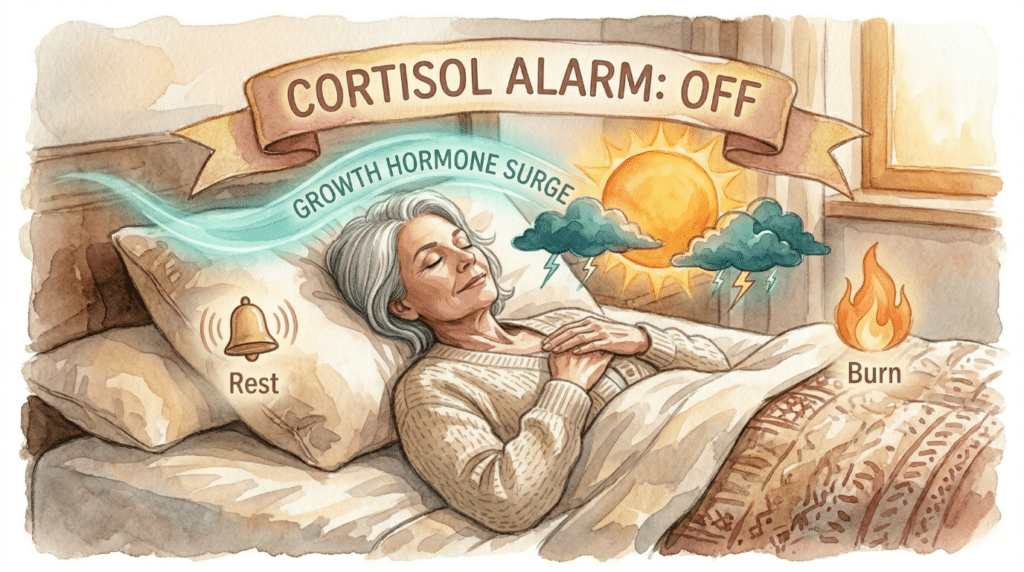
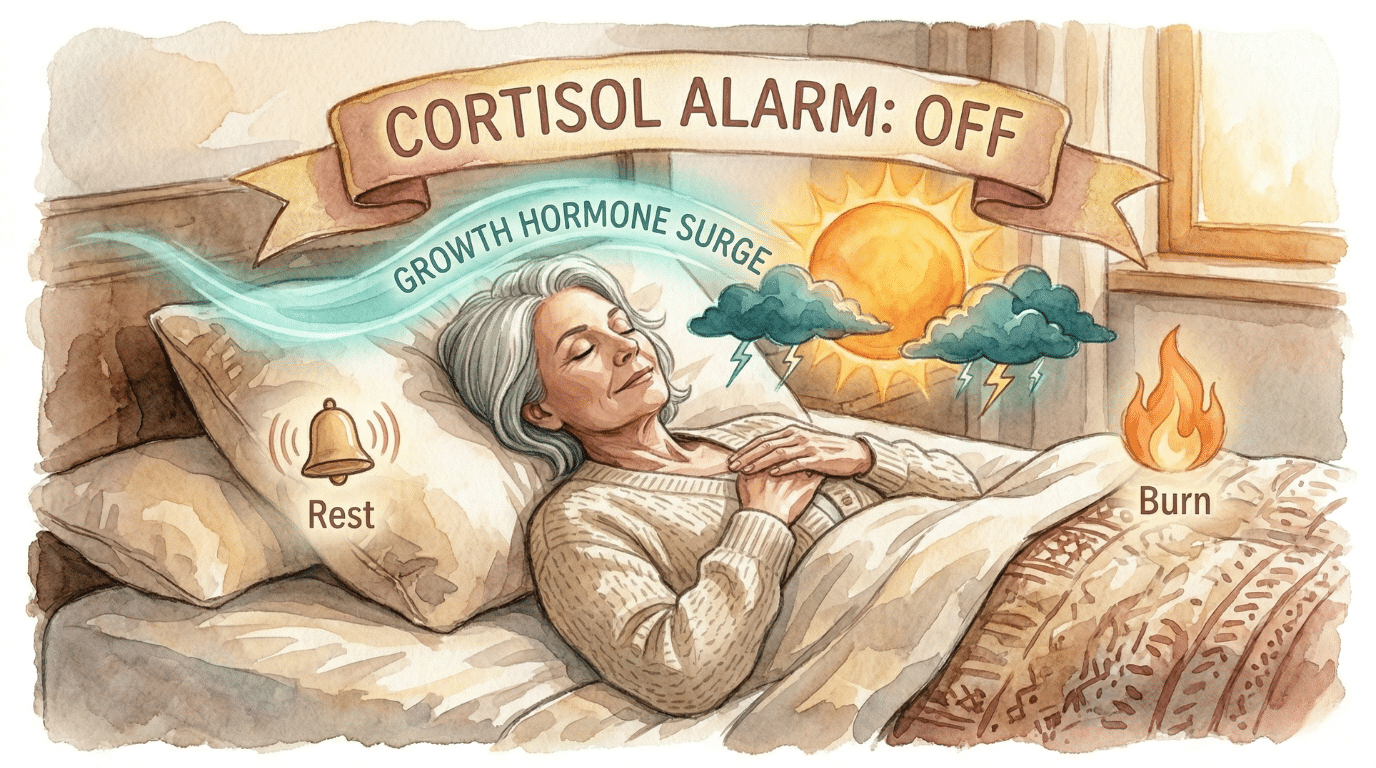
Every night, your body enters a hormonal state designed to burn fat, repair muscle, and restore balance. Growth hormone peaks. Cortisol drops. Cellular repair begins. This window is real, it is biological, and it is available to you every single night, if you stop accidentally closing it before bed.
Your Body Is Running a Program Right Now And You Didn't Write It
Weight loss is not a math problem.
That's the first thing to understand. You've probably spent years treating it like one, counting calories, measuring portions, calculating deficits. And if the math were all that mattered, it would have worked by now.
But your body isn't a spreadsheet. It's a survival machine. And survival machines don't respond to logic. They respond to signals.
Here's what's actually happening beneath the surface. Your body is running ancient biological software, programs that were written hundreds of thousands of years ago, long before grocery stores, long before fridges, long before the concept of “dieting” ever existed. Jon Gabriel calls these FAT Programs.
When your body perceives danger, real or imagined, physical or emotional, these programs activate. And their job is simple: store fat, slow metabolism, protect the organism at all costs.
Your body isn't holding onto fat because it's broken. It's holding onto fat because it thinks it needs to survive.
Think about it this way. If you were in a room slowly running out of air, you wouldn't “try harder” to breathe less. Your lungs would panic. They would gasp. Every instinct in your body would scream for oxygen. You cannot willpower your way out of a biological emergency.
Your body does the exact same thing when it senses threat. It doesn't consult your intentions. It doesn't care that you've been eating salads all week. It just panics and hoards fat.
Sound familiar?
The Science: Growth hormone, your body's primary fat-burning, muscle-building hormone, peaks during the first few hours of deep sleep. But it can only do its job when cortisol, the stress hormone, is LOW. When cortisol remains elevated at bedtime, it suppresses growth hormone release entirely, effectively shutting down your body's natural fat-burning window before it ever opens.
Here's where the night becomes critical. In the hours before sleep, your body is doing something extraordinary. It's reviewing the survival data from your entire day. Was there enough food? Was there threat? Was there danger? Based on that review, it sets its hormonal programming for the night ahead.
This is your nightly metabolic window and most people are accidentally slamming it shut.
Picture this. You're lying in bed, scrolling through your phone. The news is bad. Someone said something on social media that got under your skin. You and your partner had a tense exchange before the lights went out. You drift off eventually, but your nervous system never actually lands.
That's not a discipline failure. That's a cortisol problem. And it's costing you far more than a bad night's sleep.
Jon Gabriel didn't crack his own 220-pound transformation by simply changing what he ate. He discovered that the internal environment he created before sleep was the linchpin. The mind-body reset before bed wasn't a luxury, it was the signal his body had been waiting for. The signal that said: it's safe now. You can let go.
What Your Body Decides While You Sleep
Every night, your hormonal environment sends your body one of two messages. The first message is threat: cortisol stays high, growth hormone is suppressed, fat storage continues, and repair is minimal. The second message is safety: cortisol drops, growth hormone surges, fat-burning begins, and the body rebuilds. The difference between these two outcomes isn't determined at the gym or at the dinner table. It's determined in the hour before you close your eyes.
Bedtime is not the end of your day. It's the beginning of your body's most important work.
You aren't trying to force weight loss at night. You're trying to give your body permission to do what it already wants to do, what it was always designed to do, when it finally feels safe enough to do it.
That shift in understanding changes everything.
The Cortisol Crisis and Why Stress Is Keeping You Fat While You Sleep
Here's something nobody tells you when you're white-knuckling your way through another diet.
You can eat perfectly. You can exercise consistently. You can do everything the magazines tell you to do. And your body can still refuse to let go of a single pound.
The missing variable? What's happening in your nervous system after dark.
Let's talk about cortisol, because this hormone is quietly running the show for millions of people who can't figure out why nothing is working.
Cortisol is your body's built-in alarm system. When your brain perceives a threat, any threat, cortisol surges through your bloodstream. Heart rate up. Muscles tensed. Senses sharpened. Your body is ready to fight or flee.
It's an extraordinary system. It kept your ancestors alive.
The problem is that your body cannot tell the difference between a charging tiger and a stressful text message at 10pm. Both trigger the exact same hormonal cascade. The tiger is more dramatic. The text message is more common. But to your nervous system, the response is identical.
The Science: Cortisol signals the body that resources are scarce and danger is present. In response, your metabolism slows, your hunger increases for calorie-dense foods like sugar and fat, and your body actively stores fat, particularly around the abdomen. This is your FAT Program activating in real time, doing exactly what it was designed to do.
And here's where it gets especially important for your sleep.
Cortisol has a natural daily rhythm. It should be at its lowest point between midnight and 4am, that's when your body does its deepest repair work, its most potent fat-burning, its most critical hormonal restoration. Then it begins rising naturally toward dawn to gently wake you up.
But when you go to bed stressed, that curve gets flattened. Inverted. Your body never drops into the deep, restorative sleep state it needs. Growth hormone, the hormone that burns fat and rebuilds muscle, can't do its job. Every night you go to bed wired is a night your body spends in fat-storage mode.
Sound familiar?
The Hidden Cortisol Triggers You're Probably Missing
Most people blame stress at work. But these everyday evening habits are quietly spiking your cortisol long after the workday ends:
- Scrolling news and social media, your brain processes threat-based information loops as real danger
- Bright screen light, tells your brain it's midday, suppressing melatonin and keeping cortisol elevated
- Unresolved emotional loops, arguments, anxieties, mental to-do lists your mind keeps rehearsing
- Blood sugar crashes from eating refined foods or too little at dinner
- Inflammatory evening foods that spike insulin and disturb your sleep architecture
Going to bed stressed is like leaving your car engine running all night. By morning, you've burned through your reserves and the car hasn't actually gone anywhere.
Jon Gabriel's own 220-pound transformation wasn't just about what he ate. It was about understanding that you cannot out-eat a stressed nervous system. The internal environment he cultivated before sleep, the safety signals he sent his body every night, was just as critical as anything that happened during the day.
This is the pattern you see again and again. Someone doing everything right. Hitting their macros. Showing up to their workouts. But skipping the evening cortisol reset entirely, because nobody told them it mattered.
It matters enormously.
Cortisol doesn't know you're just watching the news. It thinks you're running from something. And as long as it believes that, it will keep your body locked in protection mode, storing fat, disrupting sleep, and resisting every effort you make to change.
The good news? Your body responds fast to safety signals. You don't need months to shift this. The right bedtime protocol can begin changing your hormonal environment tonight, starting with the very next thing you do before you close your eyes.
The Light Problem and How Your Phone Is Hacking Your Hormones
There is a villain in your bedroom. And it is probably charging on your nightstand right now.
Your body runs on an ancient internal clock called your circadian rhythm. This clock governs almost everything, when you feel awake, when you feel tired, when your body releases fat-burning hormones, how sensitive your cells are to insulin, and when your tissues repair themselves.
It is not just a sleep clock. It is a metabolic clock. And the primary signal it uses to set itself is light.
Here is how it is supposed to work. As evening comes and light fades, your brain detects the darkness and begins releasing melatonin. Melatonin signals the body that it is safe to downshift. Cortisol drops. Body temperature falls. And your nervous system finally exhales, opening the door to the deep, restorative, fat-burning sleep your body is designed for.
Simple. Elegant. Ancient.
Now here is what actually happens for most people.
At 9pm, you are horizontal on the couch, scrolling through your phone. At 10pm, you are in bed watching something on a tablet. At 11pm, you do one last check of Instagram before you finally put it down.
And your brain? Your brain thinks it is noon.
The Science: Blue-spectrum light, the kind emitted by phones, tablets, laptops, and LED televisions, directly suppresses melatonin production by signaling to your brain that the sun is at its peak. Even 30 minutes of screen exposure after dark can delay melatonin release by 90 minutes to three hours, pushing your body's entire fat-burning repair window back or eliminating it entirely.
Melatonin suppression is not just a sleep problem. When melatonin stays low, cortisol stays elevated. When cortisol stays elevated, your body stays in a state of alert, scanning for threats, holding onto fat, refusing to enter the deep sleep cycles where growth hormone does its best work.
You are not just losing sleep. You are losing your nightly fat-release window.
What Blue Light Actually Does to Your Metabolism
Late-night screen exposure creates a chain reaction that works directly against fat loss. Melatonin is suppressed, which keeps cortisol elevated, which blunts growth hormone release, which shifts your body away from fat-burning and toward fat-storage, all while you think you are simply unwinding before bed.
Sound familiar? This is the pattern. You feel tired but wired. You struggle to fall asleep. You wake up exhausted. And no matter how clean you eat or how often you exercise, the weight just sits there.
The good news is that this particular villain is easy to disarm.
Start with a simple rule: no screens within 60 minutes of sleep. That single change begins restoring your hormonal rhythm immediately, not in weeks, not after some adjustment period. Tonight.
If that feels impossible, start smaller. Use night mode or a blue-light filter app. Dim every screen in your home after 8pm. Swap the phone for a book, a conversation, or silence. Your circadian clock is extraordinarily responsive. Give it the signal it is waiting for, and it will begin doing what it was always designed to do.
Your phone is not helping you wind down. It is keeping your body in the middle of the day. And a body stuck at noon cannot burn fat at midnight.
If you're ready to stop fighting your body and actually start working with it, Jon Gabriel would like to invite you to experience the complete step-by-step system inside the 12-Week Total Transformation Program.