
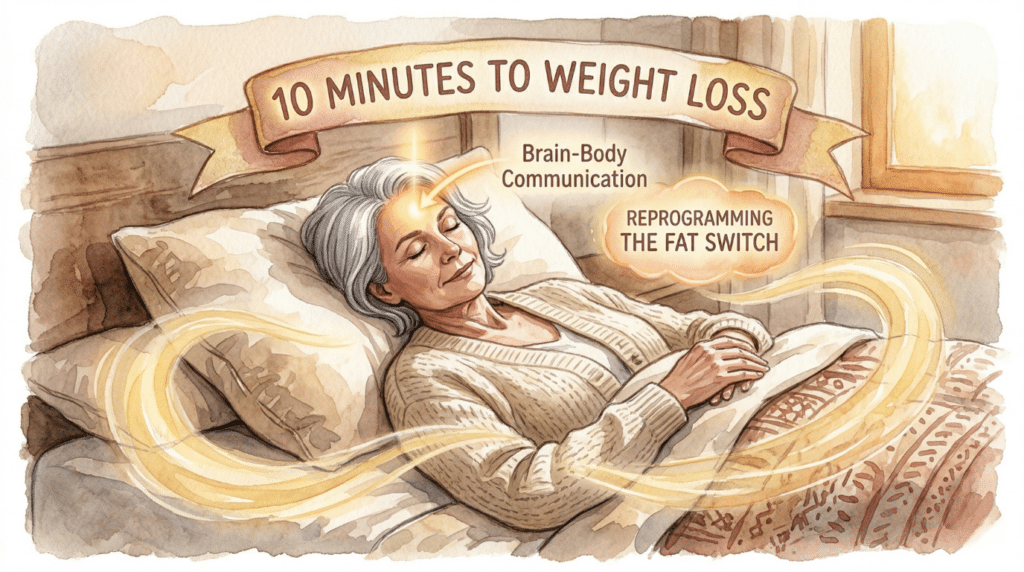
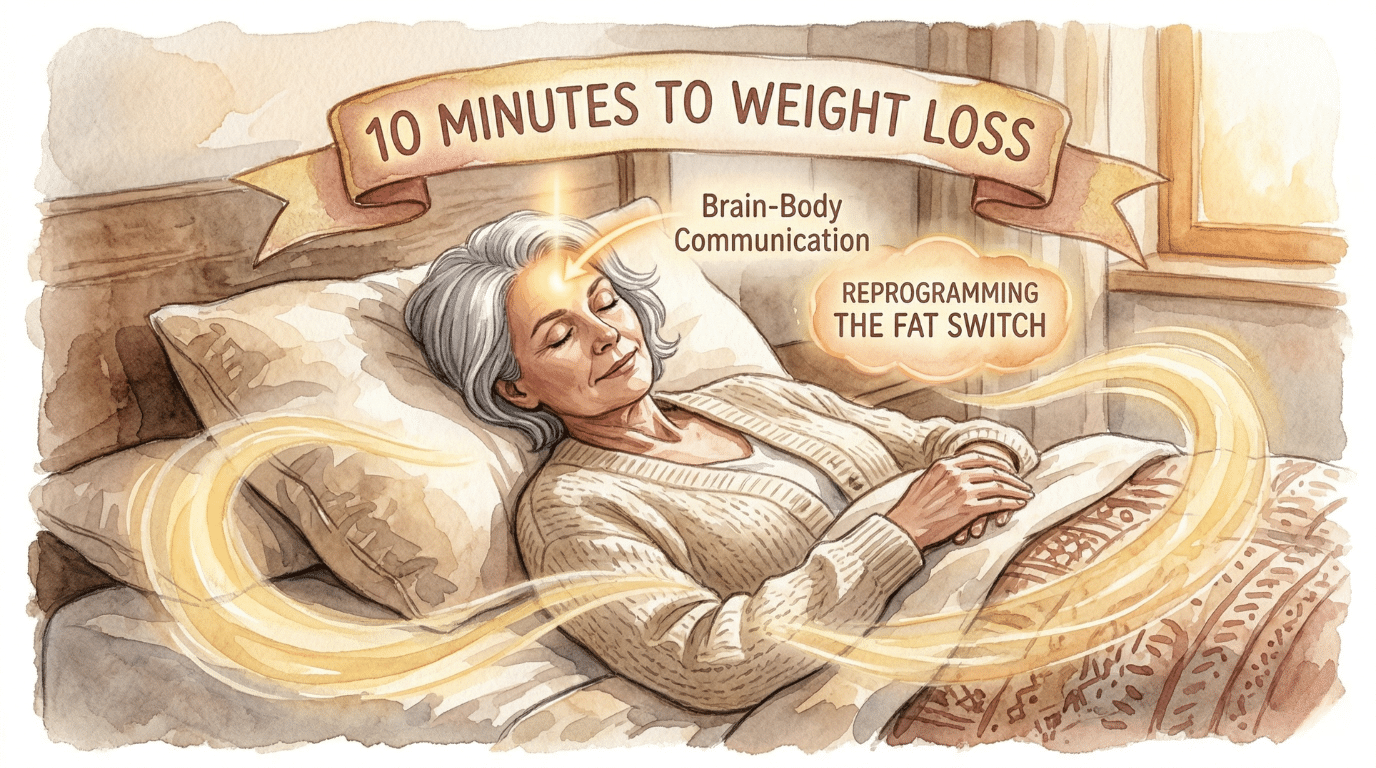
What if the most powerful weight-loss tool you have isn't in your kitchen, your gym, or your medicine cabinet, but in the 10 minutes before you fall asleep?
We know. That sounds too simple. Maybe even a little ridiculous.
You've been told the answer is discipline. Fewer calories. More cardio. A better meal plan. You've tried those things. Maybe you've tried all of them multiple times with everything you had.
And still, your body holds on.
Sound familiar?
Here's what most people don't know: it's not a willpower problem. It's not a laziness problem. It's not even a diet problem. It's a programming problem.
Your body is running a biological program beneath your conscious awareness. A program that decides, completely without your permission, whether to store fat or release it. And every diet you've ever tried has been fighting that program head-on.
No wonder it hasn't worked.
You can't outrun a program you haven't changed.
By the end of this post, you'll understand exactly how your brain creates physical fat storage, and how to use that same mechanism to reverse it. No gym required. No calorie counting. No willpower wars.
Just a new understanding of what your body is actually responding to and how to speak its language.
The Hidden Driver of Weight Gain
Research shows the brain and body are in constant communication and the brain's perception of safety or danger directly controls your body's fat-storage signals. Change what your brain perceives, and you change what your body does. That's not a metaphor. That's biology.
Your Body Is Running a Program And You Didn't Write It
Your body is not broken. It is doing exactly what it was designed to do.
That's the hardest thing to accept when you've been fighting your weight for years. Because if your body isn't broken, then why does every diet feel like pushing a boulder uphill and the moment you stop pushing, the boulder rolls right back?
The answer comes down to one thing: FAT Programs.
A FAT Program is your body's built-in survival mechanism. It's a biological instruction, encoded deep in your nervous system, that tells your body to store fat and hold onto it at all costs. Not because you lack discipline. Not because you're weak. But because something, somewhere, has convinced your body that the world is not safe right now.
And when your body believes it's not safe, fat storage isn't a mistake. It's the plan.
Think about it this way. If you walked into a room where the oxygen was being slowly drained out, you wouldn't decide to panic. You wouldn't need to think about it. Your body would gasp. Your heart would race. Your entire physiology would shift into emergency mode, automatically, instantly, without your permission.
You can't willpower your way out of that response. You can't white-knuckle your way through low oxygen and pretend everything is fine.
Fat storage works the same way.
When your body detects a threat, real or perceived, it activates the FAT Program the same way it would activate a gasp reflex. It isn't a character flaw. It's a survival response that kept your ancestors alive through famines, droughts, and brutal winters. The problem is that this ancient system hasn't gotten the update that you're living in a modern world with a grocery store two minutes away.
There are two classic FAT Program triggers. The first is famine, caloric restriction, skipping meals, crash dieting. Every time you dramatically cut calories, your body reads that as: food is disappearing, we must be starving. Store more. Burn less. The second is temperature, cold environments and perceived scarcity that signal winter is coming and resources are running out.
But today, there's a third trigger that's quietly running in the background for millions of people. And it's the most powerful one of all: chronic stress.
The Science: Your brain cannot distinguish between a physical threat and a psychological one. Unresolved emotional stress, anxiety, old trauma, chronic overwhelm, activates the same biological danger signals as a physical famine. Your FAT Program doesn't care whether the threat is real or remembered. If the signal says danger, it stores fat.
Jon Gabriel understood this from the inside out. At 400 pounds, he wasn't lazy. He wasn't undisciplined. By every external measure, he was a successful, intelligent person. But deep inside his nervous system, a very old program was running on a loop: The world is not safe. Store energy. Protect yourself.
The diet industry told him the solution was willpower. Eat less. Move more. Push harder. But every time he tried to force his body into submission, the FAT Program just got louder. Because restriction looked like famine. And pressure looked like threat. And threat meant: store more.
The turning point didn't come from a better diet. It came when Jon stopped fighting the program and started asking a different question entirely.
What Actually Triggers a FAT Program
Your body activates fat-storage mode in response to perceived danger, not just physical scarcity. The three main triggers are famine (dieting and caloric restriction), cold temperatures (physical or environmental scarcity), and chronic psychological stress (unresolved fear, trauma, or emotional overwhelm). All three send the same message to your brain: it is not safe to be lean right now. Until that signal changes, your body will resist every attempt to lose weight, not out of stubbornness, but out of survival.
So where does that signal come from? Who's sending the danger alert in the first place?
The answer lives entirely in your brain. Specifically, in neural pathways that were built, often in childhood, often in moments of fear or scarcity, and that now fire automatically, below the level of conscious thought. You didn't choose them. You don't even know they're there most of the time. But they are running, constantly, quietly shaping every craving, every metabolic response, every moment of self-sabotage you've ever blamed yourself for.
The question isn't: “How do I force my body to lose weight?”
The question is: “What is my body trying to protect me from and how do I convince it that it's safe?”
What Neuroscience Actually Says About Mental Practice
Let's get something straight before we go any further.
Visualization is not a feel-good ritual. It is not positive thinking. It is not something reserved for athletes, monks, or people with too much time on their hands.
It is a biological event. And the science behind it is about as “woo-woo” as gravity.
Here's the foundational fact that changes everything: your brain cannot fully distinguish between a vividly imagined experience and a real one.
This isn't a metaphor. This is documented, reproducible neuroscience.
When you vividly imagine biting into a sour lemon, really picture it, feel the juice hitting your tongue, you salivate. Your body responds. No lemon required. When you imagine lifting a heavy weight, the same motor neurons fire as when you physically lift it. Your muscles show measurable activation. From the inside, your nervous system is getting a real signal.
Mental input is biological data. Full stop.
Think about what that means for you. Every anxious thought about your body. Every moment of dread stepping on the scale. Every time you've replayed a moment of failure or shame around food, your body was responding to all of it. Processing it as real. Reacting accordingly.
That's not a small thing. That's your whole system being shaped, daily, by the mental imagery you're feeding it.
The Science: Research on mental rehearsal in athletes consistently shows that imagining physical movement activates the same neural circuits as performing it, leading to measurable gains in strength, coordination, and performance without a single rep being physically completed.
If an athlete can build strength by imagining movement, ask yourself this: what do you think happens to your metabolism when you spend time every night imagining yourself as lean, healthy, and at ease in your body?
The answer matters. Because the same mechanism works in both directions.
This brings us to neuroplasticity, which simply means your brain is not fixed. It can change. It changes based on what you repeatedly think, feel, and imagine. Every thought you repeat is like walking a path through tall grass. The first time, it's hard going. Walk it a thousand times, and it becomes a highway. Your current stress responses, your cravings, your automatic reach for comfort food at 10pm, those are all well-worn highways. Deeply rutted. Running on autopilot. Visualization starts building new roads.
Now here's where it connects directly to fat storage.
Cortisol, your primary stress hormone, directly signals your body to store visceral fat. It also triggers intense cravings for high-sugar, high-fat foods. This isn't a character flaw. It's an ancient survival mechanism. When there's danger, load up on calories. Your body is doing its job.
But here's what most people don't know: your brain releases cortisol in response to perceived danger, including imagined danger. A stressful thought triggers the same cortisol cascade as a real threat. Replaying a painful memory? Cortisol. Dreading tomorrow? Cortisol. Lying in bed cataloguing everything wrong with your body? Cortisol, cortisol, cortisol.
The flip side is equally true.
A calming, safe mental image signals your nervous system to downregulate cortisol. To shift from sympathetic mode — fight-or-flight, fat-storing, survival-focused, into parasympathetic mode. Rest. Digest. Repair. Release.
The Cortisol-Fat Connection: By the Numbers
Three documented effects of mental imagery your body responds to right now:
- Salivation: Imagining sour or appetizing food triggers measurable saliva production, your digestive system activating without a single bite.
- Muscle activation: Mental rehearsal of physical movement produces real neuromuscular firing in the target muscles, confirmed by electromyography studies.
- Heart rate changes: Vividly imagining a stressful scenario elevates heart rate. Imagining a peaceful one lowers it. Same brain, same body, different instruction.
Your body is listening to everything you imagine. It always has been.
The only question is whether you've been deliberate about what you're feeding it, or whether you've been running old, fear-based mental loops on autopilot and wondering why nothing changes.
Every visualization session is a literal biological event. It is not imagination. It is instruction.
SMART Mode: Your Brain's Hidden Update Window
There's a moment, right before you fall asleep, when your mind goes soft.
Your thoughts slow down. The mental chatter fades. You're not quite awake, but you're not quite gone either. You exist somewhere in between.
Most people let that moment slip by without a second thought.
Jon Gabriel discovered it's the most important moment of your entire day.
That threshold state has a name in neuroscience, the hypnagogic state. And it happens twice a day, every single day, without you having to do a thing. Once as you drift off to sleep. Once as you surface from it in the morning, before full waking consciousness kicks back in. That morning window is called the hypnopompic state.
Together, these two windows are what The Gabriel Method calls SMART Mode, Super Mental Alert Reeducation Training.
Let's unpack that name quickly, because every word matters.
Super Mental Alert doesn't mean you're buzzing with energy. It means your subconscious mind is wide open, highly receptive, with its normal defenses lowered. Reeducation Training means you're not just relaxing. You're deliberately feeding your subconscious new information. New images. New feelings. New instructions.
This is not passive. This is precise.
The Science: During the hypnagogic and hypnopompic states, your brain shifts from beta waves (active, analytical thinking) into alpha and theta waves, the same frequencies associated with deep meditation, hypnosis, and accelerated learning. In these states, the critical filter between your conscious and subconscious mind relaxes. New beliefs, images, and emotional patterns can be absorbed directly, without resistance.
Think about what that means for your FAT Programs.
Those programs don't live in your rational mind. You can't argue your way out of them. You can't white-knuckle through them with a meal plan and a motivational quote. They live in your subconscious, in the deep, ancient, survival-wired part of your brain that doesn't speak logic. It speaks feeling. It speaks image. It speaks repetition.
SMART Mode is the only elevator that goes to that floor.
Here's the analogy that makes this click: Imagine your brain is a smartphone. During the day, you're running forty apps at once, work stress, family obligations, to-do lists, background anxiety. Try to install a major software update while all those apps are running, and the update fails. Or it installs badly. Or the phone just freezes.
SMART Mode closes all the other apps. The phone is quiet. The update installs cleanly. That's when real change gets written into the system.
This is the critical difference between SMART Mode and the kind of daydreaming most people do. Daydreaming is random. Your mind wanders wherever it wants, often back to the same worried loops, the same self-critical stories. There's no direction. No intention. No new programming being written.
SMART Mode is directed visualization delivered at the exact biological moment your subconscious is most receptive.
Your First SMART Mode Practice
You don't need special equipment. You don't need an hour. You need about ten minutes and a willingness to try something that actually works.
Step 1: As you're lying in bed tonight, just before sleep, let your body fully relax. Don't fight for sleep, just soften. Notice when your thoughts start to slow down. That's your signal. You've arrived at SMART Mode.
Step 2: Bring a single image to mind: you, at your ideal weight. Don't analyze it. Don't judge it. Just see it. Feel what it feels like to be in that body, energized, comfortable, at ease. Make the image as vivid and sensory as you can. Then simply hold it as you drift off.
That's it. That's the entry point.
What you do in those ten minutes isn't just relaxation. It's a direct communication to the part of your brain that controls your FAT Programs, delivered in the exact language it understands, at the exact moment it's listening.
You've been trying to change your body from the outside. SMART Mode lets you change it from the inside out.
You don't have to figure out how to rewire your biology all on your own. To get the exact daily visualizations and mind-body tools Jon used, check out the 12-Week Total Transformation Program.