
You ate a solid meal two hours ago.
And yet here you are. Hungry again.
Maybe you're standing in front of the fridge at 10pm, hating yourself for it. Telling yourself you have no self-control. That you're weak. That if you just had a little more willpower, you'd finally crack this thing.
Stop right there.
This is not a willpower problem. This is a hormone problem.
And that distinction changes everything.
Think about it this way. If you were locked in a room with low oxygen, you'd gasp. You'd breathe faster and faster, desperately pulling at the thin air. Would you call yourself greedy for oxygen? Would you feel ashamed for needing to breathe?
Of course not. You'd be responding exactly the way your biology designed you to respond.
That's what's happening in your body right now. Your cells are sending hunger signals, not because you're broken, but because a very specific hormonal conversation has gone wrong. The signal is misfiring. And no amount of restriction, shame, or white-knuckle willpower can fix a broken biological signal.
Jon Gabriel weighed over 400 pounds and tried every diet imaginable. The hunger never stopped. Not because he lacked discipline, but because his hunger hormones were completely dysregulated, running on a loop his conscious mind couldn't override.
By the end of this post, you'll understand exactly why that happens and you'll have a clear, actionable path to finally fix it at the source.
The Real Reason Diets Always Fail You
Hunger isn't a character flaw. It's a hormonal signal. When two key hormones, leptin and ghrelin, fall out of balance, your brain genuinely believes you are starving. No diet can override that signal. But a biological reset can.
The Hunger You Feel Isn't Real, It's a Signal Gone Wrong
Your body runs on two hunger hormones. Just two. And when they're working the way they're supposed to, you eat when you need to, stop when you're full, and your weight takes care of itself.
But when they're broken? You're hungry all the time. You store fat no matter what you eat. And no amount of willpower makes a dent.
Here's who the players are.
Ghrelin is your hunger alarm clock. It's made in your stomach, and it rises before meals to tell your brain: time to eat. Once you've eaten, it drops. Simple. Clean. Effective, when it's working right.
Leptin is your “I'm full and safe” hormone. It's produced by your fat cells, and its job is to send a message to your brain: you have enough stored energy. You don't need more food right now. In a healthy system, the more body fat you carry, the more leptin you release, and the brain responds by dialing hunger down.
Think of them like a thermostat. Ghrelin turns the heat on. Leptin turns it off. Together, they keep your body in balance, automatically, without you having to think about it.
That's how it's supposed to work.
When the Thermostat Breaks
Here's where it all falls apart. In millions of people, especially those who have spent years dieting, under stress, or eating processed food, the brain stops hearing the leptin signal.
This is called Leptin Resistance. And it changes everything.
Your fat cells are still producing leptin. They're sending the signal. But the brain isn't receiving it. The thermostat is broken. So the brain does what any system does when it thinks it's starving: it activates the Fat Programs. It upregulates fat storage enzymes. It cranks hunger to maximum. It tells you to eat more and move less.
And you feel it as relentless, gnawing, never-goes-away hunger.
The Science: When leptin resistance develops, the brain literally cannot detect how much stored energy you have. It interprets a full body as a starving one and responds with the same survival programs that kept your ancestors alive during famine.
Jon Gabriel understood this from the inside. At 400 pounds, he wasn't overeating because he was lazy or undisciplined. He was dieting harder than almost anyone he knew and getting hungrier every time. Restrict. Binge. Shame. Repeat. The cycle never ended because the biology was never addressed.
His body wasn't broken. It was doing exactly what it was designed to do. The problem wasn't him. It was a broken signal.
The Empty Calorie Trap
Now layer in another piece of the puzzle: MT Calories.
MT Calories are what Jon calls the empty, hollow calories that flood modern processed food. High in energy. Near-zero in real nutrients. Your cells receive a surge of calories, but none of the vitamins, minerals, and co-factors your body is actually searching for.
So what does the brain do? It keeps the hunger signal on. It keeps looking.
Think about it this way. Imagine breathing thin air at altitude. You breathe faster and faster, desperate for oxygen. You're not being greedy. You're not weak. You are starving for what you actually need. That's exactly what happens when you eat MT Calories. Your body keeps sending the hunger signal, not for more food, but for the nutrients that food never delivered.
Why Dieting Makes It Worse
Here's the part that will stop you in your tracks.
When you cut calories, your body produces more ghrelin. Not less. Dieting literally turns up your hunger hormone.
Your body cannot tell the difference between a self-imposed calorie deficit and an actual famine. Both look the same biologically. So it responds the same way, by fighting back harder. More hunger. More cravings. Slower metabolism. Greater fat storage efficiency.
Every diet that failed you? This is why.
Your Two Hunger Hormones at a Glance
Leptin = Your Fat Thermostat. When it's working, your brain knows you're full and safe. When it's broken, your brain thinks you're starving, even when you're not.
Ghrelin = Your Hunger Alarm Clock. It rises when you need to eat, and drops when you're satisfied. Dieting and chronic stress keep it ringing, all day, every day.
When both are dysregulated, you are always hungry and always storing fat. This is not a character flaw. This is biology.
The good news? Biology can be reset. And that's exactly what the rest of this post is going to show you how to do.
What Breaks Your Hunger Hormones in the First Place?
Here's the question nobody in the diet industry wants you to ask.
If your hunger is a hormone problem, not a willpower problem, then what broke your hormones to begin with?
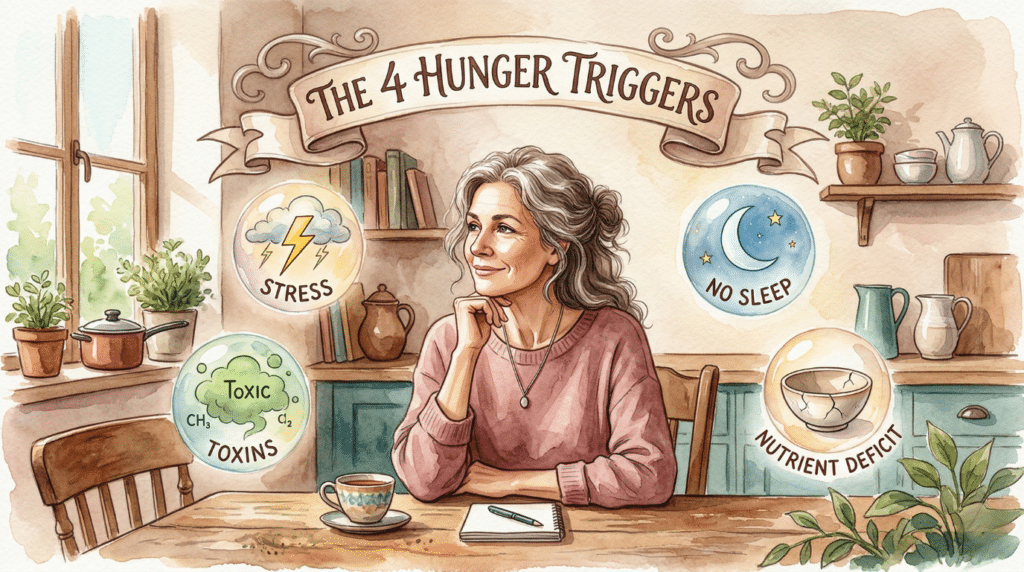
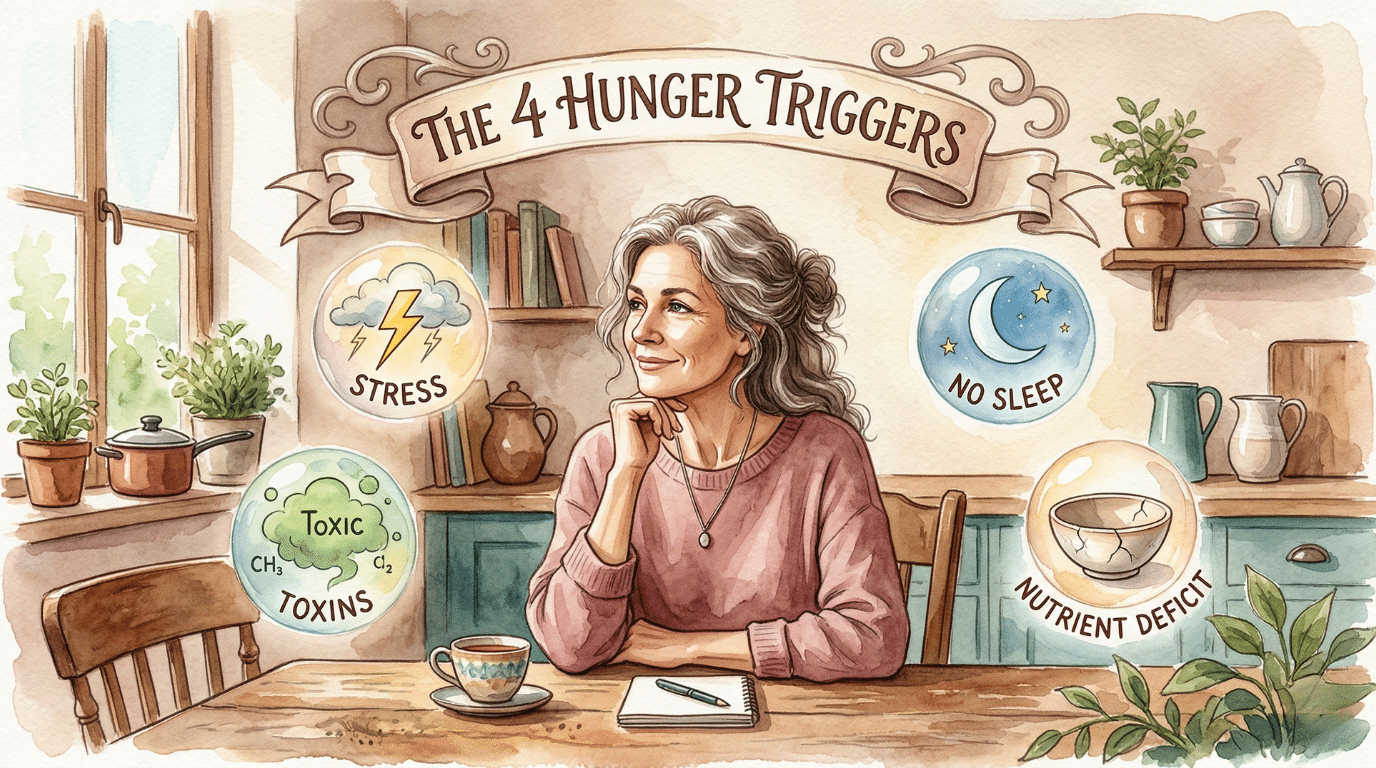
The answer isn't one thing. It's four. And every single one of them is systemic, environmental, and largely outside your conscious control. Which means none of this is your fault. The system is broken. Not you.
1. Nutritional Starvation, The Big One
This one catches people off guard. Because how can you be starving when you're eating plenty of food?
Simple. Your cells aren't starving for calories. They're starving for nutrients.
Modern processed food is loaded with what Jon Gabriel calls MT Calories, empty energy that floods your bloodstream but delivers almost zero usable nutrition to your cells. No vitamins. No minerals. No living enzymes. Just fuel with no information attached.
Think of it this way. The real benefit of any food can be measured like this: Benefit = (Nutrient Density × Bioavailability × Digestibility) ÷ Toxins. When that formula produces a low number, which it does for almost every packaged, processed, fast food product on the market, your brain keeps the hunger signal running. It's still searching for what it never received.
You can eat 2,000 calories of nutritionally empty food and your body will still behave like it's starving. Because biologically, it is.
2. Chronic Stress, The Silent Disruptor
Stress doesn't just make you feel terrible. It directly rewires your hunger hormones.
When cortisol, your primary stress hormone, stays chronically elevated, it blocks leptin signaling at the brain. The “I'm full” message gets scrambled. At the same time, cortisol spikes ghrelin, your hunger alarm hormone. The result is a relentless cortisol-ghrelin feedback loop that keeps driving you toward food.
You don't eat badly because you're weak. You eat because your stress hormones are literally commanding you to.
Jon lived this firsthand. At his heaviest, he wasn't just eating too much, he was carrying enormous unprocessed stress in his body. The food wasn't the root problem. The stress response was.
The Science: Chronically elevated cortisol doesn't just increase appetite, it specifically increases cravings for high-fat, high-sugar foods by activating the brain's reward circuitry, creating a biological preference for the very foods that deepen leptin resistance.
3. Poor Sleep, The Overnight Hormone Thief
This one is staggering when you see the numbers.
Just one night of poor sleep reduces leptin by up to 18% and increases ghrelin by up to 24%. One night. Your brain interprets tiredness as an energy deficit and dials up hunger to compensate.
Sound familiar? That desperate, almost frantic hunger after a bad night's sleep isn't weakness. It's your sleep-deprived brain trying to find energy the only way it knows how.
4. Toxic Load, The Jammed Lock
This is the one that almost never gets talked about.
Endocrine-disrupting chemicals, found in pesticides, plastics, artificial food additives, and even common household products, physically interfere with your hormone receptor sites. Including your leptin receptors.
Think of it like a key jammed in a lock. Even if your body is producing leptin correctly, the signal can't get through. The receptor is blocked. The brain never receives the “you're full, stop eating” message and the hunger stays on.
The 4 Things Breaking Your Hunger Hormones
1. Nutritional Starvation: MT Calories flood your body with energy but starve your cells of real nutrients, keeping the hunger signal permanently switched on.
2. Chronic Stress: Elevated cortisol blocks leptin and spikes ghrelin, creating a biological command to keep eating.
3. Poor Sleep: Even one bad night cuts your “full” signal by 18% and cranks your hunger hormone up by 24%.
4. Toxic Load: Endocrine disruptors jam your hormone receptors, making leptin invisible to your brain no matter how much your body produces.
None of these are character flaws. All of them are fixable.
And once you understand what's actually driving the hunger, you can finally start working with your biology instead of fighting it every single day.
If you're ready to stop fighting your body and actually start working with it, Jon would like to invite you to experience the complete step-by-step system inside the 12-Week Total Transformation Program.