
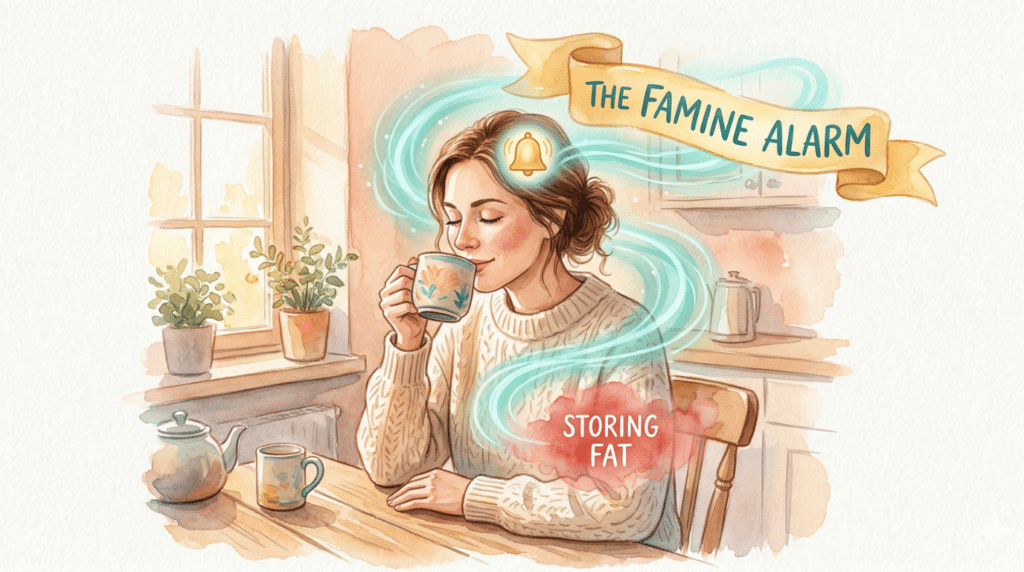
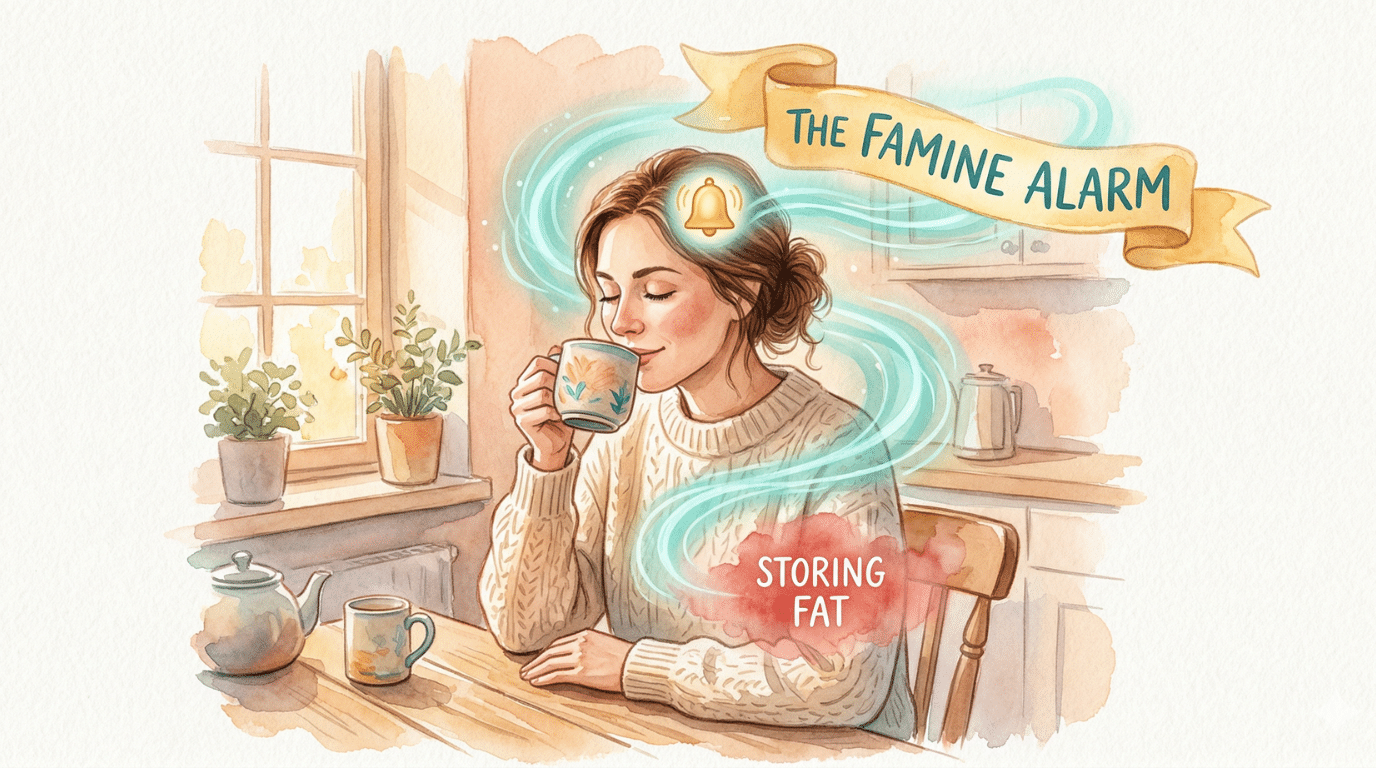
You’ve done everything right.
You’ve cut the calories. Tracked every macro. Said no to the bread basket. Pushed through the hunger pangs at 3pm with nothing but willpower and quiet desperation.
And your body held on to every single pound like its life depended on it.
Here’s the thing, as far as your brain is concerned, it did.
That’s not a metaphor. That’s neuroscience. And once you understand it, everything about your history with dieting will finally make sense.
Your brain is not a weight loss calculator. It doesn’t know about your reunion next month, your doctor’s advice, or your new gym membership. It knows exactly one thing: Are we safe, or are we starving?
And here’s the cruel twist most diets never tell you, the harder you restrict, the louder that alarm bell rings. The stronger the biological backlash. The more aggressively your body fights to hold on.
This isn’t a character flaw. It’s ancient survival programming, running exactly as designed.
By the end of this post, you’ll understand precisely why every diet you’ve ever tried was working against your own biology and what it actually takes to change that.
Why This Isn’t About Willpower
The diet industry has spent decades telling you that weight loss is simple math, eat less, move more. But your brain isn’t doing math. It’s running a survival program hundreds of thousands of years old. Understanding that program is the first step to finally working with your biology instead of against it.
You’re Not Broken. Your Brain Is Running an Ancient Program.
It’s not your fault. It’s your biology.
Read that again. It’s not your fault. It’s your biology.
I know that’s not what the diet industry told you. I know it’s not what you’ve been telling yourself every time you stepped on the scale and felt that familiar wave of disappointment. But it is the truth and understanding it changes everything.
Here’s what nobody explains: your body is not a calorie-counting machine.
It never was. It was never designed to be.
Your body is a survival machine, engineered over hundreds of thousands of years to solve exactly one problem: don’t die. That’s it. That’s the whole job description.
Your brain doesn’t know what year it is. It doesn’t know about nutrition labels or gym memberships or beach season. It knows one thing: is there enough food to keep you alive?
When the answer feels like “no,” it acts accordingly. Aggressively. Relentlessly. Without apology.
Think about what your ancestors actually faced. Long winters with no food. Droughts that wiped out entire food supplies. Hunting seasons that came up empty for weeks at a time. The humans who survived those conditions were the ones whose bodies were exceptional at storing fat and holding onto it under pressure.
That survival wiring is a miracle. It’s the reason the human species is still here.
But in a world of 24-hour grocery stores and chronic dieting culture, that same miraculous wiring becomes your biggest obstacle to losing weight.
The Science: When your body detects a sustained drop in food intake, it activates what researchers call survival metabolism, a suite of biological responses that slow fat burning, increase fat storage efficiency, and ramp up hunger signals. This is not a malfunction. It is a finely tuned emergency protocol that has kept humans alive for millennia.
These biological survival switches have a name. I call them FAT Programs (the biological switches for Famine and Temperature that drive fat storage).
When your FAT Programs are activated, your body stores fat aggressively. It resists releasing it at all costs. It fights you at every turn, not because it’s broken, but because it’s doing exactly what it was built to do.
“Your body isn’t holding onto fat because it’s failing. It’s holding on because it’s working perfectly, just on the wrong instructions.”
FAT Programs are not a bug. They are a feature. The problem isn’t the program itself. The problem is that your brain is receiving the wrong signal.
Think of it this way. A soldier stationed in a war zone doesn’t stand down just because someone tells him the war is over. He needs proof. Consistent, repeated signals of safety, before he lowers his weapon and relaxes his guard.
Your body works exactly the same way.
You can’t simply declare a ceasefire with a salad. You can’t convince your hypothalamus with three days of clean eating. You have to send your biology the sustained signal that the famine is over and that takes a completely different approach than anything the diet industry has ever sold you.
When I was carrying over 220 pounds, I tried every diet. I didn’t understand yet that every restriction was sending my brain deeper into emergency mode.
I wasn’t failing the diet. The diet was activating my FAT Programs.
What Are FAT Programs And Why Are Yours Switched On?
FAT Programs are your body’s ancient survival switches. “FAT” stands for Famine and Temperature, the two primary biological threats your ancestors faced. When your brain detects either of these threats (or anything that mimics them, including caloric restriction and chronic stress), it switches into full fat-storage mode. Your metabolism slows. Your hunger hormones surge. Your body becomes more efficient at converting food into stored fat. Understanding that these programs exist, and that you are not the problem, is the first step to finally switching them off for good.
The moment you understand that your struggles have a biological cause, not a character flaw at the center, something shifts.
You stop fighting yourself.
And you start working with your biology instead of against it.
That’s where real, lasting change begins.
The Moment You Cut Calories, Your Brain Declares an Emergency
The day you start a diet, something happens inside your brain that nobody in the diet industry tells you about.
It’s not motivation kicking in. It’s not your metabolism “resetting.” It’s an alarm going off.
Deep inside your brain sits a small, ancient structure called the hypothalamus. Think of it as mission control for your entire body. It monitors your energy levels, your nutrient intake, your hormone signals, all of it, constantly, in real time.
The moment your caloric intake drops significantly, the hypothalamus doesn’t think: “Great, we’re trimming down for summer.”
It thinks: “The food supply has collapsed. This is a survival emergency.”
And then it acts accordingly.
Here’s the hormonal cascade that fires off the second you start restricting:
- Cortisol rises, your primary stress hormone spikes, signaling to every cell in your body that resources are dangerously scarce.
- Leptin drops, the hormone that tells your brain “we’re safe, we have enough stored energy” falls sharply, triggering a full-scale panic response.
- Fat storage enzymes upregulate, your body literally rewires itself to convert more of what you eat into fat, bracing for the famine it now believes is coming.
- Metabolism slows, your body throttles its energy output to conserve every calorie it can, like a city cutting the power grid during a blackout.
Every single one of those responses is working against your goal. And every single one of them is completely, brilliantly intentional, from your biology’s point of view.
The Science: When caloric restriction triggers a Leptin drop, the hypothalamus interprets reduced fat stores as a threat to survival, not a goal achieved. It responds by increasing hunger signals, slowing metabolism, and upregulating fat-storage enzymes simultaneously. The result is a body that becomes progressively more efficient at storing fat the longer the diet continues.
Let’s talk about Leptin for a moment, because this is the piece most people have never heard and it explains everything.
Leptin is your body’s fat thermostat. When it’s functioning properly, your brain receives a clear signal: “We have enough stored energy. We’re safe. Stand down.” Fat storage slows. Hunger normalizes. Everything works.
But when you’ve been dieting, especially yo-yo dieting for years, that thermostat gets jammed. The signal gets scrambled. It’s like a thermostat with dead batteries. The room could be sweltering at 90 degrees, but the heater just keeps running. Your body could have plenty of stored fat, but the brain never gets the memo. So it keeps storing. Keeps hoarding. Keeps holding on.
This is called Leptin Resistance, and it’s one of the primary reasons long-term dieters find it harder to lose weight over time, not easier.
The Oxygen Analogy: Why This Isn’t a Choice
Imagine you’re sitting in a room and the oxygen slowly starts to thin. You don’t decide to pant, you just pant. You’re not being dramatic. You’re not being greedy for air. Your body is responding to a real emergency, automatically, without asking your permission. Food deprivation works exactly the same way. When your nutrient intake drops, your brain doesn’t see discipline or commitment. It sees danger. And it responds the only way it knows how, by fighting to keep you alive.
Sound familiar? That wall you hit around week two or three of every diet, the sudden ravenous hunger, the energy crash, the way your weight just stops moving, that isn’t a plateau caused by a lack of effort.
That’s the Famine Response reaching full activation.
Your brain has run the numbers. It has assessed the incoming signals. And it has decided, with complete biological certainty, that the famine is real and the fat is staying.
Dieting doesn’t just fail to work. It actively trains your body to store more fat.
Every restricted week. Every skipped meal. Every white-knuckled day of eating less than you wanted, each one sent your hypothalamus a clearer message: The threat is real. Hold on tighter.
That’s not weakness. That’s your survival system doing exactly what it was built to do.
The question isn’t how to push harder against it. The question is how to convince it the emergency is over.
Why Willpower Has Nothing to Do With It
Let’s talk about the voice in your head.
The one that says you’re weak. That you lack discipline. That other people can stick to a diet, so why can’t you?
That voice is wrong. And it’s been wrong this whole time.
Here’s what the diet industry has never told you: willpower and fat storage are controlled by completely different parts of your brain. They don’t even speak the same language.
Your prefrontal cortex, the rational, logical part of your brain, is the part that sets the goal. It’s the part that says, “I’ll start Monday. I’ll meal prep. I’ll be different this time.” That part of your brain is genuinely trying to help you.
But fat storage? That’s not run by your prefrontal cortex. Not even close.
Fat storage is controlled by the hypothalamus and the limbic system. These are ancient structures. Pre-rational. Pre-language. They were handling survival emergencies long before humans could form a single conscious thought. And they do not take orders from your “I’ll just eat a salad” brain.
Trying to willpower your way past a Famine Response is like trying to talk yourself out of a panic attack mid-crisis. The rational brain isn’t running that show. A much older, much more powerful system is.
The Science: Research on caloric restriction consistently shows that as leptin levels fall during dieting, the hypothalamus triggers compensatory hunger signals and metabolic slowdown that are entirely involuntary, meaning no amount of conscious effort or motivation can override them without first addressing the underlying hormonal signal.
Think about what happens when you haven’t slept in 36 hours. You don’t decide to feel foggy. You don’t choose to crave sugar and fat. Your biology takes the wheel. Hunger after prolonged restriction works the same way. It’s not a character flaw. It’s a biological override.
Sound familiar? That feeling at 10pm when every good intention dissolves and you’re standing in front of the fridge? That’s not weakness. That’s your limbic system executing a survival protocol.
Jon experienced this firsthand. At over 220 pounds, the willpower approach had failed him repeatedly, not because he wasn’t trying hard enough, but because he was fighting the wrong battle entirely. The breakthrough didn’t come from more discipline. It came from understanding what the brain actually needed to feel safe enough to let go.
Here’s the shift that changes everything:
The Willpower Trap And What Works Instead
Conventional dieting asks your rational brain to override your survival brain. That’s an unwinnable war. The real solution isn’t more discipline, it’s sending your brain the biological signals that say the famine is over. When your brain feels safe, the fat programs switch off. Not because you forced them to. Because they no longer have a reason to run.
You were never broken. You were never weak.
You were simply using the wrong tool for the job and blaming yourself when a hammer couldn’t turn a screw.
The goal isn’t to fight your biology harder. It’s to stop fighting it at all.
If you’re ready to stop fighting your body and actually start working with it, Jon would like to invite you to experience the complete step-by-step system inside the 12-Week Total Transformation Program.