
Midnight. Then the alarm.
You lay there for a second doing the math. Bed at twelve, up at five. Five hours. Maybe five and a half if you were generous about when you actually fell asleep. Not great. But manageable.
You got up. Skipped breakfast because your stomach felt off. Grabbed a coffee and told yourself today would still be a good day.
Then 10am hit.
And something that felt nothing like ordinary hunger showed up. It wasn’t a gentle nudge. It was a demand. Loud, specific, and pointing directly at the fridge down the hall.
Sound familiar?
Here’s what most people do next. They white-knuckle through it, cave somewhere around lunch, eat more than they planned, and spend the rest of the day feeling like they failed. Like something is wrong with them. Like their willpower just quietly packed up and left overnight.
It didn’t.
What happened to you this morning wasn’t weakness. It wasn’t a character flaw. It wasn’t proof that you’ll never get this right.
It was chemistry. Specifically, it was your body running a program written into your DNA roughly 50,000 years ago, a survival response so powerful it can override every good intention you woke up with.
And here’s the part nobody told you: that response was triggered the moment your sleep got cut short.
Not by what you ate. Not by your mindset. By your sleep schedule.
Once you understand what actually happened inside your body last night, the guilt disappears. And something far more useful takes its place, a real explanation, and a real way forward.
The Morning You’ve Already Had
The alarm goes off and your first conscious thought isn’t about the day ahead.
It’s math.
You went to bed at midnight. It’s 5am. You lie there doing the calculation… five hours. You stare at the ceiling for a moment, running the numbers, and then you arrive at the conclusion millions of people arrive at every single morning.
Manageable. Coffee will fix it.
So you get up. You move through the motions. Shower, get dressed, maybe skip breakfast because honestly, you’re not even hungry. You feel a strange, muted kind of okay. Not great. But functional.
And then 10am arrives.
It doesn’t feel like normal hunger. Normal hunger is a quiet nudge. This is something more urgent, a pull toward the kitchen, toward the vending machine, toward whatever is closest and densest and fastest. Not a salad. Not an apple. Bread. Chips. Something with chocolate. Anything that feels like it will actually fill the hole.
You eat something. It takes the edge off. But lunch comes and you can’t quite get comfortable. You finish the meal and you’re full, technically, but something still feels unsatisfied. Like your body didn’t get the message.
By 3pm, it’s urgent again.
The crash hits and suddenly something sweet doesn’t feel optional. It feels necessary. Pretzels. A cookie from the break room. A handful of whatever is sitting on someone’s desk. You’re not snacking. You’re responding to something that feels like an alarm.
Sound familiar?
Take Sarah. A 44-year-old mother of two who had been eating clean all week, salads, lean proteins, no snacking, no exceptions. She was proud of herself. Then Thursday night happened. A work crisis kept her up until 1am. By Friday afternoon she’d eaten half a bag of pretzels at her desk and didn’t even notice until they were gone.
She told me she felt like a failure.
She wasn’t. She was a perfectly functioning human being responding to a perfectly functioning biological alarm system.
The Science: Sleep deprivation doesn’t just make you tired, it physically alters the hormones that regulate hunger and fullness within a single night, creating biological pressure to eat more, feel less satisfied, and crave the highest-calorie foods available.
Jon knows this pattern from the inside. When he was at my heaviest, he was also chronically exhausted. He thought the weight was causing the fatigue. He had it completely backwards.
After a night like that did you lose your willpower? Did your character change? Did you suddenly become someone who doesn’t care about their health?
No.
Your hormones changed. And hormones always win.
One Bad Night. One Full Day of Consequences.
The cravings aren’t random. The inability to feel full isn’t weakness. The 3pm crash isn’t poor planning. Every single one of these is a predictable, documented biological response to shortened sleep. Your body follows a script. Once you understand the script, you stop blaming yourself and you start changing the conditions instead.
The good news is this: if hormones created the problem, hormones can fix it.
But first, you need to understand exactly what went wrong.
Meet Leptin, The Hormone That Tells You to Stop
There is a hormone in your body whose entire job is to protect you from overeating.
It is called leptin. And it is produced by your fat cells, which is important, because it means your body already knows how much stored energy you have. Your fat cells are constantly broadcasting that information to your brain like a radio signal. The message is simple: “We have enough. You can stop now.”
When leptin is working properly, you eat a meal, the signal rises, and your brain gets the message. Satisfied. Done. Time to move on.
Think of it this way. Leptin is like the fuel gauge on your car. When the tank is full, the gauge reads full, and you stop pumping. You don’t stand there at the gas station pouring fuel onto the ground. The gauge tells you the truth, and you respond to it.
But what happens when the gauge is broken or when your brain simply stops reading it?
You keep pumping. Not because you’re reckless. Not because you don’t care. Because you have no signal telling you to stop.
That is exactly what happens after a five-hour night of sleep.
Here’s what most people don’t know: leptin levels are not static. They are replenished and calibrated during sleep, specifically during the deep, restorative sleep cycles that occur in the later hours of the night. The hours between 5am and 7am aren’t bonus sleep. They’re the hours your body uses to reset your fullness signal for the next day.
Cut those hours off, and you wake up with a depleted leptin signal before you’ve eaten a single bite.
Your brain doesn’t know you slept badly. It doesn’t receive a report that says “insufficient sleep detected, adjusting accordingly.” It only knows one thing: it is not receiving the fullness broadcast. And when that signal drops, the brain does exactly what it was designed to do. It interprets low leptin as a state of depletion and it sounds the alarm.
The Science: Leptin levels can drop significantly after even a single night of shortened sleep, causing the brain to shift into perceived famine mode, upregulating hunger signals and prioritizing fat storage as a protective response.
In the Gabriel Method, we call this activating your FAT Programs. Your body perceives a scarcity signal, low leptin, and responds by doing everything it can to find food and hold onto fat. This isn’t a malfunction. It is the Famine Response. It kept your ancestors alive through brutal winters and food shortages. It just doesn’t know you’re in a modern kitchen with a perfectly stocked refrigerator.
Think about it like oxygen. If you were in a room slowly running out of air, you wouldn’t calmly decide to breathe a little more. You would gasp. You would panic. You would do anything to get air. That is exactly what your brain does when leptin drops. The hunger you feel at 10am after a bad night of sleep isn’t greed. It isn’t weakness. It’s a gasp.
And if this happens night after night, chronic short sleep, chronic low leptin, something even more damaging begins to develop. The brain’s leptin receptors become so overwhelmed, so constantly bombarded by compensation signals, that they start tuning out. This is called Leptin Resistance. The fullness signal is there, but the brain has stopped listening. It’s like trying to have a conversation in a room with the fire alarm going off. The message simply doesn’t get through.
What Leptin Depletion Actually Looks Like
After a short night of sleep, your leptin signal drops before your day even begins. Your brain interprets this as famine, not a bad night. So it responds by increasing hunger urgency, lowering your sense of fullness after meals, and pushing your body toward fat storage as a protective measure. Every meal you eat that day will feel slightly less satisfying than it should. Every hunger signal will arrive a little louder than normal. And none of it will be your fault.
Here’s the thing that should actually give you relief: this is biology, not character. Your leptin system is working exactly as it was designed to work. The problem isn’t you. The problem is that no one told you sleep was the on-switch for the hormone that makes eating feel manageable.
But leptin is only half the story. Because while leptin was dropping last night, something else was rising.
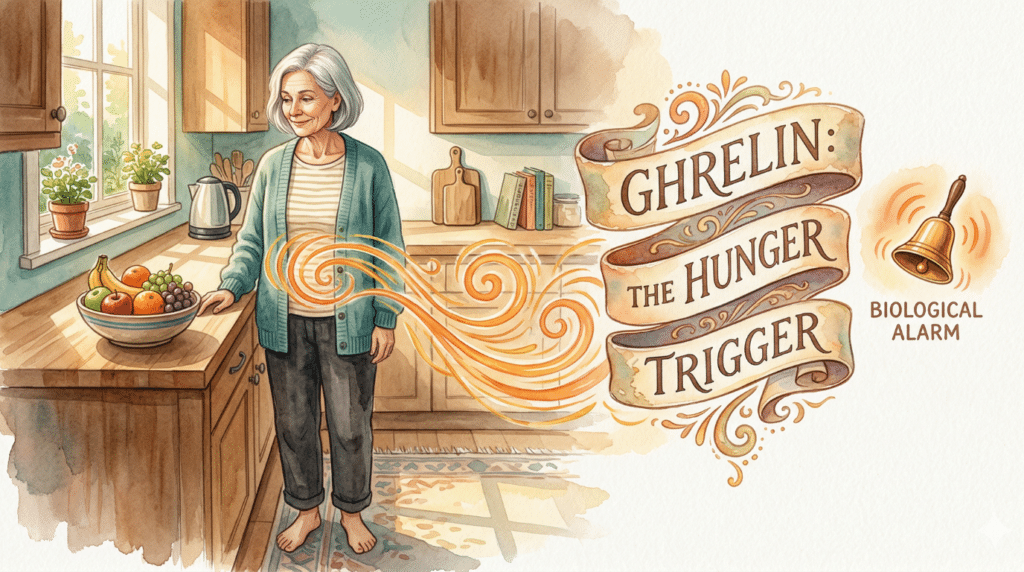
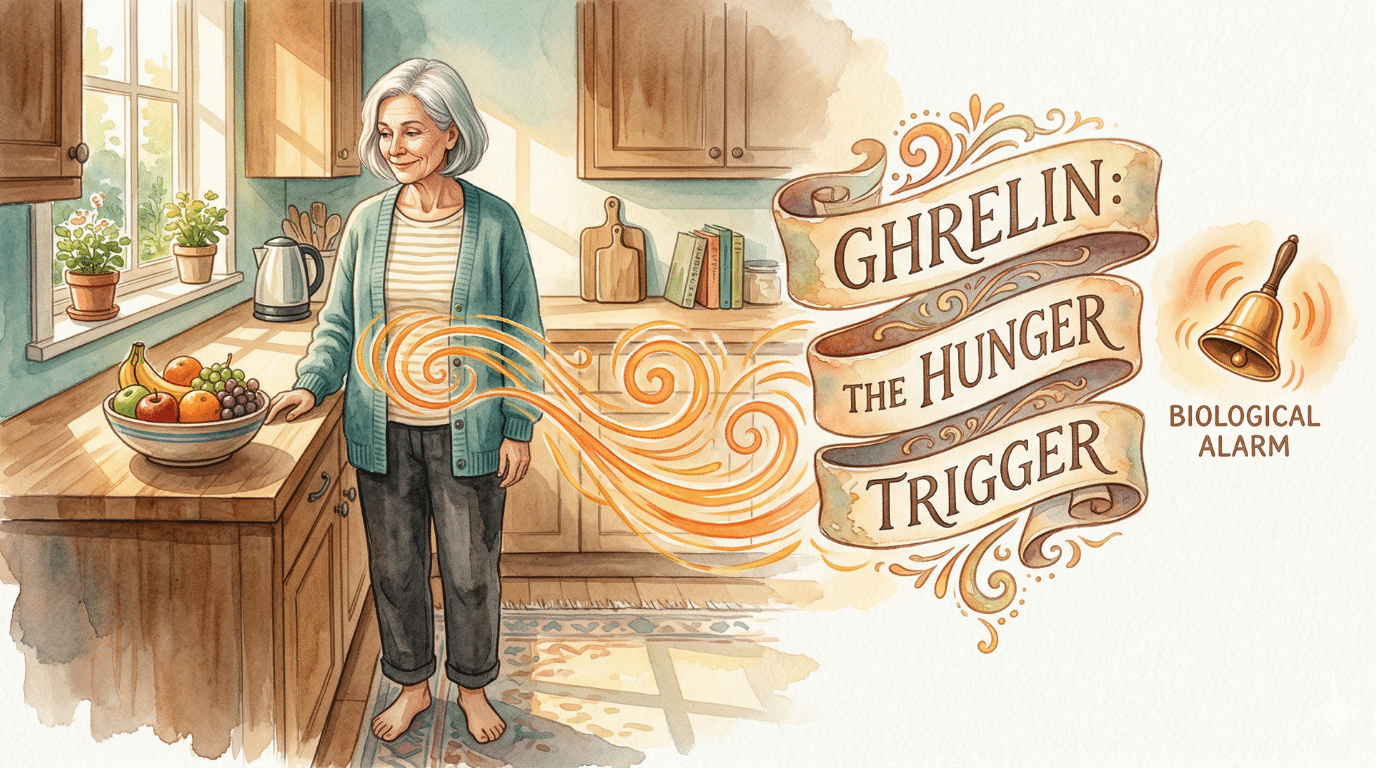
Meet Ghrelin. The Hormone That Tells You to Start
While leptin is the hormone that says “stop eating,” ghrelin is the hormone that says “start.”
It’s produced primarily in your stomach, and its job is simple: light the hunger signal, get you moving toward food, and keep that signal burning until you eat. In a healthy, well-rested body, ghrelin is actually your friend. It rises gently before meals to prompt you to eat. Then leptin steps in afterward to tell you that you’ve had enough. Back and forth. A quiet, elegant biological conversation happening below the level of your awareness.
But after a five-hour night? That conversation turns into a screaming match.
Here’s what the metabolic science tells us happens inside your body after a night of inadequate sleep. Leptin drops by up to 18%. At the exact same time, ghrelin rises by up to 28%. Both. Simultaneously. In opposite directions.
You’re not just dealing with less fullness signal. You’re dealing with more hunger signal on top of it. That’s not a subtle hormonal nudge. That is a storm.
The Science: Sleep deprivation creates a hormonal double-bind, leptin and ghrelin shift in opposite directions at the same time, leaving your brain flooded with hunger signals and almost completely deaf to any signal telling it to stop.
And here’s the part that most people never hear.
Ghrelin doesn’t just make you hungry. It makes you hungry for specific things. It amplifies your brain’s reward response to high-calorie, high-density foods, sugar, refined carbohydrates, bread, chocolate, chips, anything that delivers fast energy in a large dose.
You don’t crave a salad. You never crave a salad after a bad night’s sleep. Your body isn’t interested in fiber and water. It’s shopping for emergency fuel.
This isn’t weakness. This is your survival system doing exactly what it was designed to do. Your brain has registered a scarcity signal, low leptin, and dispatched ghrelin to fix the problem as fast as possible. High-calorie foods are the fastest solution available. So that’s what it wants. That’s what it demands.
The Hormonal Storm: What Happens in Your Body After 5 Hours of Sleep
Within 24 hours of inadequate sleep, your body undergoes a measurable hormonal shift that works directly against weight loss. Leptin (your fullness signal) drops significantly. Ghrelin (your hunger trigger) spikes at the same time. Your brain’s reward system becomes hypersensitive to high-calorie foods. And your body shifts into fat-storage mode, perceiving the sleep debt as a survival threat.
Think about Friday afternoon. The pretzels that disappeared before you noticed. The vending machine visit you swore you wouldn’t make. The second helping you didn’t plan for.
That wasn’t a character flaw showing up. That was ghrelin doing its job loudly, persistently, and very effectively.
In The Gabriel Method, we call this activating your FAT Programs, the deep biological switches that tell your body it’s time to hold on to fat, seek out calories, and prioritize survival over anything else. Sleep deprivation is one of the most powerful FAT Program triggers in existence. Not because you’re doing anything wrong. But because your body is doing everything right based on the signals it’s receiving.
And right now, it’s receiving a signal that says: we are not safe. Find food. Store energy. Do not let go.
Leptin and ghrelin are the headline act. But they’re not working alone.
Want to dive deeper into this approach? Discover how to turn off your body’s fat-storage programs for good by joining Jon Gabriel inside the 12-Week Total Transformation Program.