
You’ve been here before.
It’s early morning. You step on the scale. You’ve spent the entire week eating next to nothing, skipping dinners, saying no to everything you actually wanted, white-knuckling your way through hunger that kept you up at night.
And the number hasn’t moved.
Or worse… it went up.
That moment. That specific, crushing moment. If you’ve lived it, you know exactly what it does to you. It’s not just frustrating. It’s demoralizing in a way that goes bone-deep. Because you did everything right. You followed the rules. And your body just… didn’t care.
Here’s what no one tells you in that moment: this is not a willpower problem.
It never was.
It’s a hormone problem. Specifically, it’s a problem with one hormone that the diet industry has very little interest in talking about, because if you understood it, you’d stop buying their products.
That hormone is called leptin. And it is the master controller of your entire body weight system. It sits above insulin, above cortisol, above every other metabolic hormone you’ve ever heard of and it pulls every single string.
When leptin is working, weight loss is almost effortless. When it’s not, nothing works. Not the calorie counting. Not the cardio. Not the sheer force of wanting it badly enough.
Which brings us to the question that should change everything for you:
The Question Worth Sitting With
What if the very thing you’re doing to lose weight is the exact thing telling your body to store more of it?
That’s not a hypothetical. That’s biology. And by the time you finish reading this, you’ll understand exactly why and what to do instead.
Meet Leptin, The Hormone That Runs the Show
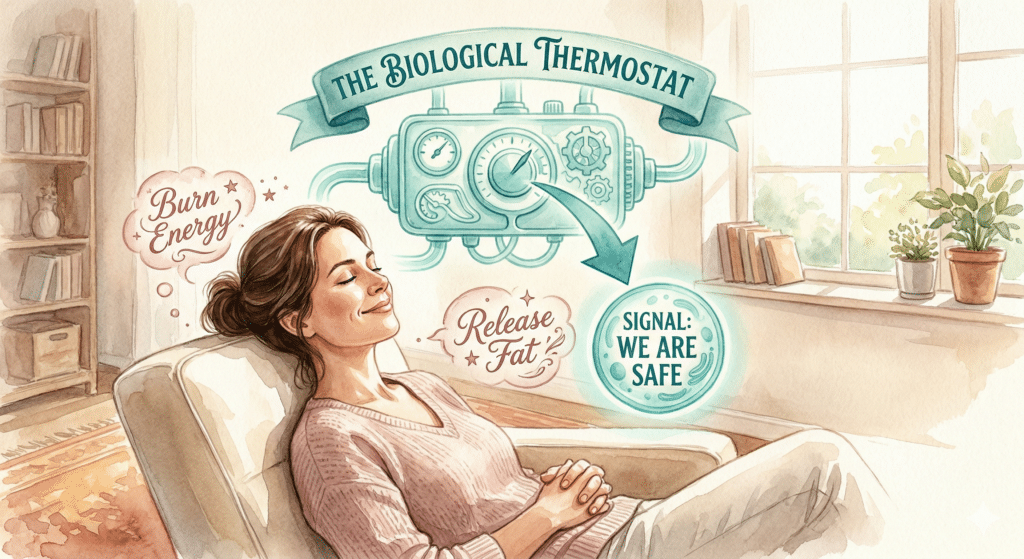
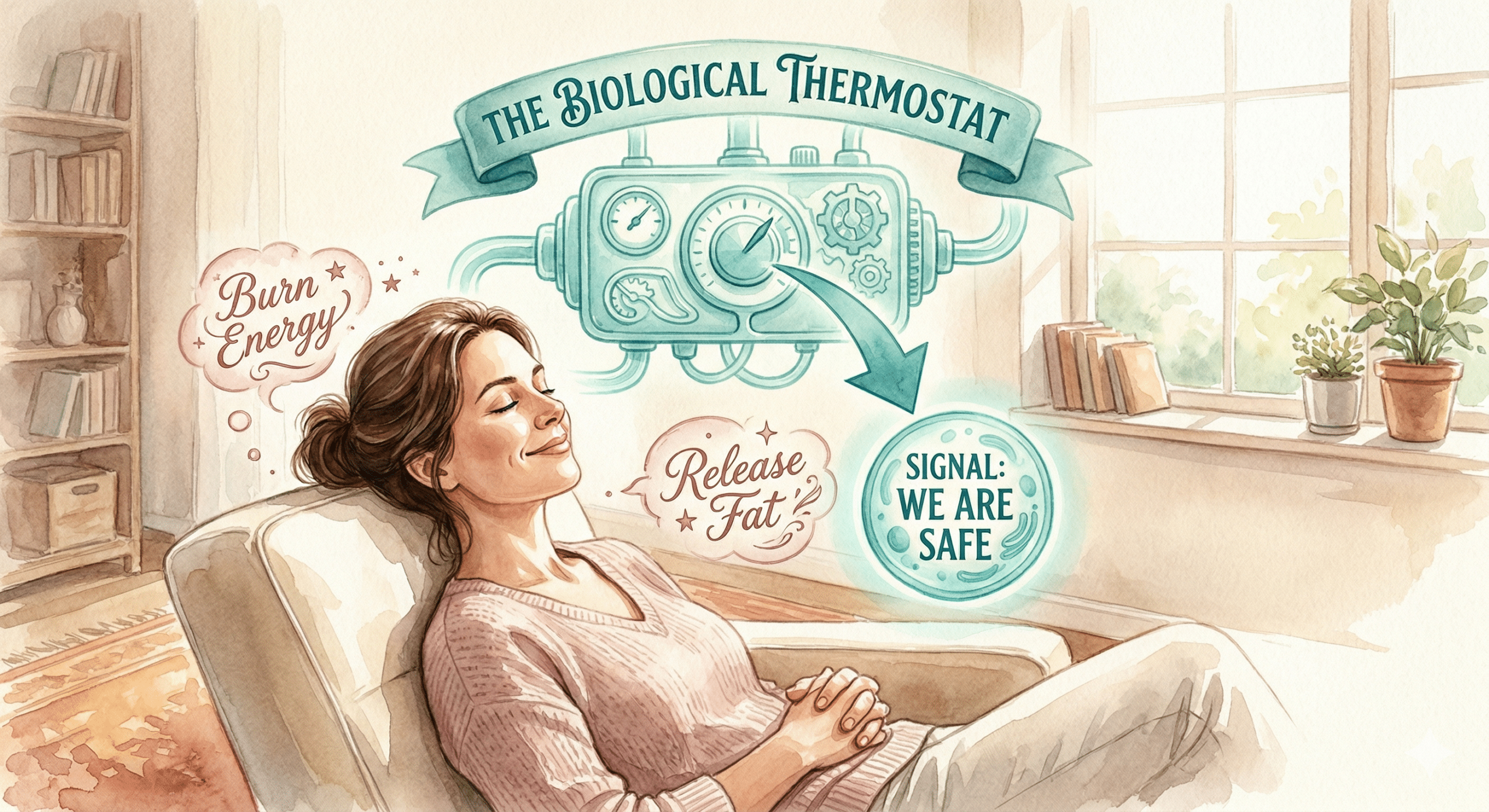
Think about your home thermostat for a second.
It reads the temperature in the room. When things get too cold, it fires up the heat. When the room is warm enough, it shuts the system down. It’s always monitoring. Always adjusting. Always in charge.
Your body has the exact same system. And the hormone running it is called leptin.
Leptin lives in your hypothalamus, the control center of your brain, and its entire job is to read your fat stores the way that thermostat reads room temperature. When your fat stores are sufficient, leptin sends a clear signal: “We’re good. Burn energy freely. No emergency here.”
But when fat stores drop, whether from dieting, stress, or anything your body reads as a threat, leptin flips into panic mode. The signal changes completely: “Famine. Store everything. Slow the metabolism down. Make this person ravenous.”
That’s not a malfunction. That’s the system working exactly as designed, just not in the way you need it to.
Here’s the part that surprises almost everyone.
Leptin isn’t made in your brain. It’s made by your fat cells. The more body fat you carry, the more leptin your body produces. On paper, that should solve everything, more fat should mean more “we’re full” signal, which should mean less hunger and easier weight loss.
But that’s not what happens. And that gap between what should happen and what actually happens? That’s the whole story.
To understand why leptin matters so much, you need to know its three primary jobs:
- Regulates hunger signals, it tells your brain when to stop eating
- Controls your metabolic rate, it tells your cells how fast to burn energy
- Governs fat storage, it decides where fat goes and whether it stays
Three jobs. One hormone. Controlling almost everything that determines whether you gain weight, lose weight, or stay stuck no matter what you do.
The Science: Leptin was only discovered in 1994, which means for most of human history, we had no idea this hormone existed. Every diet, every calorie-counting system, every willpower-based weight loss approach was built without accounting for the single hormone that controls whether your body burns fat or hoards it.
Think of it this way. If insulin is the warehouse manager, deciding where to put the incoming boxes of energy, then leptin is the CEO deciding the entire business strategy. When the CEO is communicating clearly, the whole operation runs efficiently. Energy gets burned. Fat gets released. Hunger stays manageable.
But when the CEO’s messages stop getting through? The whole company falls apart. Boxes pile up everywhere. The warehouse manager starts hoarding supplies out of fear. And no one can figure out why nothing is working.
Jon Gabriel weighed over 400 pounds at his heaviest. His body wasn’t “choosing” to stay that size out of laziness or lack of effort. His leptin signaling system had been hijacked, overridden by years of chronic stress, poor nutrition, and deep biological survival programming that had nothing to do with willpower.
Sound familiar?
If you’ve been eating 1,200 calories and still can’t lose weight, your leptin probably isn’t broken because you don’t have enough of it. You almost certainly have plenty. The problem is that your body has stopped listening to it.
That’s called leptin resistance. And it’s the real reason you’re stuck.
We’ll get into exactly how that happens and more importantly, how to reverse it. But first, you need to understand why the hunger you feel isn’t greed, weakness, or lack of discipline.
It’s survival. And the biology behind it changes everything.
What Leptin Actually Controls
Most people think weight loss is about calories and willpower. But leptin operates at a level above all of that. When your leptin signaling is working, your body burns fat efficiently, hunger stays manageable, and your metabolism runs at full speed. When leptin signaling breaks down, even temporarily, your body shifts into biological emergency mode, making fat loss nearly impossible no matter how little you eat or how hard you exercise. Fixing leptin isn’t about eating less. It’s about getting your body to hear the signal again.
The Oxygen Analogy and Why Your Hunger Isn’t Greed
Let’s talk about the thing nobody wants to say out loud.
Somewhere deep down, you believe you eat too much because you’re weak. Because you lack discipline. Because everyone else seems to manage just fine, and you just can’t get it together.
That belief is wrong. And biology is about to prove it.
Here’s an analogy that will change the way you think about hunger forever.
The Oxygen Analogy
Imagine you’re in a room where the oxygen is slowly being drained away. At first, you feel a little off. Then uneasy. Then your lungs start burning and your body goes into full panic mode. You gasp. You claw at the walls. You can think of absolutely nothing except air. Would anyone look at you and say, “You’re just being greedy for oxygen”? Of course not. You’d be doing exactly what a living body is supposed to do, fighting for survival. Now replace oxygen with nutrients. When your cells are starving for real nutrition, not calories, but actual nutrients, your brain triggers that exact same emergency response. The cravings. The obsession. The inability to stop after one handful of chips. That’s not weakness. That’s your body doing its job.
Read that again. Let it land.
It’s not your fault. It’s your biology.
Here’s where leptin comes in. When leptin signaling is working correctly, your brain receives a clear message: cells are nourished, we are safe, stand down. The hunger alarm quiets. You feel satisfied. You stop eating naturally, without willpower, without white-knuckling it through dessert.
But when leptin signaling is broken? That message never arrives.
It doesn’t matter how much food you eat. As far as your brain is concerned, you’re still gasping for air. So the alarm keeps ringing. And you keep eating. And you keep blaming yourself for something that was never in your control to begin with.
Now here’s the part that explains why modern dieting makes everything worse.
Most of what passes for food today is what Jon Gabriel calls MT Calories, empty calories that fill your stomach but deliver almost nothing to your cells. You can eat 3,000 calories of processed food in a single day and still be nutritionally starving at the cellular level. Your stomach is full. Your cells are screaming.
Think about the last time you couldn’t stop eating chips. You weren’t hungry for more chips. Your cells were hungry for nutrients that the chips were never going to deliver. The leptin signal never fired because the nutrition trigger was never pulled.
The Science: Leptin is produced by fat cells and signals the brain when the body is adequately nourished. But this signal depends on real cellular nutrition, not just caloric volume. When the diet is high in processed, nutrient-depleted foods, cells remain in a state of nutritional deficit, keeping leptin signaling suppressed and the hunger alarm permanently activated, regardless of calorie intake.
Now contrast that with what happens when you flood your cells with bioavailable nutrients, the kind packed into something like a Superfood Ice Cream loaded with whole food ingredients.
Same calorie count as a diet frozen meal. Completely different conversation happening inside your body. Your cells get what they actually need. The leptin signal fires. The brain finally hears it. The hunger alarm goes quiet.
That’s not a diet trick. That’s how your body was always designed to work.
The problem was never that you eat too much. The problem is that you’ve been eating food that keeps your cells permanently starving and then blaming yourself for the hunger that follows.
You were gasping for air. And nobody told you the room was running out of oxygen.
The FAT Programs and When Your Body Declares a Biological Emergency
Here’s something the diet industry will never tell you.
The harder you diet, the harder your body fights back. And it’s not fighting dirty. It’s fighting for your life.
Inside every human body, including yours, there are ancient survival programs that have been running for hundreds of thousands of years. Jon Gabriel calls these the FAT Programs. FAT stands for Famine And Temperature. And when your brain decides you’re in danger, these programs switch on automatically.
You don’t get a vote.
Think about what your ancestors faced. Harsh winters. Food shortages. Weeks without a reliable meal. The humans who survived those conditions were the ones whose bodies were brilliant at holding onto fat. At slowing down. At storing every available calorie for the long, cold stretch ahead.
Those survival genes are still in you right now.
The problem? Your brain can’t tell the difference between an actual famine and a crash diet. It can’t distinguish a brutal winter from chronic stress at work. As far as your hypothalamus is concerned, a threat is a threat. And when it senses a threat, it hits the emergency button.
That button activates the FAT Programs.
What Happens When the FAT Programs Switch On
Your body enters full survival mode. Every system shifts to protect you from what it believes is an incoming crisis. Here’s what that looks like biologically:
- Your metabolism slows down. Your body burns less energy, sometimes dramatically less, to conserve fuel.
- Fat-storage enzymes increase. Your body becomes more efficient at pulling calories out of food and locking them away as fat.
- Hunger signals amplify. Your brain floods you with cravings and obsessive thoughts about food. This isn’t weakness, it’s a biological alarm system.
- Muscle breaks down instead of fat. Your body burns lean muscle tissue for quick energy, while actively protecting its fat stores for long-term survival.
Sound familiar? That’s because this is exactly what happens every time someone goes on a restrictive diet.
You cut the calories. Your body reads that as famine. The FAT Programs activate. Your metabolism drops. Your hunger goes through the roof. And then, when you eventually eat, because you’re human, and your survival instincts are stronger than your willpower, your body stores those calories faster and more aggressively than it ever did before.
This is why yo-yo dieting makes things worse over time. Every cycle trains your body to be better at surviving the next famine. More efficient at storing fat. More resistant to losing it.
The Science: Research shows that caloric restriction triggers a measurable drop in leptin levels within days, sometimes as much as 50%, which directly activates the body’s famine response, slowing metabolism and increasing hunger hormones like ghrelin simultaneously.
Jon experienced this firsthand. At his heaviest, he wasn’t overeating because he lacked discipline. His FAT Programs had been running on high for years. Chronic stress. Emotional pain. A body that genuinely believed it needed to hold onto every ounce of fat just to make it through.
His body wasn’t broken. It was doing exactly what it was designed to do.
And so is yours.
The real question isn’t how to override your survival programs through sheer force of will. That battle is already lost before it starts. The question is: how do you convince your body that the emergency is over?
That’s where everything changes.
If you’re ready to stop fighting your body and actually start working with it, Jon would like to invite you to experience the complete step-by-step system inside the 12-Week Total Transformation Program.